
A young woman leads an initiative to empower girls to confront digital violence
From Upper Egypt, Amani Abdel Fattah launched "Behind the Screen" to confront digital violence and blackmail, turning awareness into an interactive shield helping girls protect their privacy—winning first place nationally.
EMAN SAMIR ALI
EGYPT — Amid the growing threats facing girls through cyberspace, from blackmail and privacy violations to account hacking and defamation, Amani Abdel Fattah, from the city of Assiut in Egypt, decided not to be content with monitoring these violations, but to search for a way to confront them, by launching the "Behind the Screen" initiative, which aims to raise awareness of digital violence and empower girls to protect themselves and deal with electronic risks.
The initiative was not, in its beginning, a project seeking competition or winning awards, but came as a response to a societal problem that Amani Abdel Fattah monitored through her following of virtual social media, after she noticed the recurrence of electronic blackmail incidents, account hacking, and publishing images without their owners' consent.
Amani Abdel Fattah, a graduate of the Faculty of Education for Childhood and holder of a diploma in special education for persons with disabilities, says that the incident of a girl in Assiut being subjected to electronic blackmail is among the most prominent motives that made her think about launching the initiative, especially after she realized that the lack of knowledge of prevention methods, reporting, and dealing with these situations may double the effects of the violation on victims.
She began studying the problem and collecting data and statistics related to it, then developed an integrated conception of the initiative that included the vision, mission, objectives, and executive plan, before launching its official page and beginning to publish awareness content about digital violence, cybersecurity, and electronic blackmail.
The initiative was officially launched through social media platforms in June 2026 and organized its first training workshop in July of the same year, with the participation of about 30 girls and young men aged between 15 and 29.
The initiative's activities varied between awareness workshops, competitions, and digital challenges, as Amani Abdel Fattah did not content herself with providing theoretical information but relied on interactive activities that help participants understand risks and choose correct behaviors when exposed to electronic situations that threaten their privacy.
Among these activities is the game "Choose Your Decision," which presents hypothetical situations and allows participants to determine how to deal with them, alongside digital privacy challenges and training related to securing personal accounts, activating two-factor authentication, and dealing cautiously with links of unknown source.
She also enlisted the help of a trainer specialized in cybersecurity to provide a training session on protecting accounts and digital privacy, and provided participants with opportunities to learn through specialized training in cybersecurity and artificial intelligence via the "Maharatak" platform of the Ministry of Communications.
Multiple challenges
Amani Abdel Fattah faced challenges related to the limited access to beneficiaries and the difficulty of building community partnerships at the beginning of the project, but she decided to overcome this by moving activities from the virtual world to reality.
In her initial plan, she set a target of 500 direct beneficiaries and 2,000 indirect beneficiaries via the internet, but her desire to reach a larger number of girls pushed her to communicate with civil associations and community institutions in Assiut.
During October 2026, the initiative implemented a number of workshops inside villages, with the participation of about 40 girls in each workshop, focusing on interactive methods and group games instead of being content with traditional lectures.
Amani Abdel Fattah believes that reaching girls in villages represents an important step in expanding the circle of awareness, especially since dealing with digital violence requires practical knowledge of rights, protection, and reporting methods, not just warning about the risks of internet use.
Her vision does not stop at organizing workshops; she seeks to build a sustainable model for transferring knowledge through the "Digital Safety Ambassadors" program, which aims to qualify girls in schools and universities to become capable of spreading awareness among their peers, through training of trainers (TOT) programs.
She also launched a platform to collect activities and awareness materials and make them available to beneficiaries, aspiring to expand its scope to reach various cities.
In the coming phase, she aspires to build partnerships with directorates of education, youth and sports, social solidarity, and endowments, to implement her programs inside schools, Al-Azhar institutes, and civil associations, and to reach the largest possible number of girls.
Turning theoretical perception into an actual community experience
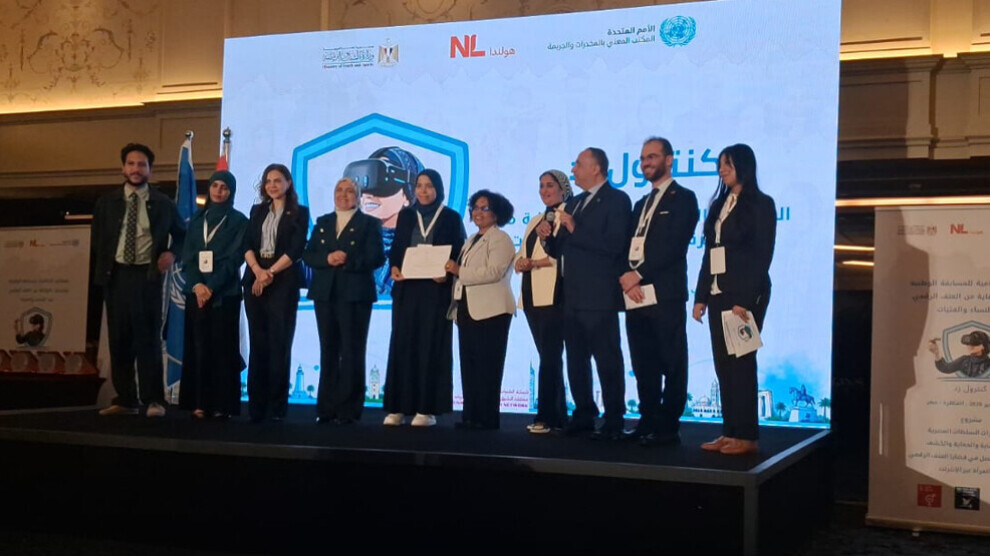
On her path toward spreading, Amani Abdel Fattah participated with the "Behind the Screen" initiative in the national "Control Z" competition for initiatives to prevent digital violence against women and girls, organized by the Ministry of Youth and Sports in cooperation with the United Nations, and was able to qualify among 59 initiatives in the first stage, then reach the second stage among 30 initiatives, before reaching the final stage among 16 initiatives, and won first place at the country level among the winning community initiatives.
Amani Abdel Fattah affirms that winning was not her primary goal, as much as implementing the idea on the ground, noting that using simple capabilities and insisting on continuing were among the factors that helped her turn the theoretical perception into an actual community experience.
For her, first place does not represent the end of the journey but the beginning of a new phase of work, expansion, and building partnerships, so that the initiative's message reaches more girls.
The "Behind the Screen" experience presents a model of a youth initiative led by a woman from Upper Egypt, starting from monitoring an issue affecting the safety and rights of women and girls, to turn into a space for learning, awareness, and digital empowerment, in an attempt to make girls more capable of protecting themselves and not surrendering to fear or silence when exposed to electronic violence.