
Testimonies of torture and intimidation behind Israeli bars
Shocking testimonies recounted by Yosra Abu Al‑Khair and her two granddaughters about three months of torture and intimidation inside Israeli prisons after their arrest during the ground invasion of eastern Gaza City in Palestine.
Nagham Karaja
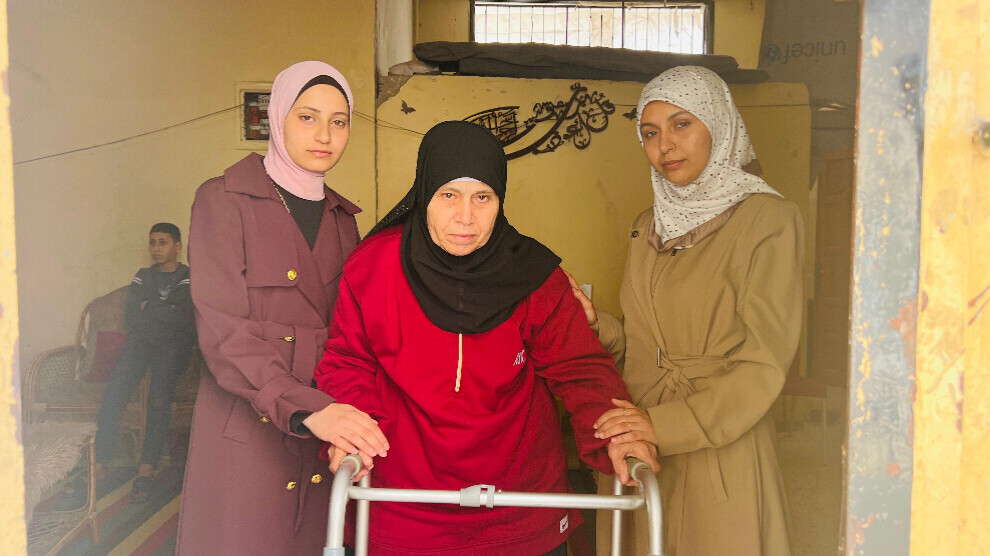
Gaza – Yosra Abu Al‑Khair, in her seventies, never imagined that the displacement journey she undertook to escape the bombing in eastern Gaza City would end with her inside Israeli cells alongside her granddaughters, Sujud and Tuqa, after days of siege, hunger, and terror. The family spent five full nights under siege with no food or water, before Israeli forces violently stormed their shelter, executed her husband before her eyes, and then took the three women into detention – one of many testimonies revealing the violations suffered by Palestinian female prisoners in Israeli prisons.
Yosra Abu Al‑Khair, leaning with difficulty on her cane months after detention and malnutrition, says: "They showed no mercy for my old age, nor did they consider that I am an elderly woman who can barely walk. They pushed us violently and shouted in our faces, as if we were not human."
The septuagenarian recalls the moment soldiers tried to arrest her granddaughters alone after storming the house they had fled to. She refused to leave them alone and insisted on accompanying them despite her deteriorating health. "I told the soldier clearly: I will not leave them alone. Either we all go, or we all stay," she says.
From the first moment of arrest, a long journey of psychological and physical torture began, according to the women's accounts. They were taken blindfolded for hours before arriving at an Israeli detention camp, where they were beaten, strip‑searched, constantly threatened with death, and held in harsh conditions lacking the most basic human necessities.
Sujud Abu Al‑Khair, 20 years old, says what stuck in her memory most was not only the beatings but the psychological warfare waged against them daily. "They blindfolded us for hours. We heard screams and insults all along the road, along with continuous beatings against us and others arrested with us. They deliberately instilled terror in us."
She adds in a faltering voice: "During one interrogation session, they told me that my sister Tuqa had been executed. I felt my soul leave my body. Days later, I discovered she was detained in the same prison. They used lies and intimidation to break us psychologically."
The violations did not stop at threats but extended, according to their testimonies, to degrading and horrifying practices inside the detention camps. Sujud says soldiers constantly threatened female prisoners with death, and some interrogators deliberately spread stories about the rape of Palestinian female prisoners to spread fear and psychological collapse among them.
She also recounts another incident that still haunts her: she noticed that Israeli forces exploited the health conditions of some female prisoners by giving them drugs containing narcotics. "We saw the prisoners after taking medication in a state of absence and imbalance, as if they were unconscious. They exploited their illness and weakness in a terrifying way."
Tuqa Abu Al‑Khair, 17, says what she experienced inside prison completely robbed her of her sense of security, making her wake up terrified every night even after her release. "I didn't know that three months could leave such terror inside a person. I thought I would return and forget, but the prison remained inside me."
She recounts one of the most difficult nights for her, when soldiers suddenly stormed the cell at midnight while she was sleeping next to her sister and grandmother, and forcibly removed their headscarves without any permission or regard for their privacy. "We woke up to the sounds of soldiers storming in suddenly. We didn't understand what was happening. We felt humiliated and terrified," she says. "What was my fault? I should have been in my school, not in a cell full of fear and insults."
According to the testimonies of the three women, Israeli forces made no distinction between an elderly woman and a young girl during interrogation and abuse. Verbal insults and degrading language were a constant part of daily treatment. They also suffered from extreme cold, lack of food, and inadequate healthcare. Yosra Abu Al‑Khair recalls their last day in detention: "They gave us blankets covered in dust; we nearly suffocated from them, but we had no other choice to protect ourselves from the cold."
The story of Yosra and her granddaughters reflects a reality experienced by Palestinian female prisoners inside Israeli prisons, amid increasing human rights reports speaking of torture, starvation, medical neglect, and psychological and physical assaults against detained women.
According to data from Palestinian prisoner institutions, the number of Palestinian female prisoners in Israeli prisons during 2026 reached about 86, including administrative detainees, children, and sick prisoners. Other reports indicated the number rose to about 90 in recent months, subjected to systematic policies including starvation, strip‑searching, denial of treatment, and continuous psychological assaults.
Palestinian human rights organizations also confirmed that most female prisoners are held in harsh conditions inside Damon Prison, with growing testimonies about isolation, medical neglect, and abuse, in addition to psychological intimidation tactics against detainees, especially after the Gaza war.
Despite the release of Yosra Abu Al‑Khair and her granddaughters, the effects of detention still haunt them daily. Yosra says, looking at her granddaughters in long silence: "We left the prison, but the prison has not left us."
Sujud Abu Al‑Khair affirms that the hardest thing she faces today is trying to regain her normal life after everything she experienced. "Sometimes I feel I am still inside the cell, and the soldiers will storm the place at any moment." Meanwhile, Tuqa Abu Al‑Khair, who should have been busy with her school and small dreams, now lives to the rhythm of nightmares and constant fear, as the detention experience has become a deep psychological wound that time will not easily erase.