
Tunisian female students: school dropout is an ongoing crisis in a difficult educational reality
The education sector in Tunisia faces a number of difficulties, making the provision of an encouraging environment for education and study one of the main national challenges, especially in interior and rural areas.
Ikhlas Hamrouni
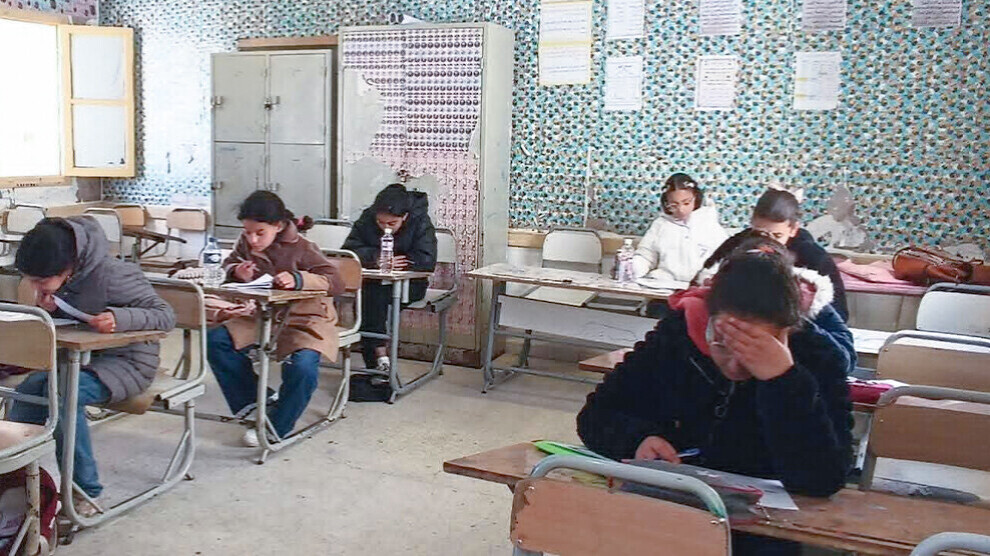
Tunis – Despite the efforts made by Tunisia over decades to establish the right to education and ensure its free of charge, the educational system today faces increasing challenges, most notably the phenomenon of school dropout, which particularly affects girls in rural areas, leaving governorates such as Kasserine among the most affected by this phenomenon.
Academic pressure and dropout
Student Sawar Al‑Hamami affirms that Tunisia suffers from a shortage of schools and universities, especially in interior regions, which reflects great pressure on classrooms and the educational system as a whole. She points out that curricula have become excessively crowded, burdening students. The long school day, sometimes extending to exhausting hours, pushes some students to dislike school and may be an indirect factor in rising dropout rates.
She adds that the government and the Ministry of Education bear primary responsibility for reforming the educational system, by reducing school hours, which have become a great burden on students. She stresses the need to provide activities and clubs within educational institutions, as they help relieve pressure and develop new skills among students. Even if some face difficulties academically, they can excel in other areas such as sports, music, or other activities.
Radical reform and comprehensive modernization
Student Darsaf Rahmouni explains that dropout is one of the biggest problems in the education sector in Tunisia, not only in Kasserine. Many children leave school early. The reasons for dropout, which are higher in rural areas than in cities, lie in living conditions and infrastructure in rural areas, which are much more difficult than their counterparts in cities.
She says poverty plays a major role, and transport and family circumstances also have a significant impact. Economic and social conditions clearly affect children's education, as difficult financial situations push some families to choose to withdraw their children from school to reduce expenses and save money to secure basic living needs.
She adds: "There is a clear difference between cities and rural areas. In cities, roads and infrastructure are better, while rural areas suffer from great weakness in these aspects; transport may be unavailable, and students are forced to travel long distances to reach schools."
To improve the education reality in these areas, she believes it is necessary to provide nearby schools in rural areas, improve infrastructure, repair roads or build new ones to facilitate students' access to educational institutions, in addition to providing suitable transport for them.
From her experience, Darsaf Rahmouni affirms that educational programs and teaching methods need radical reform and comprehensive modernization. Also, the prevailing mindset that favors males over females and considers that a girl's place is only at home must be changed. Girls are seen as dedicated only to housework and childbearing, without the right to build their academic or professional future.
She says: "Although there are many successful girls who have achieved great accomplishments, raised their families' standard of living, escaped poverty, and reached high ranks, this mindset still exists in some families. Some girls are prevented from continuing their education under the pretext that education might cause them problems or shame, while boys are encouraged to study."
She proposes that the government should financially support these groups by providing assistance and grants, especially for girls who may not be able to continue their education due to economic circumstances, noting that the law provides for free public education, but in reality it requires many expenses such as books, registration, transport, and other necessities.
A "worrying" reality
In her diagnosis of the education reality, educator Zina Mohamedi says: "The education reality in Tunisia today is worrying." She notes that the dropout phenomenon is one of the most prominent problems, especially in rural areas, although it also exists in cities but at a lower rate.
She explained that among the most important reasons for school dropout in rural areas are the distance of educational institutions and the lack of transport, which makes it difficult for students to reach schools, pushing some parents to withdraw their children out of concern for them or due to difficult conditions.
She pointed out that some rural areas still suffer from social customs that negatively affect girls' education. Sometimes girls are married off at an early age or directed to work in agriculture during harvest seasons. She affirms: "Rural women bear great burdens within the family and society, despite the continued inferior view of them, which reflects a clear contradiction between their reality and their actual role."
She says: "Addressing this problem requires comprehensive solutions, including raising awareness, providing social and psychological specialists to accompany students, improving infrastructure, in addition to activating the media's role in spreading the culture of the importance of education."
Zina Mohamedi affirmed that educators are called upon to allocate periodic awareness sessions to encourage students to continue their studies, considering that educated peoples are the most capable of progress and development.
Regarding girls, she stressed the necessity of equality between males and females and the rejection of all forms of discrimination, affirming that a girl is capable of success and self‑fulfillment if provided with opportunities and necessary support.
All the testimonies agreed that the education reality in Tunisia still faces a set of challenges, which is reflected in the quality of learning and students' chances of success.
They stressed that addressing this phenomenon requires a comprehensive approach combining improving education conditions, supporting families, developing transport and infrastructure, in addition to raising awareness within educational institutions, to ensure equal opportunities for all male and female students across different regions.