
Theater Is a Psychological Lifeline… “Buthoor” Association Provides Support and Documents Women’s Resilience
The “Buthoor” Association for Women in Palestine grants a safe space, as art is no longer a luxury but has become a first language for breathing, reducing trauma, and re-reading life amid loss, pain, oppression, and everything being experienced.
RAFIF ESLIM
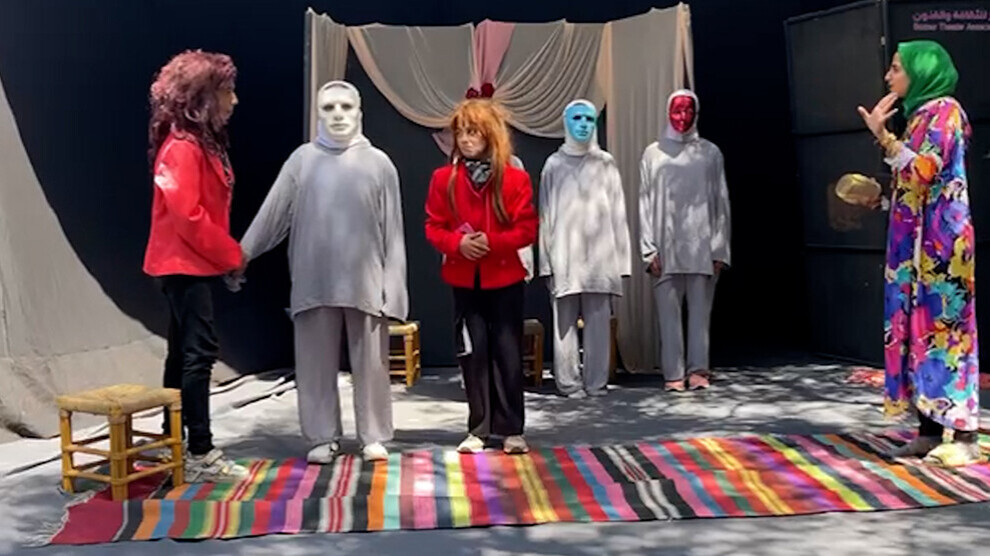
PALESTINE- The Buthoor Theater Association for Culture and Arts provided psychological support to women through the stage throughout the period of the attack on Palestine, turning their stories into performances and helping them in psychological empowerment, concluding those performances with the production of a documentary film titled “Women without a Filter” to document their suffering through art, because the story must not be forgotten but must be taken out of the Gaza Strip so that the world knows it.
Wisam Al-Deiraawi, writer, director, and executive director of the Buthoor Theater Association for Culture and Arts, explains to our agency that theater before the genocide was viewed as an artistic activity and a space for creative expression, while today the vision has changed and theater has become a psychological and social lifeline, as art is no longer a luxury but has become a first language for breathing, reducing trauma, and re-reading life amid loss, pain, oppression, and everything experienced throughout three years.
She explains that theater has transformed from a traditional space and a mere stage on which one stands to perform a show into an open place that can be moved as needed to different locations. "Women before the war used to come themselves to watch performances or perhaps participate in them, while today the situation has changed; the association is the one searching for them so that they can unburden what is inside them, and tell the many suspended stories that might come out in the safe spaces found among the tents in displacement areas in particular."
The Buthoor Association, according to Wisam Al-Deiraawi, tries to change the daily habits of women who spend most of their time in water and food queues, to tell them that they also have a life and can live it by telling their stories, standing on the stage, and giving them self-confidence that they are capable of offering something good they will be proud of one day.
She notes that women's stories must not be told only through news bulletins, but art must be brought in to talk about women's resilience and creativity in Gaza, which formed a unique model in managing its family's affairs. Therefore, there were dozens of performances stemming from the lived depth, including "Amputated Dreams" and "The Noise of Silence." "There were drama sessions for free expression that focus on producing theatrical sketches/performances from women to women telling displacement, famine, the road from north to south, and all the suspended memories."
Integrating Techniques and Tools to Produce the Best
Despite the initial uncertainty about what the psychological support sessions for women, "the barometer," could offer, their results were impressive according to Wisam Al-Deiraawi. Women in the same session would sometimes cry and at other times laugh and share jokes about the situation they live in, which means their negative feelings began to come out, especially since they were supporting one another during the session. The conversation produced what writers could not write through a screenplay.
The Buthoor Theater Association was the first to use art therapy with women through the amputees category, and it has already presented several performances before the war, integrating several techniques and tools related to dramatic activities, such as formative drama, the expert's cloak, the storyteller, music, Palestinian folk song, in addition to folk proverbs, all of which served the primary goal of improving women's psychological health and presenting performances, as Wisam Al-Deiraawi explained.
She adds that after the attack, she wanted to live a new experience by producing her first documentary film in partnership with Palestinian director Manal Barakat, where through "Women Without a Filter" she explained the experience of Gaza's women during war, displacement, hunger, loss, and fear, explaining the experience in a cinematic scene, presenting it to the world to tell it that a woman in Gaza has the right to live a dignified life. She is steadfast and strong and can make everything from nothing, but this does not mean her life should continue in this way.
A Safe Space
The film had a tour of screenings in the governorates of the central region and gained wide interaction, especially from women, as they loved showing what they experience through art, because it is the closest language for conveying pain and suffering. She also confirmed that "women at the present time need theater more than ever to be their supporter, as it is a safe space far from the role of the permanent sacrificer, so that they can find themselves, and this is what Buthoor does through the space it is preparing to open recently, 'A Neighbor Among People,' in Deir al-Balah city, which lacks cultural institutions."
Wisam Al-Deiraawi does not deny that she faces several difficulties like other cultural institutions, including scarce funding and being forced to work with the minimum capabilities among women and children, the absence of a real theater — as people standing on a theater stage gives them greater self-confidence — in addition to the psychological exhaustion of the team working in the field, especially with women, as they live the same oppression and additional pressure, which requires psychological energy in an unstable environment.