
Manuscripts Beneath the Rubble… Efforts to Rescue What Remains of Gaza’s History
Efforts continue to excavate and salvage what remains of manuscripts that were targeted in the Gaza Strip, in an attempt to retrieve what survived the cultural and heritage genocide left by the assault.
Rafif Aslim
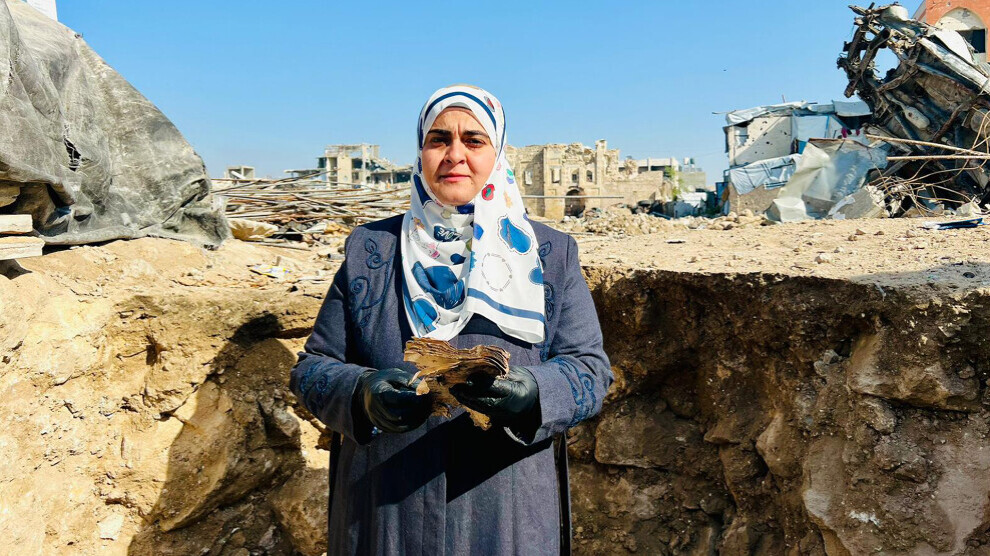
Gaza — Amid rubble and devastation, a manuscript rescue team in Gaza is trying to extract what remains of the city’s memory and civilization. Manuscripts that survived the bombardment are not merely papers; they are a historical and cultural legacy containing knowledge, literature, and poetry, and they form a living link between the past and the present.
Israeli forces targeted numerous archaeological sites across the Gaza Strip during the war. Some buildings were bombed repeatedly, as was the case with the archive of the Manuscripts Department, which contained thousands of books and ancient manuscripts dating back to the Mamluk era and possibly much earlier. All the library’s contents and archives were buried under the rubble, prompting engineer Haneen Al-Amassi and her team to extract these papers and attempt to save what remains.
Haneen Al-Amassi, head of the Manuscripts Rescue Team at the historic Qubbat Dar Al-Sa‘ada, stated that the site was targeted three times: the first in the middle of the genocidal war in the second half of 2024, followed by another airstrike two months later, and in the last attack, what remained of the site was completely demolished. The destruction scene was so devastating that it was impossible to recognize the site’s former features.
She explained that the Old City as a whole was systematically targeted multiple times. The historic buildings had been restored several times before the attack to protect them from the ravages of time. She said Israeli forces deliberately destroyed historical sites repeatedly in an attempt to erase their features.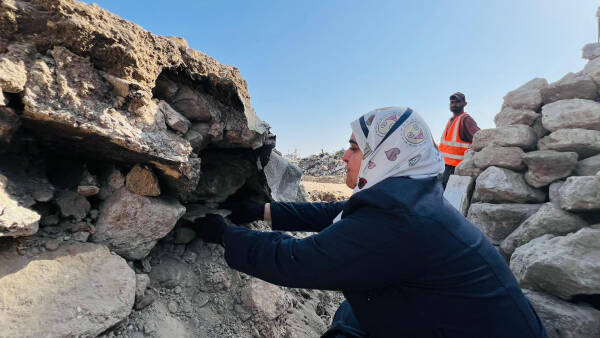
The Rich History of the Manuscripts Department
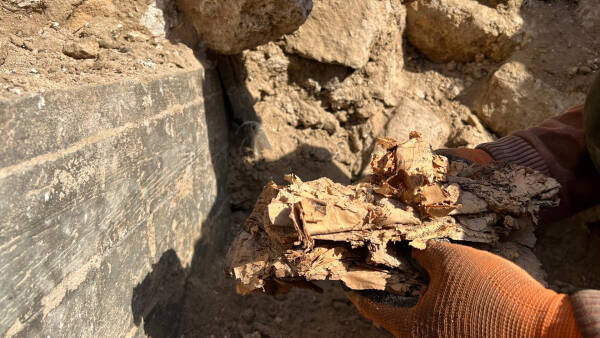
According to Al-Amassi, the Manuscripts Department once contained 228 complete manuscripts, 78 fragmented manuscripts known as “dasht”, in addition to numerous Ottoman records and waqf-related documents. After the genocidal war, 147 complete manuscripts were rescued, though they suffered severe damage. The rest were lost beneath the rubble. Only 35 sheets from the fragmented manuscripts survived, while the Ottoman records were completely lost and none were recovered during excavation efforts.
The manuscripts of the Great Omari Mosque date from the Mamluk period through the late Ottoman era. They cover various fields of knowledge, including astronomy, literature, poetry, and sermons written by scholars from Gaza, as well as jurisprudential sciences. She noted that following the first ceasefire agreement, stonecutters were brought in to help rescue a group of manuscripts, and work is now continuing to remove the historic stones in an effort to save them.
Preserving What Remains of the Manuscripts
Excavation operations continue to this day in an attempt to salvage what remains of these collections. Al-Amassi explained that the Manuscripts Department was directly targeted by Israeli warplanes and artillery shells.
She pointed out that the manuscripts suffered different types of damage, including embedded shrapnel and various forms of mold that adhered to the papers due to their long burial under the rubble—estimated at around 700 days—and exposure to rainwater. She described how, at first, she could not control her shock and grief and began digging randomly with her hands to pull out papers whose edges appeared. She felt they were pieces of her heart, not merely old papers, as she put it.
She worked and dug for longer periods to save a greater portion of history and pass it on safely to future generations. This has been her mission even before the assault—restoring rare historical manuscripts and books that have withstood the passage of time. “At present, there are no restoration operations due to the lack of appropriate tools; all that can be done is emergency first aid,” she said.
She added that in destroyed archaeological sites, the only action taken is to collect the remaining historic stones and place them in a suitable location to protect them from loss, theft, or further damage, as there are no tools or machinery to assist in restoration.
According to Al-Amassi, extracting manuscripts is a difficult and complex process due to the primitive methods used—everyone digs by hand. Sometimes, three manuscripts may be found in a week; at other times, a full month of work yields only one manuscript. This occurs amid a complete absence of international institutions or documentation of the violations that amounted to cultural and heritage genocide during the assault.
Al-Amassi concluded by emphasizing that these historical manuscripts represent the history, glory, and civilizations of Gaza, and the heritage of its parents and grandparents. They are valuable papers written by the hands of scholars and imams of knowledge who believed in Palestine’s future. Preserving them is her responsibility so that future generations may see this rich history and understand the efforts made by ancestors to develop these sciences through their scholarly contributions and innovations.