
"Light in the Shadow" Is the First Exhibition Addressing Comic Art in Gaza
Gaza's General Union of Cultural Centers held "Light in the Shadow," a comic art exhibition with 16 emerging artists, highlighting Palestinian narrative and Gaza's complex crises through innovative storytelling despite scarce resources.
RAFIF ESLIM
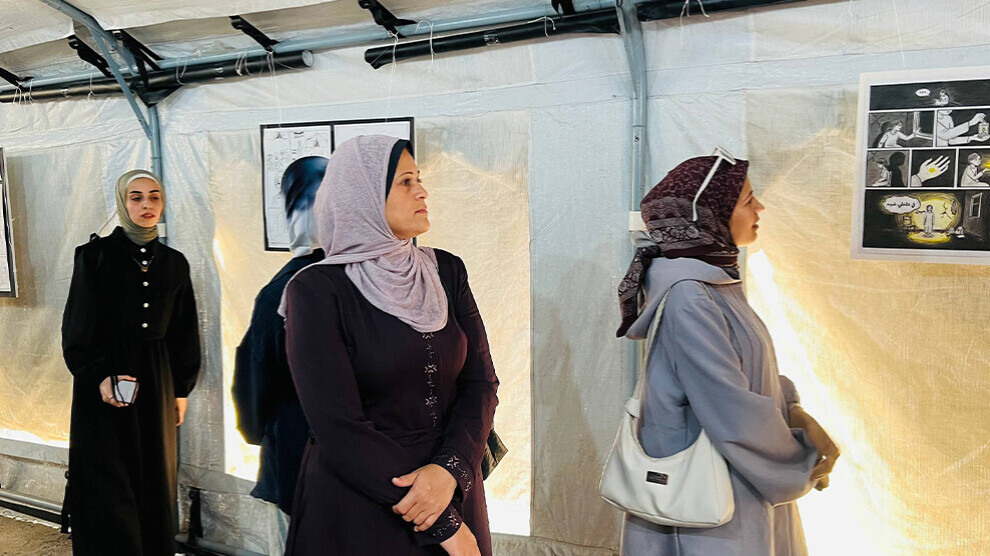
PALESTINE– Participants in the "Light in the Shadow" exhibition for comic art in Gaza unanimously agreed on the ability of this innovative art to highlight the Palestinian narrative and embody the complex crises experienced by the Strip, confirming that the continuation of creativity near destroyed centers proves the vitality of the Palestinian cultural scene and defeats attempts to erase it.
The General Union of Cultural Centers, with the support of the Abdul Mohsen Qattan Foundation, held the fifth showing of the "Light in the Shadow" exhibition for a group of emerging artists whose paintings embodied comic art for the first time in the Gaza Strip in Palestine, in the Journalists' Solidarity Tent at the Rashad Al-Shawa Center.
"Comic Art Needs Tools and Exorbitant Costs"
Artist Rufaida Sahloul, organizer of the "Light in the Shadow" exhibition, explained that this event presents comic art — illustrated stories that combine drawing and text in an organized manner — for the first time in Gaza, noting that previous attempts in this field, which dates back to the 1960s, were limited to individual efforts.
She said that the exhibition comes as a result of a series of specialized training workshops in comic arts and "video art," and witnesses the participation of 16 male and female artists from emerging talents. She noted that this showing represents an innovative platform that allows expression with simple artistic tools about prominent humanitarian, national, and social issues, with the aim of highlighting the Palestinian narrative through visual arts, and embodying the precise details captured by the artist's eye.
She confirmed that comic art needs exorbitant tools and costs and modern and broad methods, but she tried to simplify all of that according to what the besieged Strip allows. She noted that the choice of location for the exhibition has great significance as it is near the Rashad Al-Shawa Cultural Center, which was destroyed by Israeli forces, to send a message to the world that the Palestinian cultural scene is still alive and that Palestinian youth are capable of creativity despite all attempts at erasure.
The First Experience
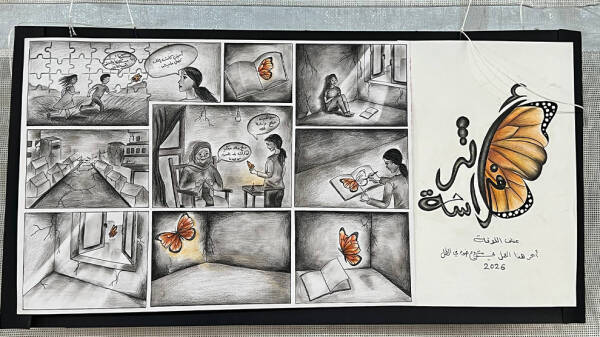
For her part, artist Basma Awad noted that her participation in the "Light in the Shadow" exhibition represents her first experience in comic art. Despite possessing a rich record of paintings that embodied the resilience and sacrifices of Palestinian women using acrylic and charcoal, she sees her current experience as completely different, as it enabled her to raise issues in a simplified and direct style that dispenses with explanation, without having to interpret her intentions to the recipient, as the texts accompanying the drawings made the painting speak for itself.
She explains that comic art differs from other visual arts, as it requires a longer time to crystallize and arrange the idea, while an artist can begin drawing a traditional painting before its idea has fully matured. "The difficulty of this art lies in the intertwining problems that the Strip suffers from. Everyone who saw her painting interacted with it greatly and expressed strong admiration for it, which made her expect an increase in demand for learning comics and adopting it as a tool to convey the voice of Gazan society in the coming days."
"An Eye That Sees What You Do Not See"
For her part, artist Reem Al-Yazji says that she participated in the exhibition with a painting titled "An Eye That Sees What You Do Not See," which depicts the youth category in the Strip who lived through the war and the fear, destruction, and lack of resources that followed, yet still insist on offering the best, changing the bleak image, and rebuilding the city covered in gray and destruction everywhere.
Reem Al-Yazji turned to comic art because visual scenes give the viewer a chronological sequence that transports them to the beginning of the problem and its details, while a visual painting may require the artist to explain it to the audience. She added that she faced several difficulties in finding the idea, especially since her painting was originally a visual painting, but the support she received from her family and friends made her work on the idea and transform it into comics.
"I Participated with Two Works"
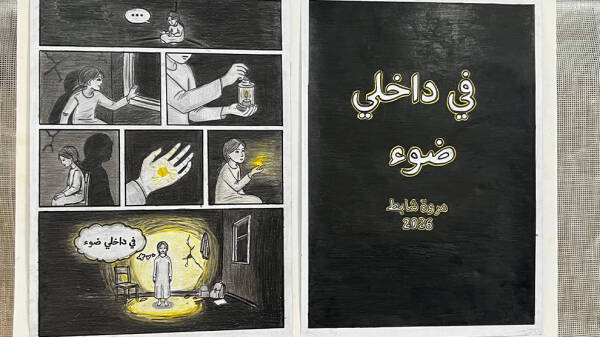
For her part, artist Marwa Shabt says that she participated in the exhibition with two works: the first "Inside Me Is Light" and the second "It Was Just a Game," to convey the idea of a kite turning into a dangerous threat that brings down Israel, expressing the anger of children who were prevented from importing toys from abroad, so they replaced them with nylon bags and made a simple toy that flies in the air. But that joy was soon killed and turned into a means of death for anyone who opposes the decision, along with his entire surrounding square.
"Comic Art Embodies the Daily Reality of the City"
For her part, Fatima Al-Zahraa Al-Sharqawi, one of the exhibition's visitors, expressed her happiness at the emergence of this new artistic trend, noting that she was accustomed to seeing conceptual art and sculpture, but today she sees "comics" embodying the daily reality of the city and its residents in a narrative storytelling style that is easy to absorb and entrench in memory. She added that the paintings formed a pleasant surprise, as they succeeded in simplifying complex suffering and shedding light on the compound crises experienced over two years with a sarcastic touch, and with a black pencil that honestly translates the available capabilities of the male and female artists in the Gaza Strip.