
Jewelry from Kurdish Memory…Gobruk Turns Heritage into Contemporary Art
In “Gobruk,” copper becomes more than jewelry,decoration more than shape, and craft a means of preserving memory, as Butan Omar leaves future generations a tangible, continuing heritage.
HELEN AHMED
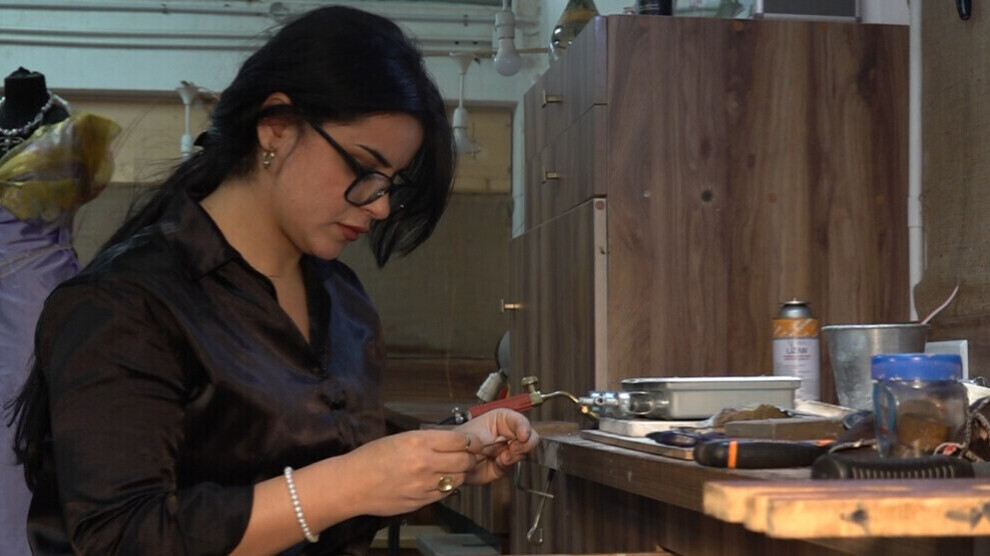
Sulaymaniyah – In one corner of the cultural workshops in Sulaymaniyah city in the Kurdistan Region, where the sounds of hammers embrace the glimmer of copper, gold, and silver, a different story takes shape. Here, jewelry is not made merely for adornment; rather, the metals in the artist's hands turn into pieces carrying the features of Kurdish memory, identity, and folklore.
In this place, the "Gobruk" project stands out as more than a shop or a workshop for making jewelry; it is a space through which Butan Omar tries to revive one of the forms of Kurdish art and handicrafts, and preserve it from extinction by transmitting it to new generations.
Butan Omar, a graduate of the Fine Arts Department, has been working in the field of jewelry crafting for about five years. During this period, she was able to make copper, gold, and silver materials capable of turning into artistic pieces carrying in their details decorations and symbols inspired by Kurdish culture.
For her, the story does not end at making a beautiful piece, but begins from it; through each design, she tries to recover an old idea, shape, or memory, and re-present it with a contemporary spirit, so that the craft remains present in the life of the new generation.
"Gobruk"... A Name That Evokes the Image of the Kurdish Woman
Butan Omar chose the name "Gobruk" for her project, after an ancient Kurdish piece of jewelry linked in popular memory to the Kurdish woman. She says that the name was not a passing choice, but carries a cultural and emotional significance, as mentioning it evokes the image of the Kurdish woman and the presence of traditional jewelry in the details of her life and adornment.
She added: "I have been working in the field of jewelry crafting for five years. My beginning was through a course held in the cultural workshops. I was a student at the time, and after the course ended I began thinking about establishing a project carrying a different idea. From here came the idea of Gobruk, which took its name from one of the oldest types of jewelry that reminds us of the Kurdish woman."
But "Gobruk" did not stop at the limits of production. The workshop also turned into a space for learning and transmitting knowledge, where Butan Omar offers lessons to a number of students, introducing them to the basics of jewelry crafting and the tools used in it, before moving to the practical side.
She pointed out that teaching this craft begins with identifying the trainee's level and needs, then introducing them to the tools and methods of using them, reaching the theoretical and practical stages that enable them to produce their own pieces.
From a Piece of Metal to an Artwork
In her work, Butan Omar relies on three main metals: copper, gold, and silver, alongside using different types of stones, according to the clients' desires and the nature of the design.
However, copper occupies a special space in her project, as she seeks to re-present it as an artistic material that can be part of daily life, not just a traditional metal. "We work on copper, gold, and silver, and we use different types of stones according to the clients' desire. But our goal is to focus more on copper, so that we can entrench its presence within society."
She explained that each metal has its own characteristics and beauty, but she chose to focus on copper at this stage, while she does not use gold in her shop, considering that it has its own status and uses. At the same time, "Gobruk" tries to combine heritage and modernity. The client can choose the type of stone and the design they want, while Butan Omar undertakes to transform the idea into a piece carrying a special artistic character.
She says: "People today ask for more modern designs, and they choose the type of stones and the shape they desire, and we try to implement their requests with an artistic spirit. All the decorations I design carry an artistic character, because I studied art, and this is clearly reflected in my work."
Art... A Specialization That Turns into Life
For Butan Omar, the artist's relationship with art should not end once the university degree is obtained. She believes that studying arts should turn into practice, production, and continuity. "Many of those who graduate from arts departments do not work in their field of specialization, but I believe that whoever studies art must continue working in their field. I completed my studies in art, and today I work in it with love and passion."
Thus, art for her has become more than an academic specialization; it is a means of building a project that tries to combine work, creativity, and preserving heritage.
Today's Craft Is Tomorrow's Memory
In the cultural workshops in Sulaymaniyah, Butan Omar does not work alone in making jewelry, but sees herself as part of a wider space aimed at supporting local products and encouraging youth and women to rely on their skills and capabilities. "We work here to preserve Kurdish culture, and all project owners in these workshops try to produce local products. Our goal is to strengthen local production and handicrafts, and for youth and women to rely on their capabilities and potential."
For her, teaching the craft is no less important than making jewelry itself; because the piece made today can be the beginning of a craft that continues tomorrow. "We do not only make jewelry, but we teach the next generation this craft so that it is transmitted from one generation to another. We want our generations to learn about the symbols of their identity, and for this Kurdish character to remain present and not disappear."