
"Hunna Al-Hayat" Museum... A project documenting Iraqi women's creativity and evoking their civilizational heritage
Iraqi researcher Mrs.Al-Nu'mani discovered women have been an integral part of civilization-building, and that their real role is far greater than what is narrated in books, which drove to establish her project, the Museum.
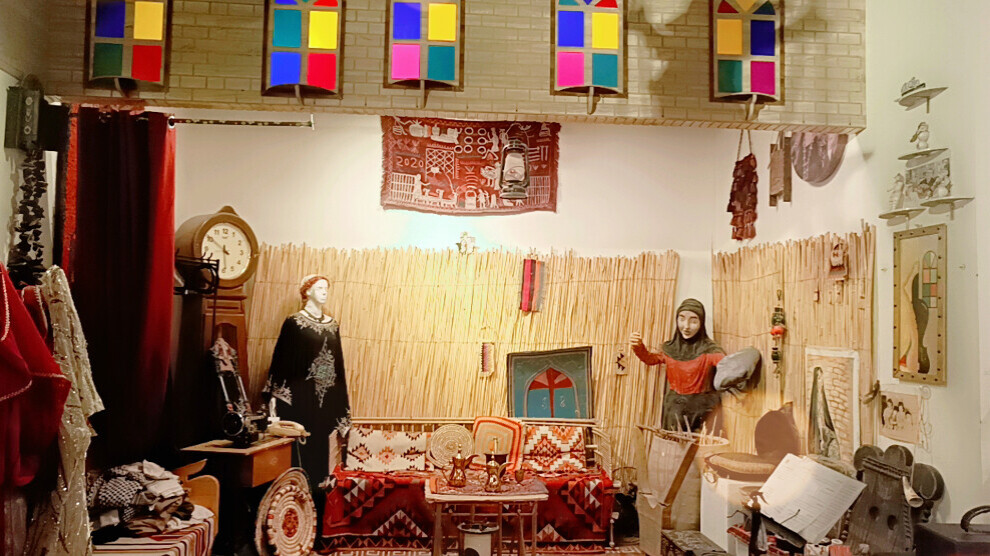
Iraq — In Iraq, where layers of history intertwine and civilizations embrace, a cultural initiative was born with a name that resembles only woman herself: the "Hunna Al-Hayat" (They Are Life) Museum, which is concerned with building human beings through enhancing women's awareness.
This project, founded and managed by Iraqi researcher Zainab Al-Nu'mani, did not come as a mere traditional museum, but as a cry of awareness and a long research journey through which she sought to restore Iraqi women to the status they have always held as an integral part of civilization-building, from the Mesopotamian civilization to the present.
She explained that the idea for the project was not the result of a fleeting moment, but the fruit of years of study and research into the history of Iraqi women, comparing it to the history of women around the world. Over time, an image began to unfold before her: Iraqi women were never on the margins of the history of Mesopotamia; rather, they were often at the center of decision-making and makers of major transformations.
Among the models that amazed her was the figure of Queen "Kubaba," the first woman known to have ruled a state in human history. Kubaba did not reach a leadership position because she was a king's wife or an heiress to a throne, but because she possessed wisdom and acumen that made her people rally around her. She achieved security and peace and led her country to stability after her victories in wars. This model, according to Zainab Al-Nu'mani, was enough to reshape her vision of women's role in Mesopotamian civilization.
Babylon... Where the story began
Zainab Al-Nu'mani chose the city of Babylon as her starting point. This city, which for thousands of years has carried the symbolism of creation and life, saw in woman the origin of existence and the one responsible for its continuity. Hence came the museum's name "Hunna Al-Hayat" (They Are Life), indicating that woman is not just a part of life, but life itself.
Babylon is one of the greatest cities known to ancient history and the homeland of one of the oldest civilizations that left its mark on humanity. The city arose on the banks of the Euphrates in the heart of Mesopotamia and flourished especially in the 18th century BCE.
Babylon's peak glory came in the 6th century BCE, when the city became a global center for science, art, and architecture. In that era, the Hanging Gardens and the Ishtar Gate with its famous turquoise decorations were built.
The city that saw woman as the origin of life thousands of years ago today returns to being a platform that restores to Iraqi women their voice, image, and creativity. As Zainab Al-Nu'mani explained, with the founding of the project, her vision expanded to become a documentary, artistic, and cultural platform concerned with the creativity of Iraqi women at home and abroad. Zainab Al-Nu'mani wanted to break the stereotypical image that reduces women and to highlight feminist models that have made a real impact in society, whether in art, literature, crafts, or social work.
A museum that transcends walls
The museum was not merely halls displaying artifacts, but a living space breathing culture. It included a vast archive of rare books, newspapers, and magazines, along with visual artworks, folkloric and historical costumes embodying different stages of Iraqi women's lives. It also contained a special wing for traditional crafts and professions practiced by women over time. Most of these artifacts were acquired through Zainab Al-Nu'mani's personal efforts, along with contributions from artists and researchers from inside and outside Iraq.
She explained that the museum contains about 150 pieces of varying sizes and time periods, together forming a broad canvas of Iraqi women's creativity across the ages. Among these artifacts are eight sculpted statues carrying deep symbolic meanings: a statue of the Babylonian goddess known as the "Goddess of the Spring" or goddess of water, a large-scale work embodying the sanctity of water and its role in creation and life; a sculpture of the "Upright Woman" symbolizing the strength and resilience of Iraqi women through time.
Also a statue of a woman baking on a clay oven, evoking women's role in daily life and heritage preservation; a statue of a woman vendor supporting her family, embodying the effort and resilience of working women; a statue of a Sumerian woman steering a mashoof (traditional boat) in the marshes, a vivid depiction of women's connection to nature and water in southern Iraq.
Two statues, one white and one darker-skinned, indicating the diversity of skin colors within Iraqi society and its cultural plurality. A statue of the Virgin Mary as the woman who raised a prophet, signifying the mother's strength and role in shaping spiritual values. A statue of Lady Zainab, the first woman to use the street pulpit to convey and defend the truth, indicating her courage and media role in exposing the events of Karbala.
Zainab Al-Nu'mani is working to develop the project through plans to preserve the archive both physically and electronically, participating in international courses for artifact preservation, as well as seeking to expand the museum's global reach and link the legacy of the queens of Mesopotamia to the creativity of contemporary women.
Zainab Al-Nu'mani noted that the project did not stop at Iraq's borders but extended to Sweden, Australia, and Jordan, becoming a global platform introducing the creativity of Iraqi women wherever they are. She emphasized that she ensured the museum embodied not only women's stories but also the features of their daily lives, through costumes, professions, and heritage artifacts.
Challenges and resilience
Zainab Al-Nu'mani affirmed that the path was not easy. She faced great difficulties, most notably the absence of a permanent headquarters for the museum and a lack of financial support. But as she says, she believed in her mission and that Iraqi women deserve to have their history documented and preserved for future generations. This belief was her motivation to overcome obstacles, until the museum today has become an internationally recognized project.
She stressed that these efforts contribute to community development and encourage girls to care about awareness and knowledge, by learning about the experiences of creative women, whether by visiting the museum or participating in its cultural activities.
At the conclusion of her speech, Zainab Al-Nu'mani addressed a message to all women, pointing out that women's awareness of their value and role is the first step toward building a healthy society. Women's awareness and self-confidence are the foundation for raising a balanced human being and a cohesive society. Woman, as she says, is not an auxiliary element in life, but its primary pillar.