
Female Sculpture Students Evoke Women's Symbols in History and Culture
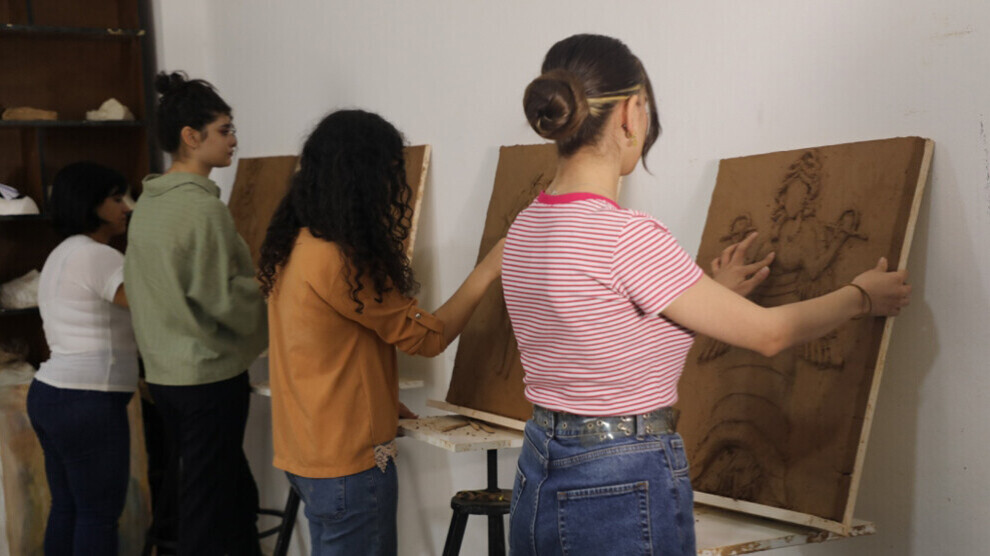
A 15 day sculpture workshop opened at the Golden Crescent Institute, where students chose historic women—Ishtar and Shah Maran—as their subjects.
RONEIDA HAJI
Al‑Hasakah — Art, as one of the most authentic languages of change and existence, plays a fundamental role in women's struggle. The sculpture workshop held at the Higher Institute of Arts — Golden Crescent is not limited to showcasing the skills of female artists but also works, by evoking history and deep symbols, to revive life and collective memory through art.
The Higher Institute of Arts — Golden Crescent in the city of Al‑Hasakah, Rojava, consists of three main departments: Visual Arts, which includes drawing and sculpture; Music; and Cinema. On September 3, an art workshop began in the Sculpture Department.
The workshop lasts for 15 days and is an opportunity for male and female students to develop their skills through art, express their ideas and feelings, and work on topics related to women. In this context, students chose women and symbols that left an impact and imprint on history to be the subject of their works.
Ishtar: Symbol of Love, Strength, War, and Fertility
Diana Farman, a third‑year student at the institute, chose the goddess Ishtar as the subject of her work. She says the goal of their participation in this workshop is to develop their artistic skills and express their ideas and feelings.
She said that through sculpture she wants to shed light on women, their will, and the problems they face. She explained that she chose Ishtar because she was known in the history of Mesopotamia as a symbol of love, strength, war, and fertility.
She noted that women's presence in the field of sculpture and in all fields of art is important, because women through art can express their vision, ideas, and problems and convey their message to society: "Women can express themselves in every field, show their ideas and feelings, and convey their message to society through art."
Shah Maran: Symbol of Knowledge, Wisdom, and Healing
In the same workshop, student Amal Ibsh chose the figure of Shah Maran for her project. Shah Maran is known as a woman with a snake's head and body and holds a special place in the culture and tales of the region's peoples.
She explained that she chose Shah Maran for her project because she is considered a symbol of knowledge, wisdom, and healing, affirming that women have always played an important role throughout history in preserving culture, memory, and societal values.
She noted that the story of Shah Maran is one of the famous tales in the region, transmitted from generation to generation through art, and that through this workshop they are trying to revive the true history of women and show their role.
She affirmed that women, in various eras, have been a symbol of strength, resistance, love, and giving, and that their goal is to convey this truth to everyone.
Art for Preserving Culture and History
The choice of historical female symbols and figures, as Amal Ibsh affirms, does not aim only to produce artistic works but also seeks, through art, to preserve women's culture, history, and memory and transmit them to new generations.
After the 15‑day workshop concludes, the works completed by students at the Higher Institute of Arts — Golden Crescent will be displayed. This workshop is one of the first preparatory steps before the institute officially opens its doors to begin the educational process