
A jordanian Artist Who turned her Brush into a tool to Resist Silence and Write Women’s Stories
Artist Dima Abu Sharkh turned art into expression, resistance, and healing_her paintings extending women’s voices and experiences beyond color and form.
BARA’A AKRAM
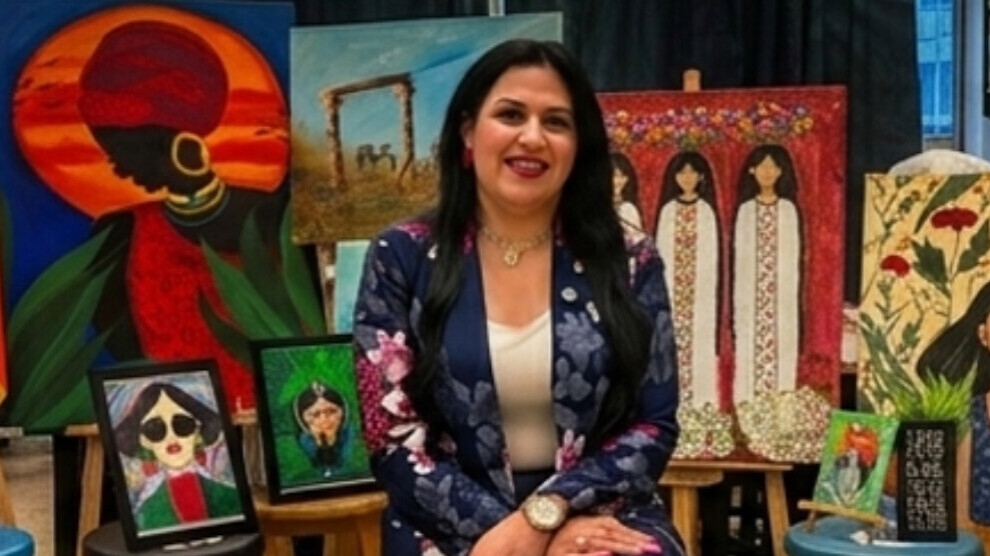
Jordan_In Jordan’s cultural and educational landscape,exceptional figures emerge who have managed to transcend traditional roles and social constraints to forge their own paths. Among these inspiring models stands Jordanian visual artist and educational researcher Dima Abu Sharkh, who has succeeded in transforming art from a mere means of aesthetic expression into a tool for social advocacy, psychological healing, and the preservation of human memory.
Dima Abu Sharkh, a mother of five, a teacher at the Orthodox School, and a researcher specializing in women’s issues, believes that a painting is not merely a space for colors but a space for stories, pains, and hopes_ and that art can document homelands and healing wounds that words cannot describe.
From loss of Self to its Recovery
Dima Abu Sharkh’s relationship with art began in her early childhood, when her drawing garnered admiration in school exhibitons and revealed a remarkable talent. However, the path of life, as it does with many women, tool her toward family responsibilities and societal demands, finding herself immersed in the model of the “superwoman” who is expected to succeed at everything while postponing her own dreams and personal needs.
From Loss of Self to Its Recovery
Dima Abu Sharkh's relationship with art began in her early childhood, when her drawings garnered admiration in school exhibitions and revealed a remarkable talent. However, the path of life, as it does with many women, took her toward family responsibilities and societal demands, finding herself immersed in the model of the "superwoman" who is expected to succeed at everything while postponing her own dreams and personal needs.
But a defining moment reshaped her life. Dima Abu Sharkh speaks of that phase, saying: "I suddenly felt that Dima had disappeared, and that my soul had faded amid the responsibilities." At that point, she decided to return to herself through writing and painting. "I picked up the brush once more, and began a challenging journey of self-education, going through trial and error, breaking paintings and rebuilding them, guided only by my inner voice and passion for art."
The path was not without challenges; she faced family rejection of her sculpting practice for cultural and religious reasons, but she insisted on continuing her journey, affirming that her artworks are nothing but a true reflection of her identity and soul. "This is me, and this is my soul."
Spontaneous Art... A Platform for Defending Women
Although she did not receive academic training in the arts, Dima Abu Sharkh managed to build her own visual language as a self-taught artist. She believes that true art is not measured by technical perfection but by its ability to honestly express feelings and human experiences. "Art is an emotional, psychological, and physical state—it is a message and a visual pleasure at the same time. It does not have to be perfect as some expect."
With her studies in the Master's program in Women's Studies at the University of Jordan, she began to develop a deeper vision regarding women's issues and their shared challenges. Since then, art has become for her a means of advocacy and giving voice to women whose experiences are often marginalized.
In every painting she creates, she evokes the image of a woman she knows or has encountered in life—her daughter, her mother, her friend, or an unknown woman who passed by her on the street. Among her most cherished works is the painting "The Disappointed Woman," which depicts a woman facing life's harshness and solitude with faith and resilience, surrounded by a warm sun symbolizing divine help and the hope that gives her the strength to continue.
Palestinian Memory Between Art and Pain
Dima Abu Sharkh's concern was not limited to women's issues but extended to national and humanitarian causes. In the "Freedom" exhibition held in Jabal Al-Luweibdeh, she presented a different artistic experience through which she evoked the tragedy of Palestinian displacement, describing the idea as "crazy."
She chose an abandoned space resembling ruins and transformed it into a living space that tells the story of diaspora through images, lighting, and visual elements that made the visitor experience a simulation of the loss of land, home, and identity.
On Palestinian women, she says: "She is a model of strength and leadership, but she carries immense pain within her. Behind the image of resilience, there are daily losses and unceasing loss—from home to children to even the small details of life."
"Heaven Haven"... A Safe Space for Healing and Creativity
Believing in the importance of providing supportive environments for women and artists, Dima Abu Sharkh launched her project "Heaven Haven"—an art studio and safe space that allows participants to practice painting, sculpture, and music away from social and psychological pressures.
The project began with only three girls but quickly transformed into a small community bringing together creatives seeking an outlet to express themselves and restore their psychological balance, in the face of the pressures, digital and social violence imposed by modern life.
Education as a Message of Change
Dima Abu Sharkh's passion for art and women's issues was also reflected in her educational work. Since childhood, she saw education as a mission that transcends professional boundaries, which drove her to integrate gender concepts into the educational environment through approaches that respect Jordanian society's privacy and cultural values.
She developed gender-sensitive educational lessons, encouraged seventh-grade students to launch their own projects, and introduced art therapy techniques, drama, and breathing exercises into the educational process aimed at enhancing students' mental health and improving their emotional well-being.
This innovative approach earned her wide recognition, culminating in her winning the Excellence in Education Award in Dubai in December of last year. Today, she continues her efforts to develop methods for integrating students with disabilities into classrooms in a way that preserves their rights and supports their psychological well-being.
Women Who Inspired
Dima Abu Sharkh draws a large part of her strength and inspiration from four female figures who left influential marks on history and art: Cleopatra and Hatshepsut, representing a passion for knowledge and learning; Hind bint Utbah, whose name is associated with strength and leadership; and the Mexican artist Frida Kahlo, who transformed her personal pain into timeless artworks that had a profound impact on her society.
She strives for her children to be proud of her, just as the children of those inspiring women were proud of their mothers, and for her success to be a practical message to them about the value of diligence and self-belief.
A Message to Every Woman
Dima Abu Sharkh concludes her experience with a message addressed to every woman suffering from the conflict of roles and the constant feeling of guilt between family and ambition, affirming that personal success does not contradict family giving but rather enhances it.
In conclusion, she says: "Our children love to see us strong, successful, and distinguished. When you love yourself and set clear boundaries for your time and needs, you become more capable of giving love and care to your family and community. Be yourself, and give your dreams the space they deserve."