
"Those Who and Their Stories"… Narratives of women who resisted breaking and fragility
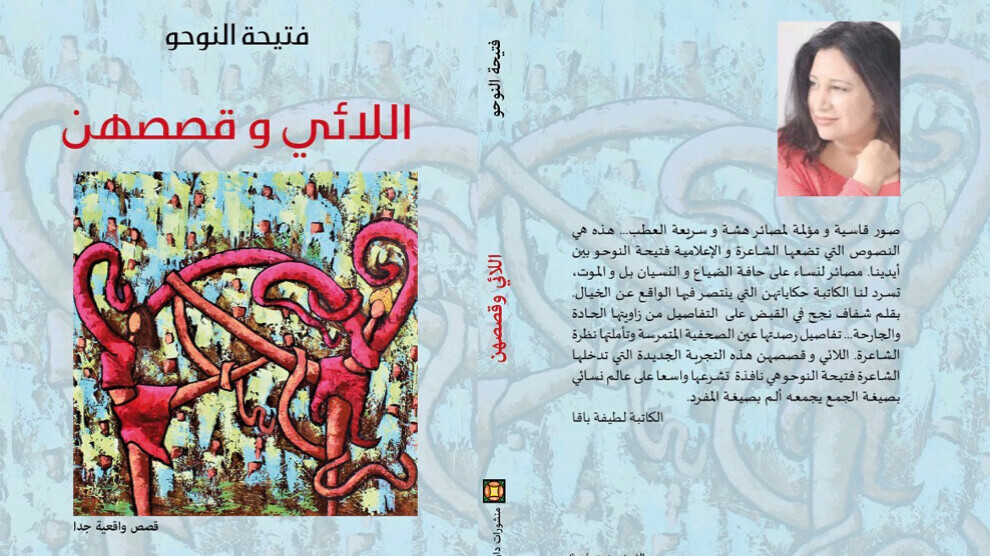
Moroccan author Fatiha Al-Nouho broke silence on women's reality through her story collection 'Those Who and Their Stories', revealing the harsh reality women live, yet they resist to continue.
Rajaa Khairat
Morocco — Her years of journalistic experience and her poetic language made her narrative texts a unique blend, combining the "journalistic investigation" of female characters who suffered oppression. Fatiha Al-Nouho wrote in a beautiful poetic language, able to take the texts out of the dry and rigid mold of journalistic writing, transforming them into narrative texts pulsating with life.
Women emerging from the shadows... Testimonies transformed into narrative
About her story collection and its characters, writer Fatiha Al-Nouho told our agency: "I did not have the luxury of selection, because with every woman whose story I listened to, I felt that the echo of her cry pierced me, and it was my duty to sail it faithfully and committedly to the port of publicity, so that it would not remain in the shadows."
She added: "My work in women's journalism gave me the opportunity to connect with women belonging to different social levels, of different ages, and with varying degrees of cognitive and field awareness. Some of them came to me directly, some I met by chance in my professional and personal paths, and others whose stories caught my attention, so I took the initiative to listen to their sorrows. These stories, or story-based investigations if you will, were published intermittently in the Arab magazines 'Sayidati' and 'Women of Morocco,' but they never left me; they were like a sail with which I sailed into the depths of the human soul and its hidden twists."
At the suggestion of her colleague, visual artist Naïma Al-Malkawi, they gathered her texts into a story collection, later published as a book titled "Those Who and Their Stories" by Al-Tawhidi Publishing House, with support from the Ministry of Youth, Culture and Communication - Culture Sector of Morocco.
She also explained that "Those Who and Their Stories" is not just psychological narratives of female selves separate from the human condition in its fragility, but rather scarred souls that subjected her journalistic pen to the guillotine of moral responsibility and awakened her creative sense while listening to their ordeals and setbacks. She found that the alphabet of pain is too sacred to be translated by the metaphors of language, yet the mechanism of recording and compiling these tales remains a duty.
Regarding whether she feels she has done justice to these women by revealing their suffering and breaking the wall of silence about what they endured, at least hypothetically, she affirmed that liberating the pain resting on their hearts through disclosure can be considered half the justice for silence, due to considerations that may be lost between fear, shame, or those whom circumstances did not do justice to pave a way for them to discharge grief.
When news intersects with metaphor
Fatiha Al-Nouho is also a journalist who practiced this profession for many years, and she has published poetry collections, which gave her narrative experience this richness in means of expression, between conveying news and news stories and using poetic devices. She said about this experience: "Perhaps I practiced journalism with a poetic soul, so the non-news article was written with a metaphorical effect that distances it from dry writing. The poetic spirit assists the journalistic tool in human sensitivity towards issues where humanity's right is violated by tyranny and injustice, regardless of its source. Poetic language then takes the lead to convey, with the weakest metaphor, what those fates are experiencing."
As she has written about women and worked extensively in women's journalism, she said about women's literature: "Literature is distinguished by its ability to touch the human being in their multiple complexities, where pain and joy coexist in an endless struggle, and the presence of woman and man intertwine as two inseparable human entities in their positive and negative manifestations. Accordingly, literary texts may grant varying spaces to each, depending on the writing self's awareness and vision of the position of this biological duality and the extent of its appreciation of its specificity. The essence of the problem does not lie in masculinity or femininity in themselves, but in their representations within the text, where feminization and masculinization become an arena of debate, if not an arena of conflict."
Fatiha Al-Nouho concluded her talk about creative writing by saying: "My literary writings practice the freedom of complete unveiling before the self; I do not write to hide, but to reveal what lies behind the apparent. I write so that the self may strip itself of its burdens, and free itself from landmines that might explode inward if it remains silent. The text, for me, is a space for purification, an honest confrontation with what we fear to admit, before it turns into a deeper wound."