
“Women Should Not Be a Party to War but a Driving Force for a Democratic Society”
Roken Naghdeh of the Free Women’s Community of Eastern Kurdistan (KJAR) urged women to organize, strengthen self-power, confront war’s impacts, and build democratic society.
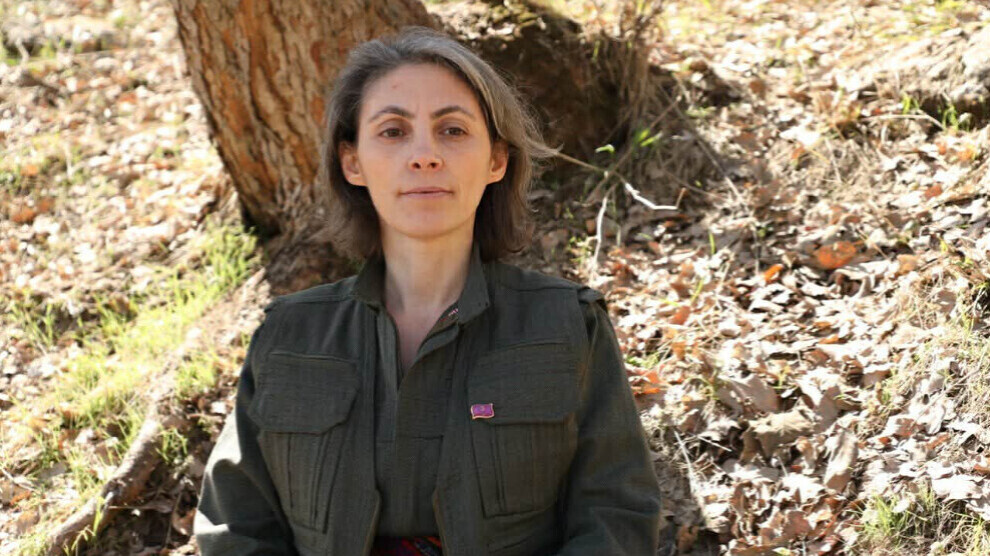
News Center — Amid rising tensions in the Middle East and the expansion of Israeli and U.S. attacks on Iran—along with the risks they pose to regional stability—the debate has resurfaced about the role women can play in confronting the impacts and consequences of war.
In light of the current situation in the Kurdistan Region and the escalating confrontation involving the United States and Israel on one side and Iran on the other, Naghdeh said that the wars raging in the region are essentially conflicts of interest between dominant powers seeking to expand their influence. She stressed that peoples—especially women—bear the greatest cost through destruction, displacement, and the collapse of social structures.
She noted that women always find themselves at the heart of war’s consequences despite not being parties to these conflicts, which makes women’s self-organization an urgent necessity at this stage.
Naghdeh explained that the philosophy of “Jin Jiyan Azadî” offers a practical framework through which women can build a social force capable of confronting the effects and challenges of war. She called on women to take the initiative and play an active role in shaping a democratic future centered on life and justice.
“The role of women should not be limited to resisting the consequences of war; it must extend to leading the process of transformation toward a more free and equal society,” she said.
War of Interests
Naghdeh stated that the core of the ongoing conflict lies in a direct confrontation between competing powers, whose repercussions extend across the Middle East, increasing the region’s fragility and deepening its crises.
She described the situation as a war of interests involving the United States, Israel, and other regional actors seeking to protect economic interests and consolidate political and military dominance, while ordinary people—particularly women—suffer the consequences.
Iranian System and the Attacks
Naghdeh said that the Islamic Republic of Iran has ruled the country for about 47 years, during which it has exercised heavy pressure and violence both within Iran and in Kurdistan and Iraq.
She stressed that although they oppose the Iranian regime, they do not justify attacks by the United States and Israel either.
From a feminist perspective, she said the longstanding tensions between Iran, Israel, and the United States are rooted in a struggle for regional dominance, with each power attempting to impose leadership and control over the Middle East through systematic policies of violence, war, and occupation.
“This War Is Not for Women”
Naghdeh emphasized that power structures are dominated by men.
“This war is not a war for women or for society. It is a war of interests whose victims are women, children, and communities,” she said.
She pointed out that women have no say in these conflicts and have been stripped of the ability to protect themselves. She also criticized Iranian laws—often justified through religious or sectarian frameworks—as increasing pressure on women, particularly through family and marriage regulations.
Despite years of repression, violence, and discrimination, she noted that women continue their struggle and refuse to surrender.
Naghdeh also mentioned that KJAR issued a statement on International Women’s Day proposing ways for women in Iran to organize themselves under current conditions and emphasizing the importance of viewing March 8 as a day of struggle to strengthen women’s organizations against the mentality of war.
Time to Show Determination
She warned that the Middle East, particularly Iran, faces the risk of large-scale war and destruction. According to her, women can provide an alternative path based on the philosophy of Jin Jiyan Azadî.
Naghdeh added that KJAR has developed alternative democratic programs for Iran in areas such as education, healthcare, and women’s protection.
She stressed that one of the biggest problems facing women in Iran is the lack of political identity, highlighting the importance of women reaching decision-making positions and gaining a stronger presence in political life.
Finally, she affirmed that the organization seeks a democratic Iran that includes all peoples and identities, calling on women of different backgrounds—Kurds, Baloch, Azeris, Arabs, and others—to unite their efforts.
“Women from different ethnic groups can unite to build a shared political will and a democratic future. Today is the time to show strength and determination,” she concluded.