
Women’s Voices -poetry Evening Celebrating Women on their Global Day
On the eve of International Women’s Day, the House of Poetry in Marrakech organized a cultural and artistic event featuring female poets and artists who expressed their support for women’s causes on their special day.
Rajaa Kherat
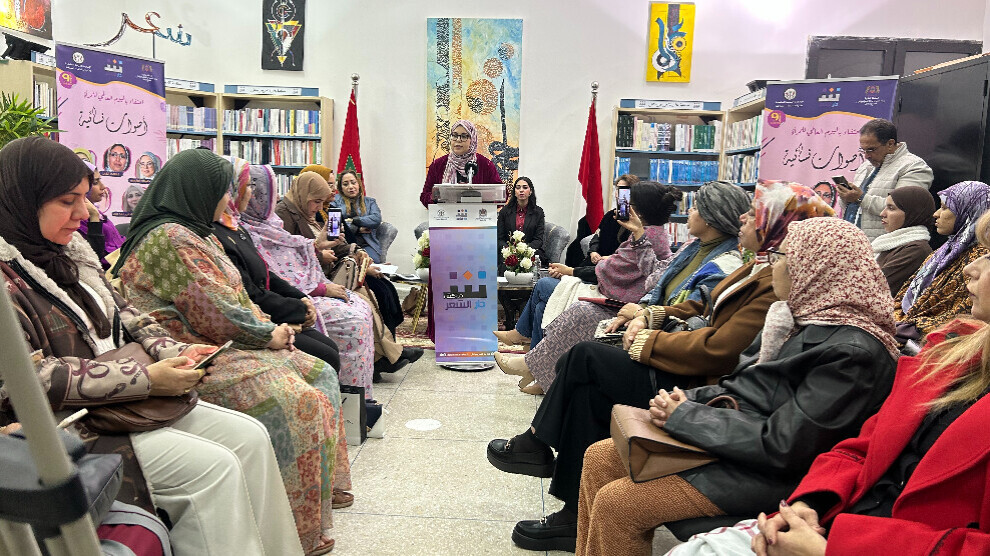
Morocco — As part of the “Women’s Voices” segment, the House of Poetry in Marrakech organized a poetry evening on Saturday, March 7, celebrating women on their International Day, which falls on Sunday, March 8.
During the event, a group of female poets from different regions of Morocco recited poems addressing current humanitarian and social issues.
Organizers highlighted that the House of Poetry in Marrakech has consistently showcased female poetic voices throughout its programs year-round. However, this evening held special significance as it coincided with International Women’s Day, emphasizing the prominent presence of women’s poetic voices in the Moroccan cultural scene.
Participating poets delivered verses that moved from reality to imagination, employing metaphors and vivid imagery to reflect a mature poetic awareness and a desire for liberation and linguistic freedom from societal constraints.
Since poetry represents a human journey, allowing the poet to explore imaginative realms using all linguistic tools to transcend conventional forms, the attending poets excelled in creating moments that served as a passage for the audience to another life, enriching their experience through art.
Moroccan poet Batoul Mahjoubi, who traveled from Oujda in eastern Morocco, expressed her delight in participating in the poetry evening organized by the House of Poetry in Marrakech. She said: “I came to renew my connection with Marrakech and to participate in this beautiful women’s poetry evening in celebration of International Women’s Day and poetry itself, alongside a selection of female poetic voices from across Morocco.”
Regarding women’s presence in her poetry, she stated that as a woman, female experiences strongly influence her work, especially the presence of her mother, which appears prominently in her verses, often unconsciously. She cited a line from one of her poems: “Whenever my lips long to sing a smile for love, I flutter into lamentation.”
On the rising prominence of female poetic voices in the Moroccan cultural landscape, Mahjoubi affirmed that women are creating across literary genres—from poetry to short stories, novels, and other arts such as singing, theater, and journalism—highlighting pride in their contributions across multiple fields.
Similarly, Fatima El Faiz, a researcher in Amazigh literature at the Faculty of Arts and Humanities, Ibn Zohr University in Agadir, southern Morocco, emphasized that in addition to her research, she writes poetry and short stories. She considers creative work a personal refuge from life’s pressures, explaining: “I escape into it to relieve work stresses. I write in Arabic, but I write more extensively in Amazigh, as I am a professor of Amazigh literature.”
El Faiz shared that poetry “chose her” early in life. She memorized much pre-Islamic poetry before moving on to free verse, finding traditional metric poetry difficult. She said poetry offered her a broad space for self-expression, while short stories provided another form of creative enjoyment. Though poetry allows expansive expression, it imposes rhythm constraints, requiring careful word selection, whereas prose offers greater freedom, influenced by her poetic background.
Regarding the topics she explores, El Faiz said she writes about all issues that concern humanity and, specifically, Moroccan society. Women frequently appear in her work, reflecting her personal perspective as a woman.
The evening also featured a handicraft exhibition by artist Zakya Al-Aqib, displaying handcrafted bags adorned with embroidery and agate stones, alongside modern interpretations of traditional Moroccan “balgha” shoes. Additionally, a group of female vocalists performed a diverse repertoire combining classical Moroccan music and Sufi singing.