
Women’s Solidarity as a Window for Rebuilding Politics in Iran and Kurdistan
Barshank Dolatyari
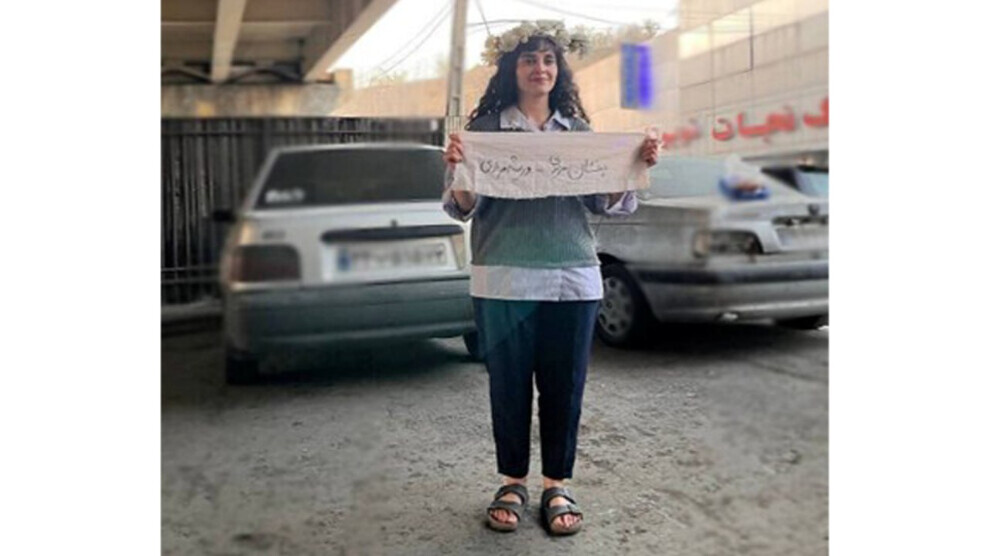
On February 20, the moment of the release of activist Anisha Asad Elahi in front of Evin Prison became more than the mere freeing of a political prisoner. It appeared as a sign of a political horizon taking shape once again. Anisha Asad Elahi walked out carrying a piece of cloth on which the names of Bakhshan Azizi and Warisha Moradi were written. This was not read only as an act of solidarity, but as a tangible translation of what has come to be known as the politics of sisterhood. Although this horizon has not yet been consolidated outside the prison walls, inside Evin—under the naked presence of power—it emerges as an ethical choice and an indispensable strategy of resistance.
The image of Anisha Asad Elahi holding the names of Bakhshan Azizi and Warisha Moradi raises a deeper question beyond its immediate symbolism: why has women’s solidarity, as an emancipatory bond formed at the intersection of gender, class, and national oppression, not become an active and dominant force in the Iranian public sphere? Another equally important question concerns the retreat of the values of Jin, Jiyan, Azadî, which swept the streets in 2022, in the face of the rise of a right-wing authoritarian discourse that has once again suffocated the political and social space.
The slogan “Woman, Life, Freedom” draws its roots from the thought and activism of the Kurdish women’s movement. It was formulated within theoretical frameworks associated with Abdullah Öcalan and movements close to the Kurdistan liberation struggle. In this intellectual system, woman is not seen merely as an oppressed being, but as the نقطة انطلاق for rebuilding society. Jineology, as a women-centered science, seeks to liberate knowledge from the monopoly of patriarchal, state-centered rationality and to rewrite history from the perspective of oppressed bodies and lives.
Before the slogan was heard in Tehran, Isfahan, and Shiraz, it echoed in the mountains and cities of Kurdistan, in the experiments of self-administration in North and East Syria, in the streets of Northern Kurdistan, and in Europe. Its importance for Iran became clear at a historical moment when the death of Jina Amini turned it into the central symbol of a massive popular uprising. Yet its roots also extended into the prisons. Years earlier, Shirin Alamholi—another prominent symbol of the “life and freedom” movement in Kurdistan—had written this slogan on her prison bed. It was a simple act, but it carried the promise of a future that had not yet arrived. Here, the prison becomes a living archive of the memory of liberation: what could not be said outside was written inside with boldness.
Marxist feminism sees women’s oppression as inseparable from the analysis of capitalist relations of production and reproduction. Domestic labor, the reproduction of labor power, and the primitive accumulation of women’s bodies are all hidden foundations of the capitalist system. Intersectional feminism also shows that forms of oppression are cumulative: a Kurdish working woman is subjected simultaneously to gender, class, and racial oppression.
Jineology takes this analysis to another level. It critiques the nation-state as a structure that narrates history in a masculine, authoritarian manner. In this system, women’s liberation is not a marginal reform but a cognitive and institutional transformation. If Marxist feminism focuses on the political economy of the body, Jineology insists on rebuilding women’s knowledge and political ethics. The combination of these two perspectives may open a horizon in which liberation is not merely legal equality but the reconstruction of social relations.
In this context, sisterhood is not limited to sympathy; it is a political strategy. It means recognizing differences without denying them and building alliances based on real experiences of oppression. In Iranian society, national, class, and ideological divisions have repeatedly weakened movements. During the 2022 uprising, these divisions briefly paused, and the Kurdish woman became a symbol of national liberation. But over time, authoritarian right-wing forces sought to strip this symbol of its radical and egalitarian meanings.
Meanwhile, women’s solidarity can form a protective shield against such appropriation because it affirms the organic link between women’s liberation and radical democracy. When Zeynab Jalalian, Bakhshan Azizi, and Warisha Moradi insist on the values of Jin, Jiyan, Azadî in prison, they are in fact defending a bond that is still evolving outside its walls.
Our tragedy is that the deepest forms of solidarity are sometimes formed in the midst of repression. Prison, despite its harsh function, can become a space for redefining relationships. By carrying the names of two Kurdish women, Anisha Asad Elahi transported this bond from inside the prison to the outside. This act is a reminder that the politics of liberation cannot be realized without transcending closed identities.
Why is this mutual understanding so difficult to achieve outside? Because the outside is a field of competing discourses. Media, capital, and nostalgia for power may marginalize emancipatory values. In prison, however, the dominance of power allows a kind of political frankness: either we are together, or we are exhausted separately.
Iran and Kurdistan stand at a critical crossroads where economic, environmental, and political crises intertwine. In such conditions, returning to the values of Jin, Jiyan, Azadî is not merely recalling a slogan; it is invoking an intellectual model that says democracy without women’s liberation is hollow, and socialism without a critique of patriarchy is incomplete.
Women’s solidarity, in this sense, is not a negation of men but a negation of structures that reproduce domination. This politics can become a bridge linking the labor left, ethnic movements, and student movements—a bridge built on the shared experience of oppression and hope.
Mentioning the name of Shirin Alamholi, recalling prison memories, and carrying a cloth bearing the names of other prisoners are all acts that embody memory. Memory here is not nostalgia for the past but a weapon against forgetting, against reducing uprisings to fleeting emotions. When we say Jin, Jiyan, Azadî, we are invoking the history of the women who gave these words their meaning with their bodies and souls.
If women’s solidarity does not become public policy, there is a risk that the emancipatory energy of movements will be dissipated in ideological conflicts. But if this politics becomes rooted in civil networks, trade unions, and cultural spaces, it will form the basis for a radical democracy that is neither imposed from above nor reproduced within authoritarian frameworks.
Today, the image of Anisha Asad Elahi carrying the names of Bakhshan Azizi and Warisha Moradi is a reminder of this possibility: that sisterhood can emerge from the darkest places and promise a new horizon—one in which women’s liberation is not on the margins of politics but at its center. Perhaps this is the secret of the endurance of the slogan Jin, Jiyan, Azadî: three words that are not merely a slogan but a program for rebuilding life, redefining politics, and creating a world in which sisterhood is not the exception but the rule.
The absence of feminist solidarity policies in Iran is not simply a lack of emotional support; it is evidence of the persistence of a competitive patriarchal logic across the entire political arena—a field that reproduces the desire for domination, centralization, and exclusion even in moments of revolution. If women’s solidarity is not elevated from the level of symbol and ethics to the level of organization, division of political labor, and the formation of alternative institutions, it will be reduced, at best, to a noble memory. The path to salvation lies precisely in transforming this bond into an institutional logic: sustainable networks among working women, Kurds, students, and teachers; horizontal decision-making mechanisms that recognize lived experience as a source of legitimacy; and alliances that do not swallow differences but turn them into a source of collective strength. In such a horizon, women’s solidarity will not be an appendix to politics but a way of making politics—an alternative to the failed politics based on charisma, centralization, and competition. Only then will Jin, Jiyan, Azadî cease to be a mere slogan and become a foundational structure for political reconstruction in Iran and Kurdistan.