
Women’s empowerment is not a gain but a strategic choice for building Syria”
The women’s experience in Rojava and North and East Syria is consolidating as an integrated political and social model based on co-chairmanship and democratic decentralization, presenting women’s empowerment as a fundamental gateway to reshaping the Syria
ASMAA MOHAMMED
Qamishlo – After decades of struggle and intellectual and political preparation, women have moved from the margins of public life to its center, benefiting from the organizational structure established by Kongra Star and the ideological vision of leader Abdullah Öcalan.
This empowerment includes the political, administrative, military, and social fields, and affirms that any future constitution or national project cannot be built without the effective participation of women, as they are a fundamental pillar of just democratic governance, safeguarding pluralism and protecting the rights of all citizens.
Influence on the course of transformation
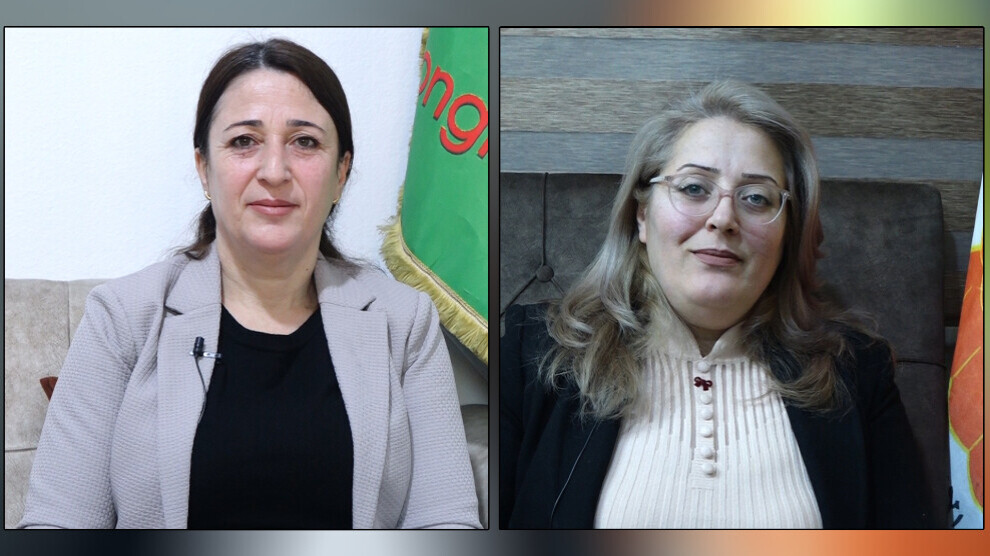
Kongra Star Coordination member Klistan Kalo stated that from the very first moments of the Rojava Revolution, women formed the most dynamic and influential force in the path of political and social transformation in North and East Syria. She emphasized that their presence was neither incidental nor limited, but was based on a long history of struggle spanning more than five decades across Kurdistan.
“The Kurdish woman led the scene of leadership and organization and contributed to shaping a new collective consciousness that redefined the relationship between society and authority, and between freedom and responsibility.”
She added that the establishment of Kongra Star in 2005 marked a turning point in organizing women, as it became an umbrella framework for their intellectual and political training and for building community support networks that strengthened their ability to engage in public life.
“This organizational structure enabled women to seize the moment of the revolution, take to the squares with confidence and determination, demand their rights, and prove their competence in the fields of politics, administration, and defense.”
This transformation, she noted, was inseparable from Abdullah Öcalan’s ideological vision, which placed women’s freedom at the heart of the project of social liberation.
“The liberation of society begins with the liberation of women, and any power structure that excludes women reproduces authoritarianism in different forms. The philosophy of the democratic nation and the co-chair system moved women from the margins of decision-making to its center, from the position of receiving to that of action and influence.”
“Women’s presence consolidates a culture of dialogue, balance, and shared responsibility”
According to Kalo, thousands of women now hold leadership positions in civil and military institutions and participate in shaping public policies on the basis of equal partnership. This reflects a structural transformation in the nature of authority and its mechanisms.
This presence is supported by a comprehensive system of training within specialized academies aimed at building leadership skills and deepening political and legal awareness, which has produced a new generation of young women educated in Rojava’s universities, capable of carrying the project forward with a modern and responsible vision.
She pointed out that the Rojava experience has gone beyond its geographical boundaries and has become a subject of wide interest inside Syria, especially with the growing calls for decentralization and the search for alternatives to the centralized system that monopolized power and excluded women for decades.
“The experience has proven that excluding women from decision-making leads to deep imbalances, because a single patriarchal mentality produces conflicts and feeds the logic of domination, while women’s presence establishes a culture of dialogue, balance, and shared responsibility.”
Kalo affirmed that women of all components — Kurdish, Arab, and Syriac — faced social and cultural systems that marginalized their role and underestimated their abilities, and that they confronted these challenges through a profound intellectual and organizational revolution, offering thousands of martyrs and laying the foundation for a new stage of social awareness.
She added that Kurdish women have today become “a global symbol of the free woman” for their resilience and ability to transform pain into creative power.
“Including women’s rights and the principle of co-chairmanship in any future Syrian constitution is not a factional demand but a national necessity to ensure the establishment of a pluralistic democratic system.”
She stressed that women are not a secondary partner in building society but its true core, and that Syria’s stability and future are closely linked to the extent of women’s empowerment and their full participation in decision-making.
“Women are moving forward in deepening and developing their experience and uniting their voices with the women of Syria and the world to shape a future in which human dignity is protected and rights are guaranteed on the basis of equality and justice.”
She concluded that the path toward a modern democratic Syria inevitably passes through empowering women and consolidating their presence in all aspects of life so that the homeland can be rebuilt with a new spirit, led by women as makers of change and guardians of the values of freedom.
Key tools to guarantee women’s rights
For her part, the co-chair of the Syriac Union Party in Syria, Shamiram Denho, affirmed that Syrian women have always been — and continue to be — a central force and a fundamental pillar in defending rights and protecting national identity. She stressed that their presence in politics, administration, and society is essential for consolidating comprehensive and non-exclusionary democracy and for ensuring genuine partnership among all components of Syrian society.
She explained that women’s participation from all components — Kurds, Arabs, and Syriacs — guarantees the preservation of cultural, social, and political pluralism and protects the rights of all individuals equally, thereby strengthening a pluralistic Syria based on justice and equality and consolidating the values of partnership and peaceful coexistence.
She highlighted the accumulated social and security pressures that Syrian women have faced over many years, saying that they have overcome all obstacles with determination by organizing themselves, raising their level of awareness, strengthening collective action, and maintaining an active presence in all fields of life.
“Women’s presence is no longer merely formal; it has become a tangible and real influence linked directly to actual powers, the pattern of organization, and the ability to make sound decisions, not just symbolic representation.”
She indicated that democratic decentralization, self-administration, and fair local representation constitute “key tools for guaranteeing the rights of women and indigenous components,” enabling them to defend their rights and participate effectively in shaping crucial decisions and implementing societal policies in a way that achieves justice, protects cultural and social diversity, ensures the sustainability of coexistence, and limits all forms of exclusion and marginalization.
Active community participation and social pressure, she added, form the first line of defense for women’s rights and the rights of all components.
“The real and effective representation of women in negotiations and decision-making is the basic guarantee for Syria’s stability, the achievement of justice, the promotion of equality, and the protection of the rights of all components within a clear vision for the future of the state.”
She addressed a message to Syrian women:
“My message to every Syrian woman of all components: be a fundamental and active partner in decision-making. Preserve your voice and your rights and work together to build a just and pluralistic Syria. Your role today determines the future of your society tomorrow. When women have a real and essential role, Syria will become a pluralistic, just, and inclusive state that respects all its components, provides equal opportunities for all, strengthens coexistence, guarantees social stability and social justice, and protects the rights of all citizens.”
Denho concluded by stressing that strengthening women’s role and empowering them “is not a political option that can be reversed,” but rather “a strategic national necessity” to ensure the building of a pluralistic Syria that protects the cultural identity of all Syrians and achieves social and political stability, reflecting a clear future vision of a strong, stable, and diverse Syria that upholds the values of partnership and true citizenship.