
Women of Rojava... Roots That Cannot Be Cut and a Voice That Cannot Be Silenced
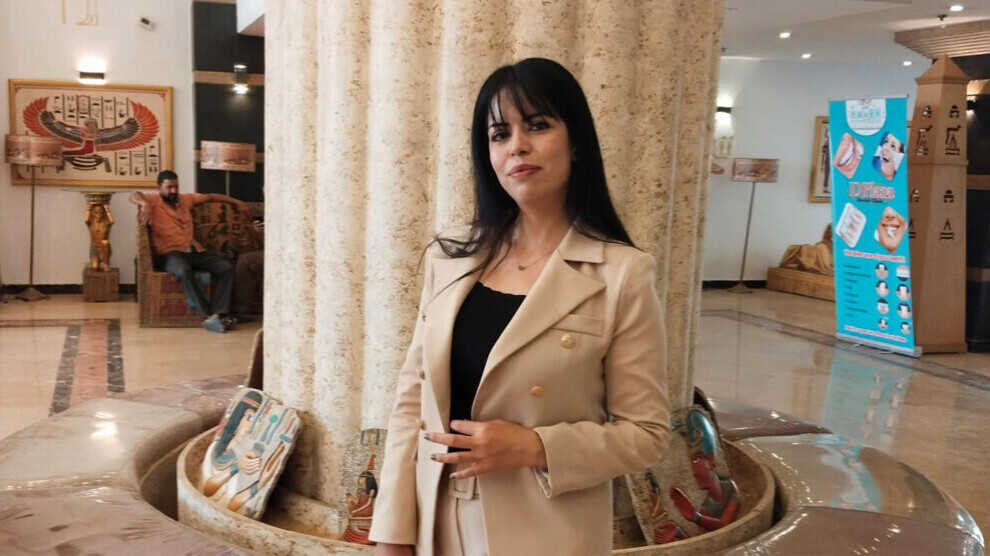
An article by Zahida Memo, member of the Academy of Jinologi in the Middle East
Fourteen years of struggle and sacrifices made by the sons and daughters of the Rojava Revolution clear facts evident to all through the achievements witnessed in this geographical area. For many years, the Kurds have been making sacrifices for the freedom and peace of all humanity.
Women continued their path following in the footsteps of Kurdish women with the philosophy of free life and peaceful coexistence, presenting it to illuminate the darkness of women suffering from tyranny. With clear courage, they proved to the world that women alone can reach freedom and gather the scattered fragments that were imposed upon them.
They were the leaders in battle and the pioneers in making their mark on decision-making. They managed to transmit their voices to all women around the world with merit and love. They proved that they are the beacon, the brilliant mind, and the sacrificing mother throughout the years. Their voices still fill all squares in preserving identity, existence, and survival despite all the storms they have passed through.
It is the Rojava Revolution that created life and wove the threads of freedom and hope. One braid from among them managed to encircle the entire world, garnering solidarity with the revolutionary women. It created the imprint and identity and drew aside the curtain of darkness.
They stood against tyranny with strength and fought to preserve the legacy of the revolution, writing a venerable history that narrates women's struggle and revolution against injustice. Women carried life in one hand and faced loss with the other. They did not fight to prove they can die, but rather to affirm their right to life—a dignified and free life in every sense of the word.
They brought about a clear change and an indelible impact in the people's revolutionary war and self-defense. Women—Armenians, Syriacs, Circassians, Turkmen, and Arabs—were in the front lines facing the jihadists. Mothers took upon themselves the protection of the homeland and supported their children in battles.
They faced dangers despite all that but never faltered or weakened. Rather, they stood against surrender with rigor and courage. This is what placed them in the face of tyranny. Wars ignited over the years to control their struggle. The colonizer, the occupier, the tyrant, and the despot fought them in every form and still struggle to undermine the existence and entity of women in every place and time—and this ignited the fire of hatred and revenge in them.
The despot knew, and planted in the minds of societies, that women have no existence except to be slaves—no place for them in defense, in decision-making, or even in thinking. They do not even have the right to bear arms and fight against dark-minded ideologies.
These dark minds launched their brutal attacks on women's bodies primarily, and the example of Syria is the living model at the present time, especially after the fall of the regime and the beginning of attacks by followers of the transitional government and its factions that launched assaults on the neighborhoods of Aleppo. Here, after the failure of agreements that were supposed to be officially concluded, they sabotaged all agreements and launched their brutal attacks.
In two small neighborhoods, they brought down the body of a female fighter who wanted to defend humanity, a cause, and existence. They brought her down as if they wanted to bring down fear itself, to show the world that women have fallen. By doing so, they wanted to send a message to all women to be silent and retreat from struggle. But they did not know that when one woman is martyred, a thousand women are born who refuse silence and submission.
They have multiplied violations against women. Female fighters were run over by tanks, and prisoners were tortured without them batting an eye or their conscience stirring. These acts are committed under the name of religion and Islam, which are innocent of them and their deeds. As if these were heroic acts and proof of manhood—but they are actually proof of fear of women's strength and resistance. They do not know that they have ignited the fire of hatred and revenge in the soul of every woman.
People did not flee from war, but from killers who have different names but the same actions. They chased them in the streets and dragged them from their homes. The charge was not a weapon or a stance, but a photo—a Kurdish symbol on a phone screen, or a picture of them in a Kurdish area. Thus, the phone became a charge and a pretext for killing and exile. This is how people are killed today—simply because they are Kurds.
The Kurd was not alone in struggling to survive and deserve life; rather, everyone who worked sincerely with them and knew the meaning of being a friend to the Kurd became exposed to the threat of death. The women who emerged from under the rubble of ISIS worked with the Kurdish women's movement, not seeking power, but seeking a free life not governed by fear. They built institutions, achieved the dream of unrestricted freedom, and were in decision-making centers. Today, they face threats after the return of ISIS to the region, now operating under the name of the transitional government that has taken control of the area—killing, looting, and sowing discord among the existing components and cultures.
Here too, these dark hands expanded their geographical reach to target North and East Syria. In Kobani, they completely besieged it, and five children fell victim, freezing to death—no water, no electricity, no heating. The siege continues today, and these attacks increase in intensity to control this Kurdish area. What conscience accepts this in such an era? Has the death of children from cold and hunger become normal, witnessed by the world while it feeds on silence?
And there, a braid was cut—not just hair, but the history of a woman, her dignity, and the memory of struggle—gifted to another as if it were war booty and a symbol of the tyrant's pride in having stolen a body. But he does not know that it was never merely a means for styling hair and its aesthetics for women; it symbolizes identity and resistance, with historical roots unknown to many. In some societies, braids symbolized religious and spiritual adherence and also identity. They were also associated with waiting for the return of the absent and adherence to the cause.
Throughout history, conflicts and wars have been primarily known for targeting violence against women's bodies as a means to strike at the dignity of societies and humiliate them. They tortured them, raped them, and abused their bodies to break their identity. Hegemony worked to transcend human and ethical boundaries.
That scene, and all other scenes, was not just the act of an individual, but a manifesto of hatred and animosity, a clear message saying: We fear the free woman, and we fear the cohesive and democratic free society, and we fear your children, your trees, and your homes. Therefore, they try to break and obliterate everything within us. Yet we remain heroes and brave in battles, in homes, in neighborhoods—the imprint of every woman who bore arms in defense of dignity and identity. We remain, for roots cannot be cut, and the wombs of mothers will give birth to heroes who carry love of the homeland in their souls