
Where Are the 19 Yazidi Women from the Internatioinal Day for the Elimination of Sexual Violence in Conflict?
As the world annually commemorates the International Day for the Elimination of Sexual Violence in Conflict, Irap’s history witnessed one of the most horrific human tragedies, when ISIS, In the heart of Mosul, burned nineteen Yazidi girls alive.
HAEVY SALAH
Sulaymaniyah_In 2015,the United Nations General Assembly, with the consensus of all its members, adopted a historic resolution designating June 19 of each year as the International Day for the Elimination of Sexual Violence in Conflict.
The primary goal of this step was to create global pressure to prevent the exploitation of women’s and children’s bodies as a means of breaking the will of communities and terrorizing civilians during armed conflivts.Yet, only one year after this historic resolution_specifically in 2016, as the world was preparing to mark its first anniversary_ISIS demonstrated in the city of Mosul that international laws alone cannot protect women without genuine political and military will to implement and enforce them.
Slave Markets and the Collapse of Human Values in Mosul
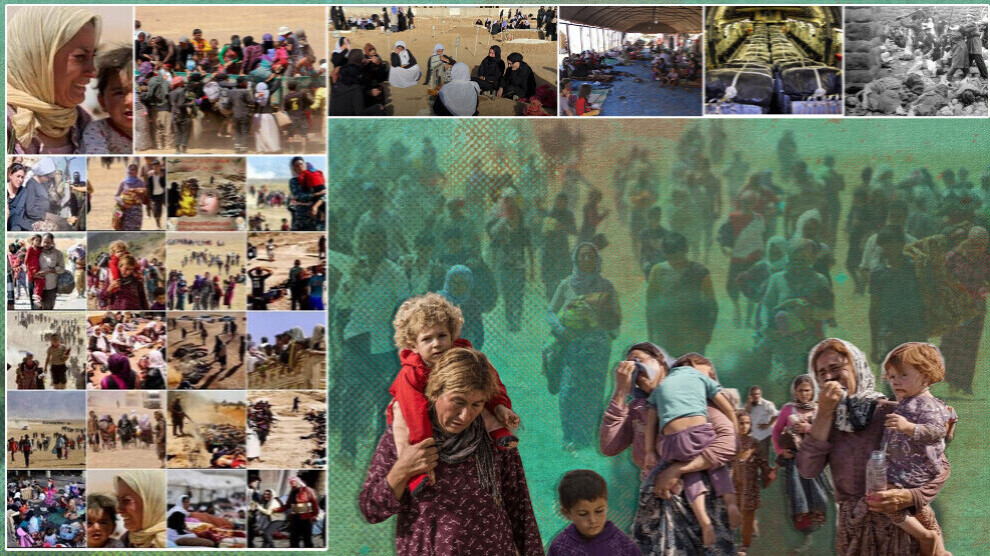
One of the darkest and most brutal pages in twenty-first-century human history unfolded after ISIS seized control of Shingal and its surrounding areas, abducting thousands of Yazidi women and children and transferring them to Mosul, which at the time served as ISIS's de facto capital and main decision-making center.
In the city, ISIS established open markets for buying and selling humans, where young girls were treated as spoils of war for sexual exploitation, while extremist and distorted religious fatwas were used to justify the assault on their bodies and the violation of their rights. However, the story of these nineteen Yazidi girls was different: they refused to submit to the terrorists' brutality and insisted on preserving their dignity and religious identity.
Yazidi Women's Resistance to Torture and ISIS Sharia Courts
According to documented information from within Mosul at the time, these nineteen girls ranged in age from 14 to 25. After being held for long periods in ISIS prisons and special camps, and subjected to the most severe forms of physical and psychological torture and repeated humiliation, they refused to respond to ISIS leaders' demands—whether to change their religion or accept being passed among militants as objects of sexual exploitation.
This defiant stance enraged ISIS leaders, who were unable to break their will. Consequently, the ISIS-affiliated Sharia court in Mosul issued a decision to execute them collectively, making them a lesson for the remaining captives.
The Iron Cage and the Execution of the Most Atrocious Punishment: Burning Alive
The method of carrying out the collective burning alive embodied the highest degree of human cruelty. On June 2, 2016, in the center of Mosul, before the eyes of hundreds of residents, the nineteen Yazidi girls were placed inside a large iron cage. ISIS members then poured flammable materials over it and set it ablaze.
In those moments, the girls' screams in defense of their dignity echoed through the city's sky as they were burned alive until they turned to ash. Yet they did not accept abandoning their honor and identity to satisfy the terrorists' temporary desires. This incident has become a global symbol of women's resilience in the face of religious and military fascism.
The Contradiction Between International Slogans and the Bitter Reality of War Victims
When the United Nations decided to designate June 19 as the International Day for the Elimination of Sexual Violence in Conflict, the aim was for such violations to be viewed not as a side effect of war but as a war crime and a crime against humanity.
However, the bitter reality witnessed in Mosul that year proved the vast gap between the slogans raised in international forums and the tragic facts on the ground. While the bodies of Yazidi girls were burning in the flames, there was no rapid international mechanism capable of reaching the heart of Mosul to break the iron cages and save their lives—a fact considered evidence of the international community's failure to protect vulnerable communities and ethnic groups in the Middle East.
Sexual Violence as a Strategy of Genocide Against Yazidi Identity
Under international legal standards, the Geneva Conventions, and UN Security Council resolutions on the protection of women during conflicts, this crime is viewed as an integral part of the genocide campaign targeting the Yazidi community.
ISIS used sexual violence and the execution of women as part of a systematic strategy aimed at eliminating future generations of this community and dismantling its social fabric. When a girl is killed because of her adherence to her identity and dignity, it is not merely the killing of one individual but an attempt to assassinate the spirit of an entire community striving to live freely on its land.
Shingal's Unhealed Wounds
Although many years have passed since that painful tragedy, its psychological and social effects remain strongly present in the Shingal areas and displacement camps. Therefore, June 19 represents for the Kurds, and especially for the Yazidi community, not merely an official occasion for holding seminars and delivering speeches, but a day of national and human mourning in which the memory of ISIS crime victims is commemorated.
Historians and media also bear the responsibility of continuing to document and narrate the stories of these nineteen girls' resilience, so that future generations may understand the heavy price paid to preserve human dignity, freedom, and identity.