
When Migration Takes the Face of a Woman
By Moroccan journalist HANAN HARIT
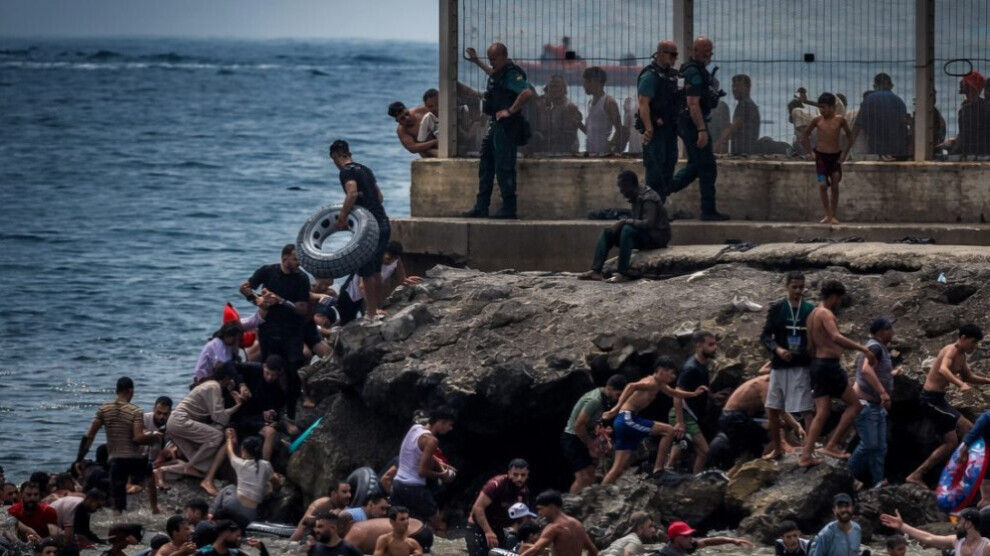
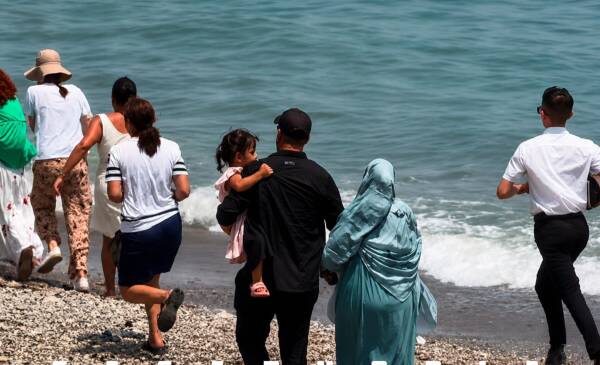
Over the past two days, I've been following the wave of migration that swept through northern Morocco toward occupied Ceuta, the Moroccan city under Spanish administration. This time, the scenes didn't resemble what we've grown used to in recent years. The sea was no longer receiving only young men attempting to cross — whole families appeared, fathers and mothers carrying their children, even infants, in scenes that opened up a debate about what drives an entire family to risk everything they have for the other shore.
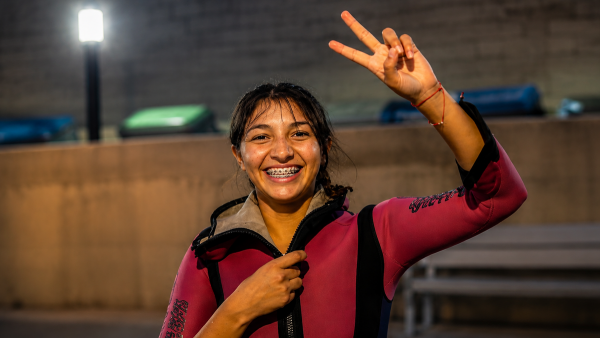
Among the images that stuck with me most was one of a young man carrying his mother on his back as he tried to reach Ceuta with her — as if the journey were no longer an individual's decision, but an entire family's. Yet amid all these scenes, I lingered longest over a different image: a photo of joy — of the swimming champion who arrived in Ceuta raising a victory sign.
What drew me in wasn't that she had crossed the sea — that sea had already witnessed thousands of crossing attempts before her, and will witness many more after. What drew me in was that the image became a mirror onto which every side projected its own reading.
Among those readings, I paused over a post by rights activist Bushra Abdou, who read the victory sign as a silent cry of protest — as if it were saying that succeeding in reaching the other shore exposes a failure to provide the conditions for a dignified life at home, affirming that true salvation should not come through flight, but through claiming the right to a dignified life.
In the same vein, but from a different angle, I read what political activist Kabira Chatar wrote, seeing in the young woman's smile an expression of an entire generation's rebellion — particularly young women — against a reality that narrows their dreams, and against a discourse that still reduces the future of many women to marriage, even as they now demand their right to education, work, independence, and making their own choices.
In these two posts, I wasn't looking for an explanation of the young woman's smile itself, but for an explanation of the debate that smile gave rise to — because images don't say everything, and no one can speak on behalf of a woman whose full story we don't know. Yet at the same time, that image reveals a great deal about the society looking at her, and about the questions occupying its mind. Perhaps that's why my memory didn't stop at that one image alone, but led me back to other images that have stayed with me over years of journalistic coverage.
Often, an image becomes more than just documentation of a moment — it turns into a mirror condensing the questions of an entire society. This wasn't the first time this had happened: during the Gen Z protests, an image spread of a woman pulling a young man away from the grip of security forces as she protested his arrest.
https://jinhaagency.com/uploads/photos//12795/01-08-2026--2-2c247cpre.png
That image, too, went beyond the boundaries of its own moment; it was no longer just a scene from a protest, but became an expression of mothers' fear, of women's solidarity, and of an entire generation's sense that its future had become a site of struggle. That wasn't the only image that stayed lodged in memory — it also brought me back to the women of Figuig, who continue protesting in defense of the right to water, in a scene that affirmed that women are not standing at the margins of the transformations their societies are undergoing, but at their very heart.
What united those women was not a dream of leaving, but a dream of opportunity, recognition, dignity, and a place that allows dreams to grow. That is why the image of the young woman didn't feel to me like a break from those other stories, but an extension of them.
Perhaps this is what the young woman's image reveals too: women in Morocco, as in other countries of the southern Mediterranean, have become more present in the transformations their societies are undergoing — in the labor market, in protest, in sport, in public space, and even in migration stories. Departure no longer wears only the face of a young man; it has come to wear the features of a woman too.
And even as the young woman's image was sparking all this debate, the news was reporting the arrival of large numbers of migrants in Ceuta, from Morocco and various African countries, alongside discussions of their return — the contradiction was striking. While some read the image as a moment of triumph, the facts on the ground were a reminder that reaching the other shore is not the end of the story, but the beginning of another chapter governed by borders, laws, and policies.
https://jinhaagency.com/uploads/photos//12794/01-08-2026--1-a3d50bpre.jpg
And perhaps this is where the significance of the young woman's image lies — not in the answers it offers, but in the questions it raises. The question it left open for me was this: what does it mean for migration to become, for some women as much as men, a plausible option when the space for dreaming shrinks within their own countries?
And this is a question that doesn't belong to Morocco alone. Anyone following what is happening in the western Mediterranean understands that the sea no longer tells only the story of Moroccans, but also of Tunisians, Algerians, and Libyans — and before and after them, thousands of migrants from sub-Saharan African countries. The languages and nationalities differ, but the questions carried by those crossing are similar, as they search for a horizon they believe is wider.
Perhaps that's why the image of the young woman has stayed with me — not because she is a swimming champion who crossed the sea's waves, nor because she sparked widespread debate, but because she reminded me that great transformations don't always begin with political speeches or official statistics, but sometimes with a single image that reveals the larger questions hiding behind it — questions bigger than the person in the frame. In the end, the image of the young woman isn't just about a girl who crossed the sea; it's about a society searching for a way to make its young women and men see their future as possible within their own countries, before they come to feel that the other shore is the only horizon available to them.