
Unveiling of a Memorial for Aftehan Al-Mashhari at Taiz University in Tribute to Her Struggle
Taiz University and the Waj Feminist Coalition unveiled a memorial for Aftehan Al-Mashhari, who was assassinated a year ago by gunmen on a motorcycle.
RANIA ABDULLAH
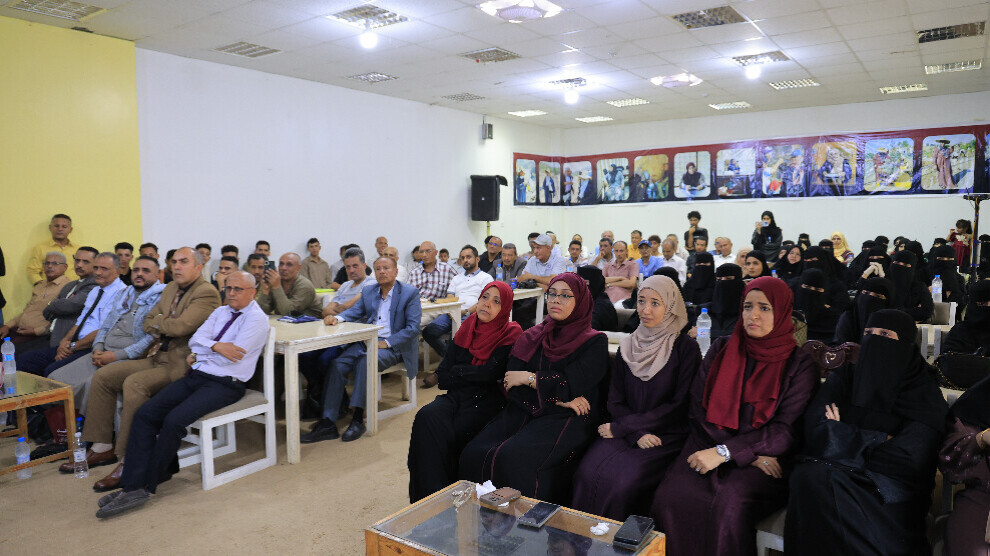
Yemen – Taiz University and the "Waj Feminist" Coalition commemorated the first anniversary of the killing of Aftehan Al-Mashhari by inaugurating a memorial to immortalize her prominent contributions and pioneering role in serving society and the university.
The assassination of Aftehan Al-Mashhari was carried out on 18 September 2025 at Sinan Roundabout in Taiz city by a gunman who fired a barrage of bullets at her.
What drove these parties to assassinate her were her firm and courageous positions in combating financial and administrative corruption since she assumed the management of the Sanitation and Improvement Fund as the first woman in this position. According to testimonies, the inciting parties proceeded to kill her after her financial and administrative reforms in the Fund, which cut off the interests of influential figures from the Fund's resources.
According to official investigations and testimonies, the inciting parties proceeded to kill her after her categorical and continuous refusal to pay "huge and illegal financial levies" that military leaders and armed groups were imposing to extort the Fund's resources.
The event, held yesterday, Sunday, 20 September, witnessed the unveiling of a memorial to immortalize her prominent contributions, with a notable presence of academic, feminist, and student leaders, who unanimously agreed in their speeches and testimonies that the deceased was not merely an exceptional administrative competence, but represented "a historical symbol of the steadfast Yemeni woman," and opened with "her firmness new horizons for women's empowerment and confronting corruption within state institutions."
Member of the Waj Feminist Coalition, Ola Al-Saqqaf, in her speech, shed light on the "exceptional imprint" she left in feminist and developmental work during her membership in the coalition and her management of the Sanitation and Improvement Fund, confirming that she was a model of the "wise woman" capable of making success from the heart of crises.
The event included a review of Aftehan Al-Mashhari's role in the technical and service development of the Central Library, and the screening of a documentary about her life and achievements.
A Model of the Honest Woman
On the sidelines of the event, Ahlam Abdel Qader Al-Shami, an employee at the Sanitation and Improvement Fund, said that "the first anniversary of Aftehan Al-Mashhari's departure still renews in our hearts and eyes a deep sorrow and a psychological fracture that will not easily fade, as if the assassination occurred today; we have not yet absorbed the bitterness of losing her."
She indicated that she "was a living embodiment of the values of integrity, cleanliness, and administrative discipline, and a unique symbol of strength, courage, and absolute dedication to work," confirming that the impact she left on women is not limited to the female cadres in the Sanitation Fund or the scope of Taiz University only, but extends to be an extended legacy for the homeland. "The martyr was an inspiring role model for all women of Yemen from its south to its north, and she taught us that strength and dignity are the only option for advancement. Therefore, her departure represents a real catastrophe and a national loss of an exceptional competence that left an indelible imprint."
For her part, Ruqaya Abdullah Al-Shaibani, secretary of the Juvenile Court, said that "Aftehan Al-Mashhari is a rare and exceptional figure in the history of administrative and developmental work in the governorate, as she combined nobility, chivalry, and firm humanitarian positions." She explained that her entry into public life and her assumption of an administrative and executive position in Taiz governorate, which had been monopolized by men in a society dominated by doubt about women's capabilities, formed "a motive and a source of inspiration and a beacon of hope for all women in the possibility of reaching decision-making centers through struggle, activism, scientific qualification, and integrity."
She indicated that the deceased proved through her work and daily practice that women "are the most transparent and defensive of institutions." Therefore, her assassination, which she described as "treacherous," was not merely a targeting of her person or of her being a woman, but was an explicit assassination of "the principles of integrity, honorable values, and the corrective approach within state institutions."
Horizons of Women's Empowerment
For her part, Wafa Amin Al-Dumaini, director of libraries at Taiz University and a colleague of Aftehan Al-Mashhari, said that "for Taiz University and all parts of the governorate, she represents the primary icon and main content of symbolism, giving, and institutional correction," and that she is "a model worthy of all women looking up to and emulating; she offered her soul and life as a sacrifice for principles so that the city and institutions could live under the rule of law and justice."
Despite the targeting, pressures, and repeated harassment she was subjected to, she confirms that she "refused to withdraw or retreat," because she believed that "protecting rights requires sacrifice and resilience."
According to her colleague, Aftehan Al-Mashhari opened horizons for the women's empowerment movement to assume leadership and executive positions without appeasement or submission to favoritism and corruption. Although her departure caused a shock and temporary fracture, "her courage will remain a living legacy that gives Yemeni women the strength to continue seizing their rights and participating in building the homeland."
The event concluded with honoring Aftehan Al-Mashhari and inaugurating the memorial in front of the library in loyalty to her rich academic and leadership giving.
It is worth noting that Aftehan Al-Mashhari had progressed through multiple administrative positions at Taiz University, where she managed the Libraries Department and then the University's Printing and Publishing House, before being appointed in October 2023 as Director General of the Sanitation and Improvement Fund in the governorate, as the first woman to hold this leading executive position.