
Unprecedented Migration Crisis... Tens of Thousands Cross and 19 Dead as Europe Mobilizes
The mass wave of migrants crossing from Morocco into Ceuta has brought the issue of irregular migration back to the forefront of European concern, after unprecedented numbers of arrivals were recorded alongside a number of deaths.
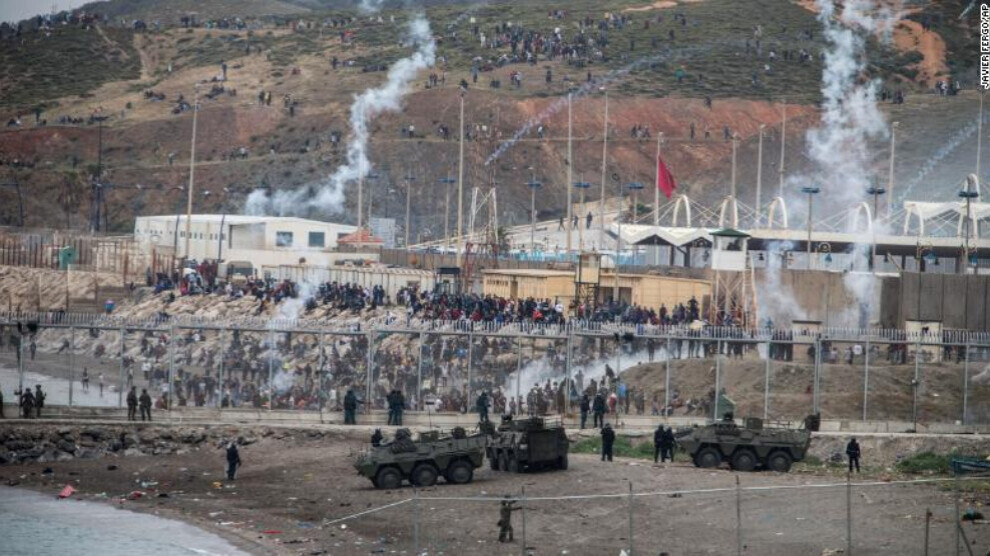
News Center— The Spanish-administered city of Ceuta has turned into the epicenter of an unprecedented humanitarian and security crisis, after witnessing, over the past few days, an influx of tens of thousands of migrants arriving from northern Morocco — the largest mass crossing wave since 2021.
Spanish police sources reported that around 40,000 migrants managed to cross the border between Morocco and the city of Ceuta over the past few days, while other estimates from Spain's Ministry of Interior indicated that the number of people who entered the city in just the past 24 hours reached around 49,000 — a sign of the growing scale of the crisis and the accelerating pace of irregular migration flows.
At the same time, around 19 migrants lost their lives while attempting to reach Ceuta by sea, after trying to swim from the coasts of Ksar el-Kebir and Fnideq in northern Morocco, in one of the deadliest migration incidents the region has witnessed in recent years.
The flow of migrants continued throughout Thursday night and into the morning of today, Friday, July 31, according to Spanish police, who explained that the vast majority of arrivals are young people and teenagers, while new groups continue attempting to reach the city by sea or through border crossings.
Field footage near the Moroccan city of Fnideq showed hundreds of people attempting to approach the border, as Moroccan security forces intervened to disperse crowds using water cannons, while clashes broke out that saw a number of buses and cars set on fire, according to footage filmed at the scene.
The city of Ceuta sits on Morocco's northern coast under Spanish administration and is surrounded by security fences, but the short maritime distance separating it from Moroccan beaches — no more than three kilometers in some areas — makes it a recurring destination for attempts at irregular migration toward Europe.
The current wave is the largest since the 2021 crisis, when around ten thousand migrants reached the city amid diplomatic tension between Morocco and Spain, before the two capitals succeeded in containing the crisis and restoring security and border cooperation.
The governor of Ceuta described the situation as "a humanitarian and social state of emergency," affirming that migrant reception centers have become fully overcrowded and unable to accommodate further arrivals, warning that if the flow continues at this rate, the city could be pushed back into the crisis conditions it experienced five years ago.
Moroccan-Spanish Coordination to Return Migrants
As part of efforts to contain the crisis, Madrid and Rabat announced strengthened security coordination between them, with the two governments agreeing to activate procedures to return migrants who entered Ceuta irregularly as soon as possible, while intensifying efforts to prevent further crossing attempts.
The head of the Northern Human Rights Observatory association explained that Moroccan security forces set up a security cordon around the land border crossing, while the Royal Navy stepped up its patrols along the coastline, in an attempt to curb crossing attempts, even as large crowds continue arriving in the city of Fnideq.
The repercussions of the crisis have extended to the European level, with France announcing tighter controls along its border with Spain, in anticipation of any onward movement of migrants toward its territory.
In Italy, the crisis has sparked political controversy after its foreign minister called for suspending Spain's membership in the Schengen Area, arguing that irregular migration poses a threat to European national security, and criticizing Madrid's migration policies as encouraging human trafficking networks.
The current crisis highlights the growing challenges Europe faces in managing the file of irregular migration, amid continued economic and social pressures in countries of origin and the expanding activity of human smuggling networks — a warning sign of escalating security and humanitarian challenges along the western Mediterranean coast in the period ahead.