
Under the slogan "We Love Life Tomorrow," Palestinian children celebrate cinema amid the rubble
Gaza Children's Film Festival's second edition launched from destroyed Al-Nasr Cinema's ruins on World Children's Day under "We Love Life Tomorrow," aiming to bring screenings and joy to displacement camps' children.
NAGHAM KARAJA
PALESTINE— Participants in the Gaza Children's Film Festival affirmed the children of the Strip's adherence to their right to life, safety, and culture, despite the continuation of bombardment and displacement, calling on the world to protect their stolen childhood and provide a safe environment.
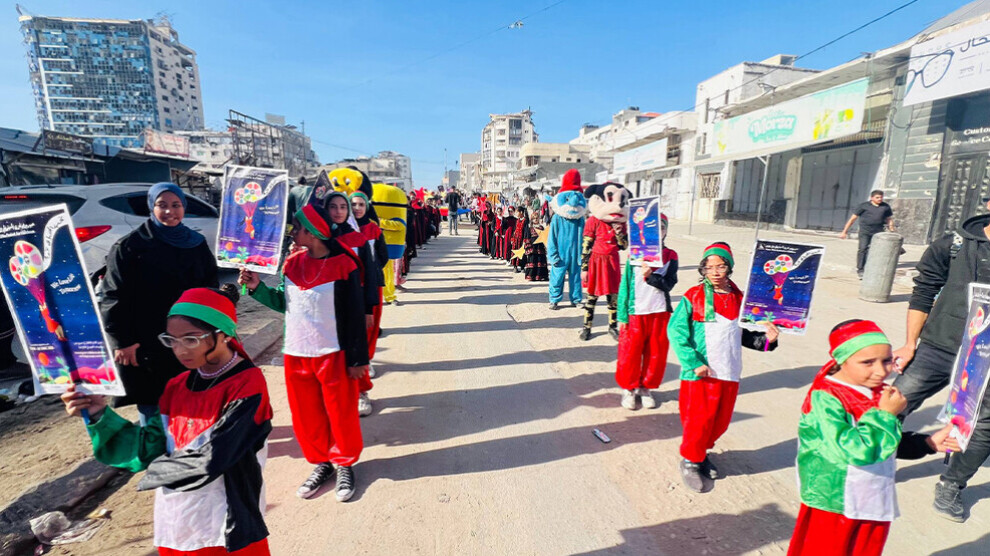
From in front of the ruins of the historic Al-Nasr Cinema in Gaza City, Palestine, the activities of the second edition of the Gaza Children's Film Festival launched yesterday, Friday, November 20, coinciding with World Children's Day, in an attempt to restore a space of joy and imagination to the lives of children besieged by war, fear, and deprivation, under the slogan "We Love Life Tomorrow."
While children carried dolls and flags and chanted songs during the opening carnival, the sound of bombardment remained present in a scene that revealed the contradiction between their right to celebrate and their reality that still threatens the simplest details of their childhood.
The choice of Al-Nasr Cinema as the venue for launching the festival was not a passing detail; the building that was once a space for screening films and receiving audiences has nothing left but ruins, after the war affected it. From in front of this place, the "Mashharawi" Foundation for Supporting Cinema and Filmmakers wanted to announce the launch of the new edition and remind of Palestinian children's right to culture, art, and entertainment even in the harshest conditions.
The opening carnival launched with the participation of Palestinian scout teams, dabke teams, children, clowns, and dolls, in a scene that attempted to restore the manifestations of celebration in a city burdened by destruction and displacement. The festival's activities continue until December 30, with its screenings and activities moving to displacement camps in various areas of the Strip, north and south.
The festival coordinator, Yafa Al-Mashharawi, explained that the opening came in the form of a broad carnival, affirming that the festival carries a message that transcends organizing cinematic screenings, to reach the world with the voice of Gaza's children who want life despite what they have gone through. "The slogan 'We Love Life Tomorrow' expresses children's adherence to their rights, despite the difficulties they lived through during the war. We want to convey the voice of the Palestinian child to the world, and to affirm that he deserves, like any other child, to live a dignified life and obtain his rights."
"Cinema reaches displacement tents"
The festival's program was not limited to organizing a celebration in Gaza City; its organizers turned to mobile cinema to reach children in their places of displacement, as the absence of screens and electricity and the destruction of homes became additional obstacles to their access to cultural and entertainment activities.
She explained that the idea of mobile cinema came in response to children being deprived of watching films in their homes, after many lost their homes, electricity sources, and stability. She pointed out that the festival organizers decided to go to the camps instead of waiting for children to be able to reach screening venues. "We wanted to reach children in their camps and displacement places throughout the Strip, to tell them that we are by their side, that we want to provide them with the opportunity to watch films on screens, and to transport them, even for a short time, from the atmosphere of war to an atmosphere dominated by life and hope."
"Gaza's children have the right to live their childhood"
For her part, Nabil Al-Azbaki, the festival's media and public relations officer, explained that choosing World Children's Day as the date for launching the second edition carries special significance, as the organizers wanted to celebrate with Gaza's children in their own way, and to direct a message to the world regarding their rights that were deprived during the war.
She pointed out that the presence of the festival next to Al-Nasr Cinema carries a painful paradox, as the cinema was supposed to host the screenings, but the destruction that affected it prevented that. "We are today presenting cinema between displacement camps, and I stand next to Al-Nasr Cinema, one of the cultural landmarks in Gaza where we were supposed to host our cinematic screening, but the war destroyed the place," affirming that the organizers chose to celebrate with the children of the Basmat Amal camp in an attempt to bring joy into their lives. "The festival's screenings will reach displacement camps in various areas of the Strip."
A childhood between rubble and bombardment
The celebration was not separate from the reality of war; the testimony of child Ruwaida Abu Shaaban, a participant in the festival, carried a direct image of the gap between a childhood that knew home, screens, and play, and a reality in which children walk among rubble and fear that any gathering will turn into a dangerous place.
She pointed out that children want to celebrate their international day, even under war, displacement, and living inside tents, even if the war continues and even if bombardment is present.
Ruwaida Abu Shaaban recalled the details of life before the war. "Before the war, we used to live in our homes and set up a cinema inside the house when we all gathered, turned on the screen, and watched films amid an atmosphere of joy," noting that children of the world go out to play safely without fearing bombardment.
She described the transformation that occurred in their lives. "We today walk among rubble, piles of ash and debris, while the world's children walk among green spaces, playgrounds, and games. Everything has changed, and our lives have become full of misery and fear, after we used to go out, play, and feel joy."
For Ruwaida Shaaban, bombardment was not just a memory or a scene she evokes from the days of war, but a danger she says pursued children even during their participation in the festival carnival. She revealed that bombardment occurred while they were walking in the carnival, in a moment that reminded them again that they cannot feel safe even in events dedicated to bringing them joy.
Rights not summarized by celebrations
The need for these artistic spaces transcends the limits of entertainment, in light of the scale of losses that affected children's lives and basic rights. UNICEF data reveal the widening gap left by the war; the organization reported that about 700,000 children, aged between 4 and 17, were deprived of formal in-person education for nearly three consecutive academic years, while about 98% of school buildings were damaged.