
The Syrian Coast Massacres…A Year Since the Execution of justice
The First anniversary of the massacres committed on the Syrian coast by Jihadists of Hayat Tahrir al-Sham has passed, yet justice has still not been achieved for the victims and their families.
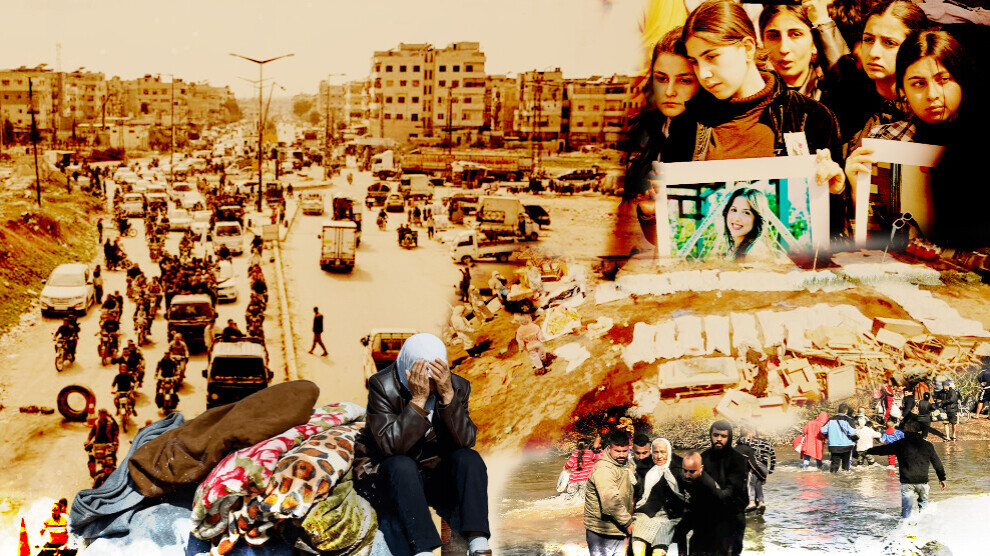
News Center — March 7, 2025 marked a bloody chapter in the history of the Alawite community, which was targeted in retaliatory attacks by jihadists from Hayat Tahrir al-Sham in the name of Sunni victimhood in Syria. To this day, the entire Syrian people continue to bear the burden of the pain and trauma left by those massacres.
A full year has passed without accountability—or even a clear intention to pursue it. Instead, some of the perpetrators have assumed significant leadership roles in the so-called “New Syrian Army.” Rather than holding those responsible to account, the “National Investigation Committee,” hastily formed by Ahmed al-Sharaa under international pressure, attempted to justify the events, claiming that “although the attacks were widespread, they were not intentional,” and that “the motives were driven by revenge rather than ideology,” despite acknowledging that the attackers used sectarian language.
Investigation committees in Syria—both during the former regime and under the current one—have often served merely as mechanisms to buy time until public outrage fades and the collective memory of suffering diminishes. As a result, the committee failed to achieve its primary purpose: holding the perpetrators accountable. Some of those same individuals reportedly took part only months later in the massacres in Suwayda.
With this massacre, critics argue that the Salafi-jihadist, Brotherhood-aligned system that seized control of Syria’s revolution and its promised victory drove the first wedge into the coffin of civil peace. It was followed by further violence that shattered what remained of the dream of a new Syria in Jaramana, Suwayda, and later across North and East Syria.
Between the Syrian and the UN Commissions
The “National Investigation Committee” into the Syrian coast events, formed by the interim government, identified 298 individuals allegedly involved in the massacres that, according to the committee, resulted in the killing of 1,426 civilians, including 90 women. Although it recommended “pursuing those who fled justice and continuing transitional justice procedures,” none of these steps have been implemented so far.
The committee acknowledged the crimes committed against civilians on March 7, 8, and 9, stating that they included killing, intentional murder, looting, the destruction and burning of homes, torture, and the use of sectarian insults.
By contrast, the investigative body of the United Nations on Syria offered a broader legal characterization, describing what happened as “war crimes.” Its report stated that the violence included killings, torture, and inhumane acts related to the treatment of the dead, along with widespread looting and the burning of homes. The attacks led to the displacement of tens of thousands of civilians.
Some of these horrific acts were filmed and circulated on social media, including footage showing civilians being abused and humiliated.
The report also noted that jihadist fighters reportedly first identified men belonging to the Alawite community, then separated them from women and children before taking them outside and executing them. Bodies were left in the streets for days, and families were prevented from burying them, while others were buried in mass graves without proper documentation.
Brutal Attacks
Following the change of power in Syria by international and regional forces on December 8, 2024, violations targeting specific communities began to escalate—sometimes through killings, sometimes through kidnappings, and sometimes through harassment. The Alawite community bore the brunt of these attacks, from Homs to Latakia, Jableh, Tartus, and even Damascus. The interim government and its supporters frequently dismissed these incidents as “individual acts,” until the situation escalated dramatically.
The situation initially involved soldiers and officers of the Syrian Arab Army from various sects who had surrendered their weapons to the new authorities and had their legal status settled. However, according to critics, the ideology associated with Ibn Taymiyyah—which they say influenced jihadist groups such as Hayat Tahrir al-Sham—meant that the mentality guiding events was not that of a state or a revolution, but rather one of revenge and sectarianism.
As with many crimes, a justification was presented: the interim government accused Alawites of attempting to sabotage the country and restore the previous regime. At the same time, the authorities were unable—or unwilling—to control jihadist fighters. The attacks expanded, eventually reaching what critics described as acts approaching genocide against a native Syrian community.
The violence escalated when forces linked to the interim government—many of whose fighters had previously served under the banners of groups such as Al-Qaeda, Islamic State, and Jabhat al-Nusra before becoming part of Hayat Tahrir al-Sham—stormed the town of Beit Ana near Jableh in the countryside of Latakia, supported by helicopter gunships and artillery bombardment on March 6 of last year.
The fierce assault was met by groups of young men who took up arms to defend themselves. Instead of de-escalation, the interim government launched widespread attacks on Alawite areas, as if waiting for such a moment to justify collective retaliation. These attacks were accompanied by media rhetoric filled with hatred and incitement, portraying the killing of Alawites—whether children, men, elderly people, or women—as justified, while blaming the entire community for crimes committed during 53 years of Ba’ath rule.
Several Arab media outlets—particularly Al Arabiya, Al Hadath, and Al Jazeera Media Network—were accused by critics of amplifying sectarian tensions and adopting the government’s narrative. Even mosques in areas controlled by the interim government reportedly became platforms for spreading sectarian incitement through religious rulings that justified killing.
The Oak of the Coast
Jihadist fighters reportedly left no Alawite village untouched, storming towns, committing violations, filming them, and in some cases even boasting about them.
Among the most widely circulated incidents was the killing of several young men while their bodies were displayed in front of their mother, Zarqa Sabahiya, who defiantly confronted the attackers. The 86-year-old mother and grandmother stood grieving yet steadfast, holding back her tears as the fighters hurled insults and mockery at her.
Meanwhile, abducted Alawite women were reportedly treated as captives. Some were transferred to Idlib, often described as a stronghold of Syrian jihadist groups, where they allegedly faced further violence and sexual exploitation. Some women were able to return to their families after ransoms were paid, while others remain missing with unknown fates.
Where Is Justice?
Justice has not yet been achieved. Instead, the massacres have largely been delayed and obscured, as later events—such as the massacres in Suwayda—demonstrated similar patterns of violence against civilians. Some of the same faces accused of crimes on the coast reportedly appeared again.
In Sheikh Maqsoud and Ashrafieh, further atrocities were reported, including mutilation of bodies and civilians being thrown from balconies.
And so the Syrian people continue to ask the same question:
When will justice be achieved for the victims and their families?