
“The Struggle Is One”: Iraqi Women Activists Stand in Solidarity with the Kurdish People
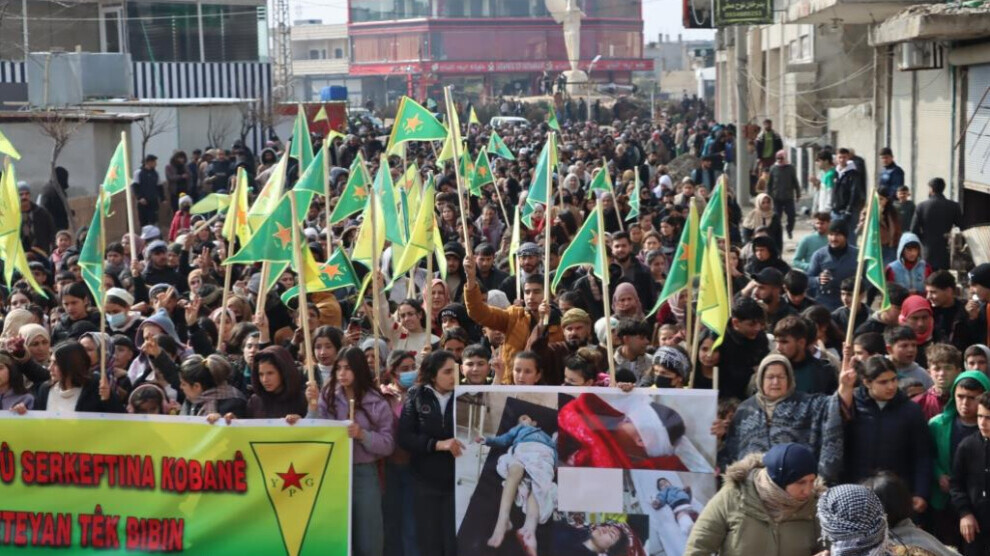
Cross-border women’s solidarity has become a tangible reality, as evidenced by women’s solidarity with Gaza, Yemen, Libya, and today with Kurdish women in Rojava.
RAJA HAMID RASHID
Iraq – Iraqi women activists and media professionals have affirmed their solidarity with Kurdish women amid the siege and the consequences of ongoing attacks.
Supporting Kurdish women and conveying their suffering and resistance to local and international public opinion has grown significantly within the framework of cross-border feminist solidarity that supports women everywhere in their legitimate struggles. Iraqi journalist and activist Brayan Ahmed Zardasht emphasized this point. She joined a group of volunteers from various scientific and cultural fields and visited North and East Syria, specifically the city of Hasakah, where she witnessed firsthand that what the Kurdish people are experiencing today is a struggle to attain their rights in the face of major international powers opposing them.
She explained that civilians in North and East Syria are subjected to systematic injustice and direct targeting, noting that the primary reason for this lies in the fundamental difference between their philosophy of life and that of dominant powers and the global capitalist system. She stressed that this people is demanding nothing more than its right to survive and live with dignity.
She further noted that the current conditions of siege, conflict, and an uncertain future have had a compounded impact on women, who bear the greatest burden during wars. Their suffering is exacerbated by harsh weather conditions and extreme cold, in addition to the hardships faced by Syrian families due to the blockade imposed on Rojava regions.
“An Existential Struggle Between Life and Death”
Brayan Ahmed Zardasht called on women of the region to stand in solidarity with the Kurdish people in general, and Kurdish women in particular, affirming that Kurdish women have played a pivotal role in defending the dignity of women and the peoples of the region. She stressed that the time has come to return this commitment through support and solidarity from all components of society.
She pointed out that Kurdish regions in North and East Syria are living under a suffocating siege, explaining that the city of Kobani is currently suffering from water cuts and interruptions in internet services.
She emphasized the necessity of conveying the voice of the Kurdish people to the international community, stating that what is taking place constitutes an unjust war waged by multiple forces against a single component whose sole aim is survival. She described the situation as an existential struggle between life and death, insisting that the world must be informed of the reality faced by these regions.
She also stressed that support from other peoples and communities has become essential, even if only through online campaigns, hashtags, social media posts, or speaking a word of truth. “It is necessary for these forces—who bear primary responsibility for the suffering of the people today—to realize that the people of this land, its women, youth, and children, are deeply rooted in their land and will remain steadfast and resilient.”
Brayan Ahmed Zardasht concluded by stating that resolving these crises has become an urgent necessity that cannot be postponed, and that they must be addressed through political and diplomatic dialogue rather than the continuation of violence and the compulsion for everyone to take up arms.
Women Are the Foundation of Justice and Peace
For her part, Maryam Al-Fartousi, a women’s rights activist and head of the Al-Yass Organization for Women and Family, affirmed that women pay the highest price in wars and conflicts through violence, displacement, poverty, and the absence of safety. She noted that women face a harsh reality in which responsibilities multiply under increasingly difficult conditions.
She explained that Kurdish women in Syria continue to suffer from the repercussions of war, despite their prominent role in protecting the family and society, preserving identity, dignity, and resistance.
She stressed the importance of women’s solidarity across borders, emphasizing that women supporting one another and ensuring that women’s rights are a core component of any political or humanitarian solution represent a crucial step toward achieving justice and peace.
Maryam Al-Fartousi called on the international community to assume its responsibilities in protecting women, holding perpetrators of violations accountable, and guaranteeing women’s participation in peace processes, rather than limiting action to symbolic positions.
She concluded by affirming her full solidarity with women in conflict zones, stressing that the struggle is one, and that achieving justice and peace cannot be realized without the active participation of women