
The Middle East Between Two Projects: "Peace and Democratic Society" and "The Abraham Accords"
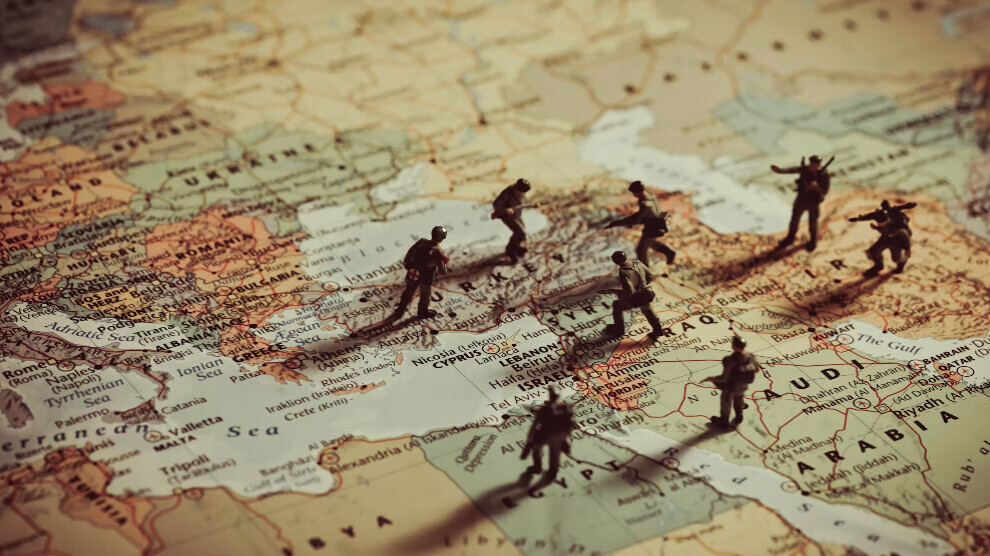
The Middle East faces two projects: the first by leader Abdullah Öcalan, and the second by Israel. What are these two projects, and what would be the repercussions of their implementation on the region and its peoples?
Journalist Sanaa Al-Ali
The Peace and Democratic Society project announced by leader Abdullah Öcalan examines the foundations of authoritarianism, proceeding from the premise that understanding the essence of the problem is the easiest path to its solution. In contrast, the Abraham Accords promoted by "Israel" care neither about the essence of the issue nor even the interests of the region's peoples. Its sole concern is the establishment of the "Greater State of Israel," achieved by turning the hostile environment into a friendly one.
The Middle East is faced with two projects, with no third option for now. This is not a prediction, but a reality that must be addressed. Israel is pressing to implement normalization as quickly as possible, regardless of the methods used. To achieve this goal, it has no problem toppling regimes and appointing alternative ones in their place to secure acceptance of its terms. Easy normalization with these authorities comes at the expense of the peoples, especially the indigenous peoples unjustly labeled as minorities, pushing towards committing massacres against them to ensure their alignment and facilitate division.
Whoever Makes Concessions Loses Legitimacy
Since the Nakba in 1948 and the establishment of the State of Israel, until a few years ago, Israel as an occupying state was the common enemy of all the region's peoples. Arabs and Muslims worldwide, and Christians of the Middle East, adopted the cause of Palestine, perhaps more than the Palestinians themselves. It became the focal point of resistance.
The Arab regimes, despite their dominance and authoritarianism, could not publicly change their anti-Israel rhetoric, despite secret agreements, because "normalization is treason and causes regimes to lose their legitimacy." But the first to dare break this rule was Anwar Sadat, the President of Egypt, by signing the Camp David Accords in 1978, which shocked the Arab street and led to his assassination in 1981.
Although Sadat lost his life for accepting normalization, his peace initiative with Israel encouraged the Palestine Liberation Organization itself to later seek the Oslo Accords in 1993. These, too, sparked Arab and Palestinian anger and were dubbed the "Accords of Shame" due to the level of concessions made by the Palestinian side by recognizing Israel over 78% of the country's area, meaning recognition of the 1967 borders, not the 1948 war borders.
Achieving the Goal Began with Replacing Regimes
The scenes of killing in Palestine and the violations by Israeli forces since the Nakba (1948) until the recent months of 2010, especially during the Palestinian popular uprisings, stirred Arab, Islamic, and international public opinion, but did not change the reality of the Israeli presence.
The Israeli side has a methodology known to those who follow its policies. Thus, it grew weary of this Arab-Islamic hatred and cleverly worked to redirect this Arab and Muslim anger away from Israel and towards the peoples themselves. Israel, along with America, planned the "New Middle East" project, which transformed the conflict from Arab-Israeli to Arab-Arab, or a conflict of authority versus people, oppression versus freedom, by hijacking the revolutions and implementing the "New Middle East Project."
The "New Middle East" is a strategic political project based on redrawing the geopolitical map of the region and modifying borders by overthrowing regimes. This also entails changing alliances and centers of influence to align with the interests of Israel, America, Britain, and other international powers. The aim is for "Israel" to be preeminent not only militarily but also politically and economically in the region, after its rejection by the region ends, becoming a pivotal actor in the new regional order. The easiest method is to follow a "divide and rule" policy, thereby dividing countries into small states by igniting sectarian war, exploiting the significant diversity in the region's social fabric.
The project was announced by former US Secretary of State Condoleezza Rice in 2006, but its implementation began much earlier. In fact, since 1998, all plans changed for the dominant powers, which pushed the Turkish state to arrest leader Abdullah Öcalan after pressuring the Syrian regime to expel him from the country, paving the way for his arrest in the autumn of 1999, thus removing the threat his project posed to the "Greater Israel" project.
The major events following Öcalan's arrest confirm that the plan began implementation: the bombing of the World Trade Center towers in New York and the subsequent changes across the region, the invasion of Iraq, the besieging of the former Syrian regime, and the earlier direct occupation of Afghanistan by US forces under the pretext of fighting the Taliban (whose existence America itself had supported to fight the Soviets). Likewise, pressure was applied towards the partition of Sudan on an ethnic basis, and work is underway today to also divide the northern part. All countries in the region, according to plans leaked via WikiLeaks and others, will face division.
Officials in America and the Mossad do not hide their role through numerous statements and occasional leaks. According to these, the godfather of change is America, which is under pressure from powerful Jewish economic lobbies, the hidden player is "Israel," and the tool so far, as the region witnesses, is "Political Islam" with its fundamentalist and Muslim Brotherhood branches. The West and Israel allied with Political Islam because it is the most organized and capable of implementing the scheme with minimal support, benefiting from the environment hospitable to this ideology that seeks to Islamize everyone, even if it requires their extermination, starting from the woman's body and its covering, considered the "cause of all the calamities that befell the nation." This opens wide the file of education, as curricula teach the foundations of fundamentalism to children, accepted by all regimes in the region, and support Quranic study circles in mosques funded by Qatar.
Political Islam achieves what the dominant powers in the region cannot accomplish on their own. This is what these powers realized early on, so the alliance of "the strongman, the priest, and the youth" began, in a new form in our era, but this time not only against women, but to fragment any cause of the peoples. This justifies the unlimited funding for these groups since the first day of the revolutions, the introduction of weapons and internationally prohibited arms to jihadist groups, and the support of Arab media channels to wage sectarian and inciting discourse. This support is not only to topple regimes but also to distort the revolution and bring it to a point of no return.
Western powers, Turkey, and Israel do not support leftist movements naturally due to the hostility between "socialism and capitalism." But they also do not support liberal or secular feminism as much as they support Political Islam groups. There are resources to be exploited, and national movements would not allow the theft of the people's wealth after a successful revolution. And whoever arrested a president from his bed for the sake of oil will not let this wealth slip away in countries where the ruler sells the homeland for the presidential chair. This is what happened in Libya: liberal movements actually won the elections, but the results were annulled due to the intervention of religious groups, leading to ongoing conflict that has brought Libya to the brink of division.
Syria... A Story of Announced Death
The regime of Ahmed Al-Sharaa (Al-Jolani) paid the first installment of the price of power: removing the Golan from the Syrian map. It has begun delivering the second installment of Syrian lands to Turkey. No one knows the extent of the concessions the interim government has made to play a role at this stage because the survival of a jihadist authority in Syria for further years cannot be suitable for its neighbors. When the concessions run out, we might witness a sudden coup in the presidential palace.
The plan for the complete division of Syria began to crystallize on January 6, 2026, when attacks started on the Kurdish areas in Aleppo city, then on areas in North and East Syria. This is the third installment, and perhaps not the last. All the massacres happening against Syrian components are driven so that the latter raise their voice demanding independence, as happened in Suwayda. And when the people are preoccupied with massacres, high costs, and rising prices, they will not remain as attached to the land; they will forget the Golan and who sold it, just as many forgot the Hatay Province (IsKenderun Sanjak), and the media will no longer dare to mention Aleppo as a Syrian city from now on.
A Country Devoured by Sectarianism
Lebanon, like Syria, is characterized by its sectarian and religious diversity, which has affected the life of the family, the nucleus of society. The problems of laws that change according to a person's sect, instead of following a civil system, have not been addressed. The sectarian quota system entrenched the division of power based on sectarian affiliation rather than competence, causing resentment among the Lebanese populace towards their system. At the same time, it faces a policy of dissolution; part of it (the Sunni majority) might return to Syria under the propaganda of pursuing the remnants of the former regime. Attacks on the borders with neighboring Lebanon have not subsided since the change of the Syrian regime on December 8, 2024, fulfilling Ahmed Al-Sharaa's (Al-Jolani) alleged pledge, according to some media leaks, to America to fight Hezbollah in Lebanon and the Popular Mobilization Forces in Iraq, thus igniting an open Sunni-Shia war. This situation is similar to what Iraq is experiencing, and there is no need to elaborate. There is also a plan to resettle the people of Gaza in Jordan.
After the October 7 war, comprehensive change began according to an Israeli report deliberately leaked after the 2006 war, confirming that what the Palestinian and Lebanese arenas are witnessing is nothing but a comprehensive military-political plan developed in cooperation with America, with Arab participation and European approval. Its clauses include the partition of Lebanon and igniting wars in the region.
The Democratic Nation Project
As for the Democratic Nation project, which laid the foundation for the "Peace and Democratic Society" proposal by the Kurdish philosopher Abdullah Öcalan (due to which he has been imprisoned for over 26 years on İmralı Island in Turkey), it is generally based on shared coexistence among all sects, nationalities, components, and ethnicities in one homeland, away from the complex of borders and geography.
He concluded that division or creating a homeland for each component is illogical and unattainable due to the intermingling of components within the same city and neighborhood, intermarriage, kinship, and other ties binding everyone together. Considering that diversity is the essence of life, the isolation of each nationality, sect, or component makes no sense. The project is also based on true and complete equality between the sexes, considering that woman is first and foremost a human being, not an extension of man or a second sex, as the French philosopher Simone de Beauvoir stated. This equality includes not only rights but also duties. The project relies on the principle of self-defense for these peoples, meaning independence from external guardianship, and practicing politics as the art of managing society, not as defined in political science books as the "art of managing lies and deception."
It advocates for a cooperative, non-profit community economy to meet society's needs, get rid of the slavery of imports, and oppose monopoly. Philosopher Abdullah Öcalan called for anarchism and considered the environment a fundamental basis of democratic society, drawing parallels between the concept of woman and the concept of nature; rethinking these two issues with a rebellious mindset, blowing up traditional visions of them. This project saves Turkey from the division scheme sought by the Western project.
Why is the Democratic Nation Project Thwarted Every Time?
Despite all these positive aspects the project holds for society and the state, numerous challenges repeatedly undermine it. The Democratic Nation project and its resulting "Peace and Democratic Society" proposal, recently aimed at initiating serious dialogue with the Turkish state regarding the Kurdish issue, faces the primary challenge of lacking political cover. It relies entirely on popular support and the support of some intellectuals and human rights advocates around the world.
However, at this critical juncture in the region's history, even relying on popular support is difficult for several reasons, most notably the decline in societal awareness as a result of successive crises, primarily the deterioration of education levels and economic crises that push people to search for a livelihood rather than a cause, displacement, and lack of security. A clear example is what happened in the Autonomous Administration of North and East Syria. When this project was on the verge of achievement, it collapsed in large parts and receded to Kurdish-majority areas because not all components of the region believed in it. The Arab media strongly pushed in this direction, and this retreat was accompanied by a rise in Arab nationalist rhetoric against the Kurdish presence.
The Ethical Question
Here, the question arises: between the project of Peace and Democratic Society and the Abraham Accords, what will the peoples of the region choose? That is, if they possess the right to choose, or whether external agendas are ready for implementation regardless of free will.
Here, it must be said that knowledge is important to choose the better project. This knowledge comes from delving into both projects and asking the most important question: if the Peace and Democratic Society project is implemented, what will the people gain or lose? Likewise, what are the repercussions of the Abraham Accords on the peoples? We leave the answer to you, but...