
The Destruction of the Woman’s Statue in Raqqa: An Attempt to Turn Back the Clock to the Era of ISIS
The escalating attacks on women’s symbols in Raqqa and Tabqa are seen as a dangerous indicator of a growing anti-women discourse seeking to reproduce an exclusionary mindset that undermines the gains achieved after the defeat of ISIS.
Asmaa Mohammed
Qamishlo – The destruction of the woman’s statue in the cities of Raqqa and Tabqa was not an isolated incident that could merely be classified as individual vandalism or an attack on public property. According to observers, it came within a broader context linked to the political and social transformations taking place in the region and to attempts to redraw the symbolic landscape that was formed after the defeat of ISIS.
The statues erected after liberation were not merely artistic sculptures; they embodied a pivotal historical phase in which women moved from the position of victim to that of actor and partner in decision-making. These symbols became tied to a collective memory documenting women’s participation in fighting ISIS, in administering liberated areas, and in building a governance model based on partnership and equality.
The Kurdish Woman as One of the Most Prominent Symbols of That Period
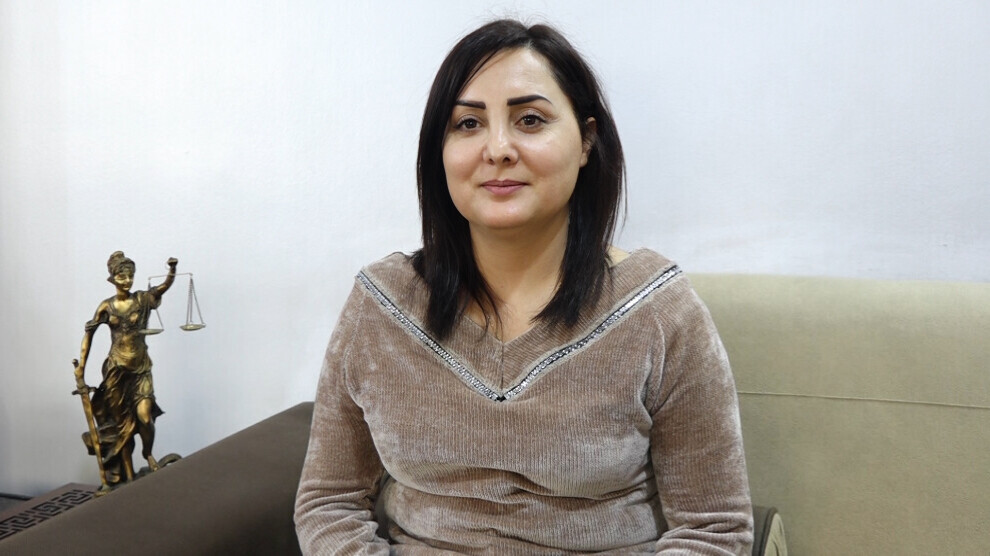
In this context, Ronahi Hassan, spokesperson for the Committee of Relations and Political Agreements of Kongra Star, stated that targeting the woman’s statue cannot be separated from the rise of anti-women rhetoric aimed at undermining the achievements made in the years following ISIS’s defeat.
She explained that “the communities of North and East Syria went through extremely harsh experiences during ISIS’s control, when women were subjected to killings, enslavement, sexual slavery, and mutilation of bodies in blatant violation of all human values. Despite their brutality, these crimes failed to break women’s will; instead, they pushed them to organize themselves and engage in major resistance that ultimately led to the liberation of vast geographical areas.”
She added that Kurdish women in particular became “one of the most prominent titles of that phase” after taking up arms to fight ISIS and contributing to the liberation of cities and towns previously known as its main strongholds. “This experience changed the stereotypical image of women in the region and established their presence as an active social, political, and military force.”
Severing the Link with the History of Women’s Struggle
Accordingly, the destruction of symbols associated with that period represents “an attempt to sever the connection between new generations and the history of women’s struggle,” she emphasized. The symbolism carried by the statue “goes beyond the artistic dimension to express a profound transformation in the structure of society, after women became essential partners in administration and decision-making, rather than mere followers confined to the private sphere.”
The marginalization of women’s roles in the current phase—whether in political appointments or in discussions related to drafting the constitution—reflects, according to Ronahi Hassan, “a worrying trend toward reproducing exclusionary patterns that contradict the transformations the region has witnessed in recent years.” She stressed that “any constitutional process that does not guarantee effective participation of women effectively means ignoring the needs of half of society,” given that women are best positioned to express their own issues and rights.
Gains Are Not Temporary Achievements
Contrary to claims that the women’s revolution in North and East Syria has begun to decline, Ronahi Hassan believes that the gains achieved over fourteen years were not temporary or narrowly local accomplishments, but rather “the result of a long trajectory of political, social, and military struggle that helped redefine women’s position within Syrian society as a whole.” She noted that targeting symbols associated with women activists—whether military, political, or civil—falls within the framework of “an attempt to weaken their symbolic presence as a prelude to weakening their actual presence.”
She considered that the message some actors seek to convey through these practices is based on “diminishing women’s roles and confining them to traditional positions.” However, the women’s experience in the region “has proven that women who confronted the most dangerous extremist organization of the modern era will not retreat in the face of symbolic attempts to erase their history.”
Women in North and East Syria, she affirmed, “will not allow their gains to be undermined and will continue to defend them as part of their dignity and political and social identity.” She stressed that what has been achieved is not a gain for women of one particular region or ethnicity, but an experience that can serve as common ground for all Syrian women striving for freedom and equal participation.
Ronahi Hassan concluded by emphasizing that protecting these achievements is a collective responsibility. She called on women’s organizations, human rights organizations, and entities concerned with women’s issues to take clear positions to ensure the continuity of what has been achieved. “Preserving the struggle memory of women is an integral part of safeguarding the future of a democratic Syria.”