
The Bell of Civil War Tolls in the Middle East
Can external military and economic interventions by dominant powers destabilize Middle Eastern countries, triggering widespread unrest and potentially escalating into severe internal conflicts and prolonged instability?
Afrîn Navdar
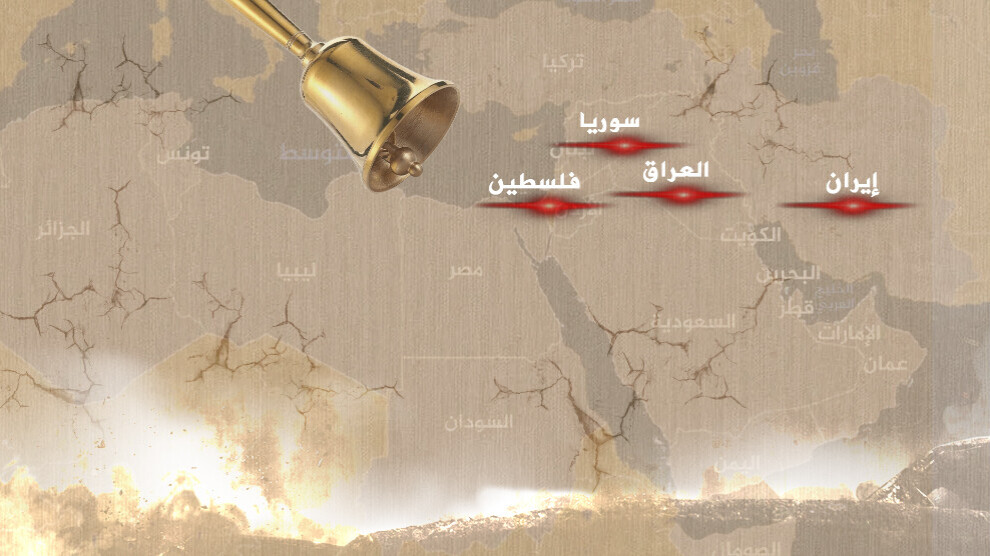
Center News — The Middle East is experiencing an unprecedented phase of tension, where local conflicts intersect with regional and international interventions, raising questions about the possibility of the region sliding into broader unrest that could reach the level of civil war. The events in Palestine, Sudan, Yemen, and Syria are no longer isolated but have become links in a chain of conflicts extending from the Eastern Mediterranean to the Red Sea and the Gulf.
In a regional landscape where fronts overlap and interests intertwine, the conflicts in Palestine, Sudan, Yemen, and Syria are no longer events isolated from their surroundings. Instead, they have transformed into links in a broader chain of tension stretching from the Eastern Mediterranean to the Red Sea and the Gulf. The ongoing war between the Hamas movement and Israel, the military and political division in Sudan, the continuation of the complex conflict in Yemen, the attempt to legitimize the jihadist mentality in Syria, alongside the Israeli-American attacks today against Iran, and the targeting of Hezbollah positions in Lebanon and the Popular Mobilization Forces in Iraq, emerge as key elements in drawing a new map of regional influence. As the arena of confrontation expands, concern grows that these fronts could transform into a comprehensive conflict.
While military operations and mutual strikes escalate between the conflicting parties (Israeli-American against Iran), anxiety increases that these fronts could turn into a wider engagement arena. Its repercussions may not be limited to external confrontations alone but could extend to the Iranian and Iraqi interiors, given the fragility of political, economic, military, and social balances. Thus, the region appears to face a complex equation: local conflicts with international dimensions, cross-border alliances, and possibilities open to further escalation or a redrawing of the map of regional influence.
Iran Between Economic Pressures and Social Transformations
Internally, Iran faces a cluster of accumulated crises that constitute a decisive factor in its political and social stability. What further complicates the Iranian scene is the economic imbalance suffered by the Iranian interior: high inflation and a decline in production, high unemployment, especially among the youth, vital sectors affected by international sanctions, and the collapse of the Iranian currency.
These crises are not born of the moment but are the result of a long interaction between external sanctions and internal imbalances. As the confrontation between Iran and external powers escalates, the question remains about the ability of the Iranian economy to withstand as the scope of military confrontation widens.
In Iran, the "Woman, Life, Freedom" uprising was not merely a transient protest but was a popular renaissance against the Iranian authorities that marginalize women and society. This uprising, led by women, weakened the regime's grip and clearly revealed an overwhelming popular will seeking genuine and radical democratic transformation. From the perspective of democratic modernity, the popular movement elevated itself to a more organized and conscious level, expressing a profound rejection of the structure of the prevailing system in Iran.
These uprisings also re-raised questions about freedom, justice, and democracy. The most appropriate answer that the Iranian people resorted to was to live according to the philosophy of "Woman, Life, Freedom."
In the midst of deep internal crises and the ongoing conflict in Iran, the Iranian people remain the pivotal player in choosing their future. Here, choices arise between resistance and struggle to build an alternative system that accommodates the demands of the people, especially women, within a democratic framework, which will be the decisive factor in charting Iran's course internally and externally.
Stability, or sliding towards broader unrest, depends not only on the movements of the political elite or regional conflicts but on the ability of the Iranian people to impose their will and demand their livelihood and social rights. In the end, the people's choice is the most influential factor in the equation: either to lead to genuine reform, or to internal escalation that multiplies the fragility of the situation and increases regional risks.
Iraq Between Internal Fragility and Regional War Escalation
At a time when Israeli-American attacks against Iran are escalating, Iraq and the Kurdistan Region become a sensitive arena where regional interests intersect with internal balances. The country, suffering from an accumulation of political, economic, and social crises, stands on the brink of increasing fragility, where any external spark could turn into an internal explosion.
The sectarian division between Shiites and Sunnis, along with the conflict between competing political forces, forms fertile ground for fueling conflicts. In this context, any escalation in Iranian-Israeli attacks or American responses linked to the alliance with Israel could quickly turn into confrontations on the ground, with armed factions like the Popular Mobilization Forces being exploited as tools in a larger conflict. This could lead to a potential explosion in major cities such as Baghdad and Karbala, extending to the border areas.
Today, Iraq has become a living laboratory for the repercussions of the confrontation between Iran and Israel, where regional conflict meets internal fragility. If the Iraqi people are unaware of this scenario and a popular stance does not emerge, the possibility of disagreements between the dominant powers transforming into a (sectarian) civil war could become one of the greatest risks threatening the region.
The Scenario of Mobilizing ISIS: A Double Threat to Iraq and the Entire Middle East
With the escalation of Israeli-American attacks against Iran, another danger emerges: the possibility of exploiting terrorism. ISIS elements, who were transferred from prisons run by the Syrian Democratic Forces under an international plan, could exploit security vacuums and internal divisions.
In this scenario, ISIS might exploit any regional preoccupation or internal weakness to regain its influence in western and central Iraq. The military escalation against Iran, the killing of its Supreme Leader, and the attempt to spread wars in the Middle East could grant ISIS an opportunity to move unhindered, whether to launch direct attacks on civilians or to recapture strategic locations.
In this case, Iraq would not merely be an arena for confrontation between Iran and Israel, but would become a laboratory for a double explosion combining regional intervention and the return of terrorist groups, threatening the stability of the entire Middle East, especially Syria, which forms a continuous link for ISIS due to the affiliation of its authority to the same jihadist-Salafist mentality.
This scenario recalls the danger of repeating the genocide suffered by the Yazidi people in 2014, making the region's peoples most vulnerable to violence.
The Project of Peace and Democratic Society: An Alternative Vision for the Future of the Region
In a region battered by continuous conflict, from the Iranian-Israeli-American tension to the internal divisions in Iraq, Yemen, Palestine, and Sudan, facing this intricate scene, the project of leader Abdullah Öcalan, "Peace and Democratic Society," emerges as one of the options capable of offering a different approach to the conflicts in the Middle East. The project is based on building a participatory democratic society that addresses the roots of sectarian, denominational, social, and economic crises managed by international plans, and gives a central role to peoples in determining their own destiny.
In the second phase of his project, known as the "Democratic Integration Phase," leader Abdullah Öcalan focuses on the necessity of political dialogue and rejecting reliance on external interventions that often increase divisions. The project is considered an effective strategic tool to redraw the map of the Middle East based on active popular participation, social justice, and recognition of national and cultural diversity.
This project not only offers a theoretical solution but also forms a strategic framework to address internal and external conflicts, paving the way for sustainable peace in the region.