
Sudanese Women Between Displacement, Hunger, and Violence…One thousand Days of Ongoing tragedy.
After 1,000 days of conflict between the Sudanese army and the RSF, women continue to suffer severe violations, including sexual violence, repeated displacement, loss of breadwinners, and arbitrary detention.
Mirvat Abdel Qader
Sudan — Over one thousand days of conflict between the army and the Rapid Support Forces, Sudanese women have lived through painful stories that reflect the scale of the humanitarian catastrophe. They have endured repeated displacement, loss of providers, hunger, and grave violations, most notably sexual violence and detention, making Sudanese women the primary victims of a conflict whose devastating effects on society have not ceased.
One thousand days after the conflict erupted on April 15, Sudanese women continue to bear the greatest burden. With each passing day, their suffering deepens as they face various forms of abuse, including sexual violence, abduction, enslavement, and trafficking, amid the absence of protective laws and a lack of societal empathy. Women also endure the harsh realities of displacement and the loss of breadwinners, while carrying the burden of raising children in wartime conditions. Despite their suffering, society often views them as guilty rather than as victims, ignoring the pain they endure and the cruelty imposed upon them by reality.
Heartbreaking stories weigh heavily on the soul and bring tears to the eyes. Lives are stripped of the most basic means of survival. Through repeated displacement and exhausting journeys, Sudanese women have endured the harshest experiences during the conflict. They walk for days on foot, carrying their children on their backs, without belongings, water, or food, bearing immense patience while pain consumes them and fear of the unknown constantly follows them—journeys that resemble nothing but a brutal test of humanity and endurance.
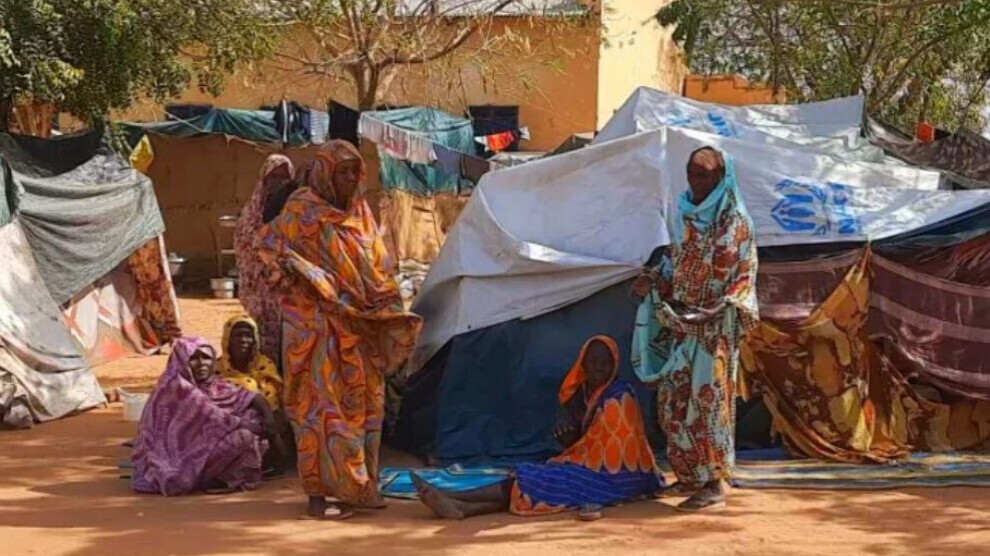
Displacement journeys repeatedly afflict Sudanese women. Every area reached by the Rapid Support Forces becomes uninhabitable, forcing women to flee again in search of safety for themselves and their children. In one displacement camp in El Obeid city, North Kordofan State in western Sudan, our agency’s camera documented part of the situation of displaced women on the city’s outskirts. In a semi-desert area, simple tents were erected to shelter those fleeing the horrors of the Darfur conflict, standing as silent witnesses to the cruelty of displacement and the suffering of women burdened with survival in conditions nearly devoid of life’s essentials.
Hunger and Injury
Zeinab Malik, a displaced woman from El Fasher in western Sudan, found herself facing an unbearable reality as famine swept the city and the siege on civilians tightened. With no other option, she fled, eventually settling in shelter centers in El Obeid.
Zeinab recounts her harrowing five-day journey on foot, carrying her infant on her shoulder while accompanying her other children, with no food to sustain them or ease the hardship of the road. She says:
“This was not just a move from one place to another; it was a bitter test of patience and willpower in the face of hunger, fear, and the unknown. I was shot while fleeing; the bullet lodged in my leg, leaving me with limited mobility. I had to send my children to ask for help from city residents so I could provide food for them, especially with my husband absent for a long time without any contact.”
She confirmed that the bullet remains lodged in her leg to this day, as she cannot afford hospital treatment or surgery to remove it, amid ongoing suffering.
A Journey of Displacement Between Loss and Hope
In Port Sudan, eastern Sudan, amid the challenges of displacement camps, Nesma Mohammed—originally from El Fasher—endured a long series of displacement journeys across Sudan before finally settling in Port Sudan. She says the Rapid Support Forces killed her husband and father, forcing her to flee with her children and mother in search of survival. However, her mother could not withstand the harsh journey, hunger, and thirst, and passed away during the displacement journey from El Fasher.
Despite the pain and loss, Nesma continued her arduous journey without water or food, moving between camps in Northern State, then Atbara in River Nile State, and finally to Port Sudan, where she now attempts to start a new life under harsh displacement conditions.
With a voice heavy with sorrow, she confirmed that forces committed violations against civilians, stating that she lost her entire family and everything she owned, leaving her with nothing but her children.
“I wish the war would end and that we could return to our homes, which now hold only faint memories—memories that recall the faces of our loved ones taken by the war and stand as witnesses to the cruelty of loss and exile.”
Zeinab and Nesma represent millions of Sudanese women who have suffered immense hardship, lost everything they owned, and have nothing left but hope for the end of this prolonged conflict and the recovery of what remains of their memories.
Hunger and Sexual Violence
Hunger and sexual violence have been among the most severe hardships faced by women during one thousand days of conflict. Sexual violence has been used as a weapon of forced displacement, compelling families to flee their homes to protect their women. The Rapid Support Forces have practiced sexual violence against women as a means of revenge and punishment, making women the primary targets whenever these forces enter any area. Numerous videos have surfaced showing RSF leaders encouraging their fighters to target women as a method to subjugate and control regions.
UN Women previously warned that women face the risk of sexual violence while searching for food. In a recent statement, the agency confirmed that women are enduring sexual violence and bearing the brunt of Sudan’s humanitarian crisis, noting that most female-headed households lack sufficient food.
UN Women highlighted that households headed by women are three times more likely to face food insecurity, emphasizing that hunger in Sudan is increasingly gendered, as gender inequality continues to worsen due to the conflict.
Estimates indicate that more than 21 million people are currently suffering from acute food insecurity across Sudan, most of them women and children. The United Nations reports that approximately 34 million people—50 percent of whom are children—are in need of humanitarian assistance.
Arbitrary Detention
For women in Sudan, safety does not merely mean distancing themselves from battle zones. Leaving areas controlled by one party to the conflict exposes them to new dangers, most notably arrest and long-term detention under accusations of collaborating with the opposing side—despite their presence in those areas being forced and involuntary.
After the fall of El Fasher to the Rapid Support Forces, hundreds of women and girls were detained in prisons on charges of collaborating with the Sudanese army, where they have been subjected to the most brutal forms of torture and abuse, reflecting the depth of the tragedy Sudanese women endure during this prolonged war.
In a recent statement, the Sudanese Women’s Initiative “No to the Oppression of Women” confirmed that the Rapid Support Forces are detaining approximately 600 women and girls in Nyala Prison in Darfur, some accompanied by their children, under extremely harsh humanitarian conditions marked by severe shortages of drinking water and food, lack of healthcare, and the absence of basic necessities.
Some detainees are also forced to perform labor outside the prison and face accusations such as “espionage” and “collaboration” without any fair legal procedures or trials, amid a complete absence of transparency and accountability.
Similarly, the women’s prison in Omdurman, controlled by the Sudanese army, holds hundreds of women and girls detained on charges of collaborating with the Rapid Support Forces simply for coming from areas previously under RSF control, without sufficient evidence. Despite the army commander announcing the release of many detainees following a prison visit, large numbers remain in detention under the same charges.
Thus, the suffering of Sudanese women continues as long as the war persists and violations go unpunished. Condemnations and rulings have failed to halt the bleeding, leaving Sudanese women to bear the greatest cost of this ongoing humanitarian tragedy.