
Star Congress moves to restructure its diplomatic work and enhance women's presence in Syria
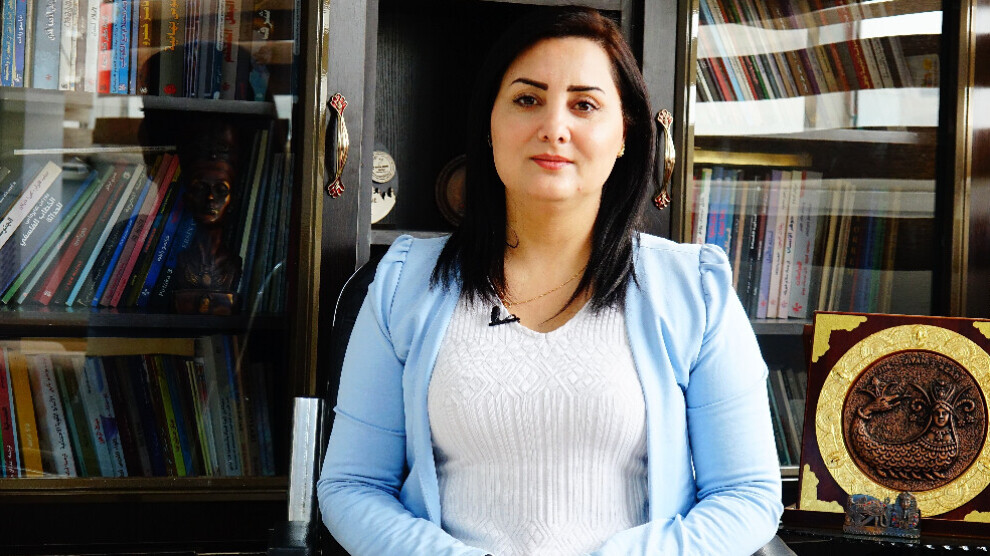
Star Congress Diplomatic Relations Committee spokesperson Ronahi Hassan said drafting Syria's constitution, advancing women's issues, and combating political and diplomatic violence are the main axes it will adopt next phase.
SORKIL SHEIKHO
QAMISHLO — The year 2026 was full of wars and crises that cast their shadows over Kurdistan, the Middle East, and the world, producing deep humanitarian, cultural, economic, political, and social repercussions that were reflected more dangerously on women's lives, rights, and gains.
Amid escalating attacks and worsening crises, the resistance of Rojava women against the attacks of jihadists linked to Hay'at Tahrir al-Sham stood out as a remarkable struggle station whose echo transcended the region's borders and re-shed light on women's role in defending their will and gains.
In this context, the spokesperson for the Committee of Democratic Political Relations and Agreements of the Star Congress, Ronahi Hassan, reviewed for our agency the outcome of the diplomatic work and efforts made by the Congress during the current year, the challenges it faced, and the features and priorities of the coming phase.
Documenting violations and crimes committed against women
Ronahi Hassan explained that building democratic relations and alliances with local, Kurdish, Middle Eastern, and international communities is among the basic objectives of their work, affirming that diplomacy constituted an important tool for protecting women's gains and enhancing women's solidarity, especially under war.
She said: "We sought to build bridges of solidarity and establish solid relations between the women's revolution in Rojava and women in the region, Kurdistan, the Middle East, and the world, as diplomacy played a defensive role in protecting this experience and its gains."
She added: "Our work was linked to political developments in the country, and with the start of attacks on the areas of northern and eastern Syria and their extension to Rojava, we worked to document the violations and crimes committed against women and to convey their truth to international legal institutions," affirming that their goal was to exert pressure on the interim government to ensure the protection of women's gains in Rojava and transform them into rights and guarantees for all Syrian women.
The women's delegation to Europe carried demands to protect women's gains
In the context of external diplomatic movements, Ronahi Hassan pointed to a visit by a women's delegation from Rojava, comprising Kurdish, Arab, Syriac, and Armenian women, to Germany, Belgium, Sweden, and France, with the aim of defending women's rights and gains and ensuring their participation in building the new Syria.
She explained that the delegation held meetings with parliaments and women's organizations, during which it discussed the need to protect women's gains and recognize their political will, noting that guaranteeing the Women's Protection Units (YPJ), maintaining the co-presidency system, and the continuation of the Internal Security Forces – Women, were among the most prominent files raised.
She added that they launched solidarity campaigns to support these demands. "Although the results did not rise to the level of our aspirations, some of our demands achieved tangible results, which confirms the importance of continuing and expanding diplomatic work."
International women's solidarity with Rojava and support for its experience
Regarding international solidarity with Rojava women, Ronahi Hassan noted that the region witnessed multiple visits by women's delegations representing institutions, bodies, and women's movements, which came to express their support for the women's experience and back its efforts to protect the system it established.
She pointed out that this solidarity was not limited to international delegations but also included women's delegations from parts of Kurdistan, which were keen to stand by Rojava women and convey their voices and demands to the relevant institutions and bodies. "The self-administration experience in the Middle East represents a pioneering and unique experience, and has become a source of hope for multiple peoples and societies, because it presented a different model in organizing society and enhancing women's role and participation in managing its affairs."
Two women's conferences drawing the features of participation in the new Syria
Within the framework of her assessment of political and organizational activities during the current year, Ronahi Hassan revealed the holding of two important conferences with the participation of women's organizations and movements from Rojava and the Middle East, alongside Syrian women figures who participated in person or via Zoom.
She affirmed that holding the two conferences came in response to the need to crystallize a common vision about the future of women in the new Syria, and to define mechanisms for their participation in building state institutions and shaping their political and legal future. "It was necessary to open a broad discussion about women's position in the new Syria, and how to ensure their actual participation in various fields, and that they not be merely an absent party from decisions that draw the country's future. The two conferences formed an important space for exchanging views and experiences."
Women of the coast and Sweida were not outside the circle of solidarity
Ronahi Hassan stressed that women's solidarity transcends geographical borders, based on the unity of women's issues and the need to support one another in confronting violations. In this context, she pointed to Rojava women standing by Alawite and Druze women who were subjected to violations and attacks by the interim government. "We view the women's issue as a single issue, and therefore we stood by Alawite and Druze women, because of the tragedies and grave violations they were subjected to."
She added that the violations included killing, abduction, and rape, affirming that Rojava women worked to convey the voices of the victims and their suffering to international institutions, supporting that with documents and evidence, alongside providing humanitarian assistance, launching solidarity campaigns, and organizing events to introduce what they were subjected to and convey their cause to public opinion and the relevant authorities.
Women's diplomacy opens new horizons for communication inside Syria
Ronahi Hassan touched on the transformations witnessed in women's relations inside Syria after the fall of the Baath regime, explaining that the previous regime's policies contributed to cutting channels of communication between them and Syrian women, but the recent political changes provided an opportunity to rebuild relations and establish new paths for joint work.
She said: "After the fall of the regime, we were able to reach women in the Syrian interior and open direct discussions with them about the new Syrian constitution, the need to guarantee women's political, legal, and rights, in addition to the importance of ensuring their participation in parliament, elections, and various decision-making institutions. In order to enhance our presence and expand our role in Syria, we opened a special office for us in the capital, Damascus, to be a center for work, communication, and developing relations with Syrian women."
Regarding women's communication at the Middle East level, she noted that political conditions and borders prevented holding a direct meeting during the current year, but they continued coordination and implementing joint activities via the internet, and exchanging demands and views. She also noted the role played by Kurds in the diaspora, through their solidarity and continuous support for Rojava and conveying its voice to the world.
The restructuring conference draws the strategy of the coming phase
Ronahi Hassan affirmed that the political changes witnessed in Rojava imposed a new reality on the nature of their diplomatic and organizational work, so "we are today heading toward holding our conference, which will constitute an important step in reorganizing our work and defining its future path."
She continued: "During the restructuring phase, we discussed all the axes and files related to our department, and the new strategy for the coming phase will be decided during the conference, based on an assessment of our reality, our needs, and the challenges we face."
She pointed out that their work is not limited to the capital. "We plan to open offices in other Syrian cities during the coming phase, which will allow us to expand our relations, develop our activities, and enhance communication with women in various regions."
Only 22 women out of 122 parliament members
Ronahi Hassan shed light on the forms of political and diplomatic violence facing Syrian women, considering that excluding women from decision-making centers and denying their will and political identity represent a clear face of the violence practiced against them.
She affirmed that the struggle against this type of violence will be among the most prominent axes of their work during the coming phase, especially in light of the large disparity in women's representation within governance and legislative institutions in Syria. "We are heading toward the day of struggle against violence practiced against women, in light of a Syrian reality witnessing wide and multiple forms of this violence, whether through exclusion, marginalization, or depriving women of their right to participate and make decisions."
She noted that "in the Syrian interim government there is only one woman within 23 ministries, while the number of women does not exceed 22 out of 122 parliament members. These figures clearly reveal the scale of disparity in representation, as the voice of 22 women remains of limited influence before the voices of hundreds of men, unless real guarantees are available that allow them actual and equal participation."
She stressed that they will continue the struggle to ensure women's presence in the new Syria. "We will not accept that the country's future and constitution be drafted away from women's will and participation. Rather, we affirm the need for women to be essential partners in drafting the constitution, and to reach a stage where women possess the ability to draft their constitution and express their rights and aspirations themselves."
She pointed out that the current phase requires building a strong women's unity and unifying ranks in the face of all forces and practices hostile to women, their rights, and their gains. "Our unity, solidarity, and extending our hands to one another are the source of our strength, and through them we can wage a broader and more influential struggle against the violence practiced against us, and wrest our status and role in building society and the state."