
Social Initiative for Peace: The Language of War Cannot Replace the Language of Peace
In response to the attacks on the cities of Rojava, 1,381 citizens from Northern Kurdistan and Turkey have called for an end to the targeting of the region, stressing that the language of war cannot replace the language of peace.
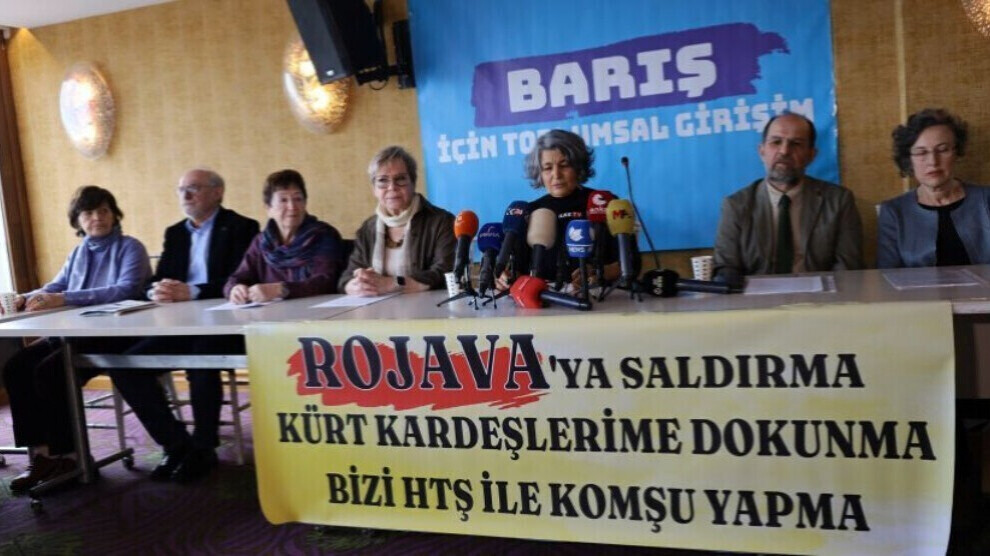
News Center — The attacks on Rojava have sparked a wide wave of international and popular reactions, including human rights campaigns, demonstrations in European and Arab cities, and protest letters sent to the United Nations and the European Union, amid warnings of escalating humanitarian disasters and mass displacement.
The Social Initiative for Peace announced that 1,381 people signed a statement condemning the attacks on Rojava. This was revealed during a press conference held by the initiative in Turkey, with broad participation from citizens and activists. During the event, a large banner was raised reading: “Do not attack Rojava, do not harm my Kurdish brothers and sisters,” in a clear call for solidarity.
The Social Initiative for Peace affirmed that Turkey’s continued support for jihadists of Hayat Tahrir al-Sham deepens the security crisis and further destabilizes the Middle East, with the backing of the United States and Israel. The initiative explained that these attacks threaten social diversity and push the region away from democracy and secularism, noting that ending this approach could open the way for Turkey to resolve its Kurdish and Alawite issues, move toward democracy, and break free from the cycle of war and conflict that has drained its resources for decades.
“They Have Posed No Security Threat to Turkey”
Writer Ayşe Goldevici Oğlu stated that Syrian Kurds have posed no security threat to Turkey throughout 13 years of self-administration, and that labeling them as an “existential threat” stems from insistence on denying them equal citizenship rights, both locally and internationally.
She emphasized that the Kurds, who are being targeted with genocide, represent resistance to attempts to plunge Syria and the Middle East into Salafi extremism. The current autonomous structure, achieved through liberating the region from ISIS, “should not allow anyone to forget the victims of ISIS in Turkey, beginning with the Suruç massacre and the deep trauma it left behind. Every wrong action reproduces historical trauma. Can we build a shared future on this basis? Can we build our future with the irresponsible language of hatred?”
“A Peaceful and Democratic Solution”
Speaking about the massacres taking place in Kurdish regions of Syria, she said: “Peace cannot be achieved through war. Peace cannot be built on broken, wounded, and oppressed hearts. We believe that equality in citizenship, living in one’s mother tongue, and local, non-centralized democracy are guarantees of peace and democracy in this country. We want to live with Kurds and others of different identities as free and equal citizens—not by moving away from democracy and the rule of law, but by implementing the conditions of democracy and the rule of law, under legal guarantees and with full transparency—toward a peaceful and democratic solution based on universal rights.