
Real Symbols Never Fade: Woman’s Statue Defies Erasure Attempts
Targeting the female fighter’s statue in Raqqa and Tabqa is not mere vandalism, but an assault on freedom’s symbolism and a struggle shaped by sacrifice.
Asmaa Mohammad
Qamishlo – In cities that emerged from the darkness of violence into the space of life, symbols are not born by chance; they are formed from an accumulation of pain and memory. Thus, the statue of the female fighter in Raqqa and Tabqa was more than a sculptural work.
The statue of the woman was a visual declaration of a historical phase in which concepts were overturned and women moved from a position of receiving to a position of action. Therefore, its destruction was not an act of random vandalism, but a directed assault on a social and cultural meaning that had taken shape through years of struggle, and on a collective memory that sought to build a different future.
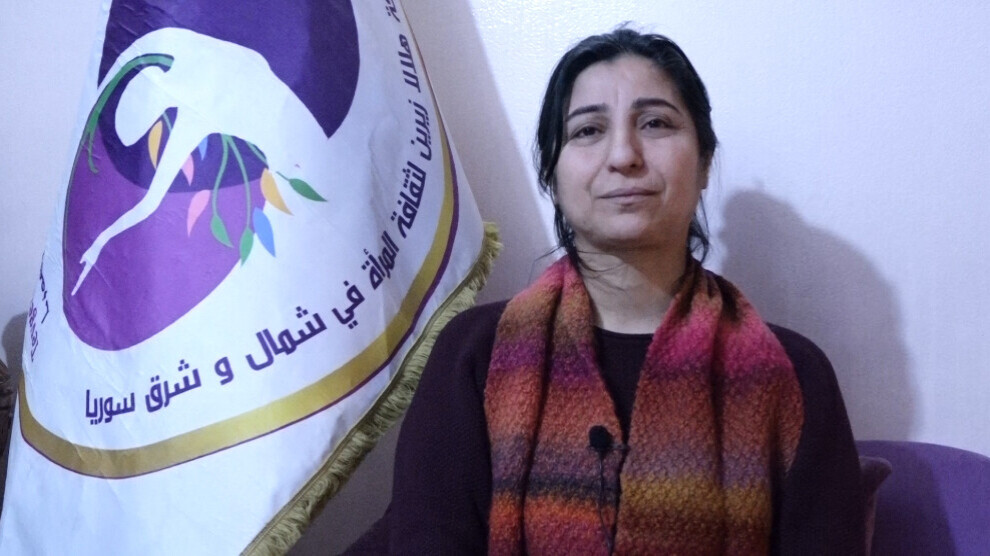
Shirin Rashid, a member of the coordination of the Golden Crescent in Rojava, confirmed that honoring the “martyrs in North and East Syria, and in Sheikh Maqsoud and Ashrafieh, through statues is not merely symbolic remembrance, but an affirmation that the major transformations the region witnessed did not come as a result of settlements, but were born of profound sacrifices.”
She explained that the Kurdish female fighter who became a symbol of struggle “was not only fighting a military organization, but confronting a deeply rooted intellectual system based on excluding women and denying their ability to think and make decisions.”
“The birth of a new social awareness”
The societies of Raqqa, Tabqa, and Deir ez-Zor, before the revolution, carried an almost fixed perception of women’s place, where their presence was confined to the home as the only socially acceptable sphere. As Shirin Rashid says, women’s emergence into the arenas of fighting and public work was not merely a shift in roles, but “a collapse of a conceptual system that had lasted for decades,” which made her statue a declaration of the birth of a new social awareness.
She believes that after 2011, with the establishment of the Autonomous Administration, women were given “spaces that had not previously been available,” and they began to work, write, participate in administration, community protection, culture, and art, and even bear arms in defense of their neighborhoods and children. “This transformation was not superficial; it redefined the relationship between society and women. They were no longer a subordinate entity, but a full partner in shaping destiny.”
She added that the liberation of the region from داعش “did not end the conflict, but transferred it from military confrontation to intellectual confrontation,” as women from conservative environments participated in cultural, theatrical, musical, and political work. This, as she describes it, created a “positive shock” that reshaped the collective consciousness and proved that freedom can coexist with social particularities without abolishing them.
The destruction of the statue carries a clear message: an attempt to “turn back time and erase the image of the active woman.” The forces that target the symbol realize that its presence in the public square تثبت the idea that women fight, lead, and think, and therefore they try to “remove the visual impact to weaken the moral one.”
What happened is essentially no different from the assaults that targeted the bodies of female fighters or their personal symbols. “These practices reflect a deep fear of the idea of the free woman. For that mentality, the statue is not stone, but a permanent declaration of breaking traditional patriarchal authority.”
Yet despite this act, the idea is not erased by removing its physical form, because “ideas do not reside in stone but in consciousness.” The seed of freedom planted through years of organization, training, and sacrifice cannot be uprooted; it has been watered by the blood of thousands of martyrs, and what is planted through historical experience becomes a collective memory that is impossible to erase.
Memory lives across generations
Shirin Rashid indicated that the coming phase may witness stronger attempts to pressure women due to the contradiction between the freedom they have experienced and what is intended to be imposed on them. “Whoever has experienced her ability to decide will not easily return to a position of silence. At its core, the struggle is a struggle of awareness, and every attempt at repression will generate a counter-awareness.”
She stressed that the slogan “Woman, Life, Freedom” is no longer a political slogan, but a lived experience rooted in the memory of girls and children. Therefore, removing the statue “will not erase its meaning, because when memory is formed in childhood, it remains alive across generations.”
She explained that protecting these symbols begins with education and culture before laws, by establishing an understanding that symbols are not individual figures but the outcome of a collective struggle against tyranny. There must also be “clear legislation that protects the achievements of women and peoples and punishes attacks on the moral and material heritage of society.”
Syria, as she sees it, “needs a modern legal system that protects antiquities, symbols, and public spaces as part of identity, and any attack on them must be treated as an attack on society itself, not as an isolated act of vandalism.”
She concluded by emphasizing that rights are not given but taken, and that the current phase requires women to intensify organization and work to protect what has been achieved since 2011. “The gains built on sacrifices cannot be rolled back. The woman who created her presence in the most difficult circumstances will always find her way back to the public sphere no matter how strong the attempts at exclusion, because when freedom becomes consciousness, it turns into a historical destiny that cannot be erased.”