
“Persepolis”: An Artistic Testimony to the Iranian Revolution and the Struggle of Generations
Persepolis is more than an animated film: it is an artistic and political testament to Iran's history, narrated through a child learning that freedom begins with truth.
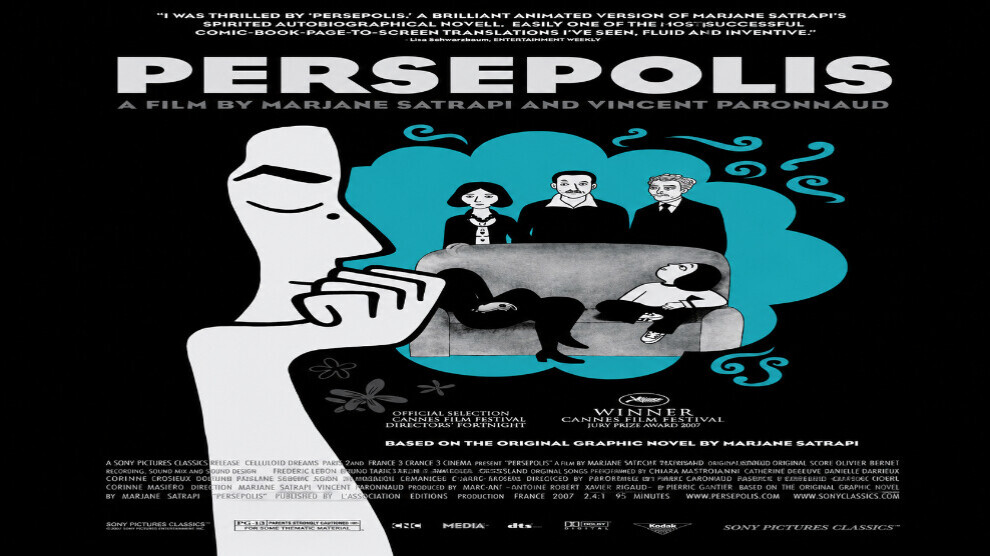
News Center — The film Persepolis is considered one of the most prominent cinematic works to address the Iranian Revolution and the subsequent political and social transformations, through a visual narrative that is simultaneously simple and profound.
Directed by Iranian-French artist Marjane Satrapi and first screened at the Cannes Film Festival in 2007, the film is based on her acclaimed graphic novel of the same name. It presents a moving autobiographical account of an Iranian girl growing up under a repressive and ever-changing political system.
Adapted from the graphic novel Persepolis, the film tells the journey of young Marji, who belongs to a liberal family living through the Iranian Revolution of 1979, the fall of the Shah's regime, and the rise of Khomeini's rule. As the system changes, the country shifts from a dream of freedom to a reality of repression, forced veiling, and the persecution of dissidents. Marji finds herself trapped between two opposing discourses: the discourse of freedom in her home and the discourse of authority at school and on the streets.
The film employs a black-and-white animation style, lending it a symbolic power that reflects the bleakness of the era. It relies on flashbacks to return to childhood memories, through which Marji learns the stories of political prisoners, most notably her uncle, who becomes a symbol of resistance and hope.
Two key figures profoundly shape Marji's life: her uncle, who was imprisoned under the Shah and later executed under Khomeini, embodying the reality that repression did not change despite the shift in regimes; and her grandmother, who instills in her granddaughter the values of honesty and love for the homeland, lending the film a warm human dimension. These two strands form the backbone of Marji's character development and grant the film a clear emotional depth.
As repression intensifies and the Iran–Iraq War breaks out, Marji's family decides to send her to Austria for her safety. Yet alienation opens a new door of struggles: she faces cultural discrimination and undergoes harsh experiences that lead to psychological collapse and a suicide attempt, before returning to Iran broken.
Marji returns to a country that has changed profoundly and finds herself confronting the morality police, living a struggle between her desire for freedom and the reality of restrictions imposed on women. In time, she realizes that her future does not lie in Iran and decides to emigrate to France, sharing a poignant farewell with her grandmother, who tells her, "Be true to yourself."
Despite the darkness of its events, the film insists on offering a glimmer of hope, affirming that change is possible and that peoples can reclaim their freedom no matter how long it takes. For this reason, the film has powerfully returned to the forefront during the women's protests in Iran in recent years, becoming a symbol of feminist resistance against oppression.