
Participants in a Women's Conference in Ankara: Peace Must Be Given a Societal Character
Participants in the conference held in the capital, Ankara, stressed the necessity of giving lasting peace a societal character and ensuring equal citizenship, and emphasized the importance of women being a fundamental actor in decision-making processes.
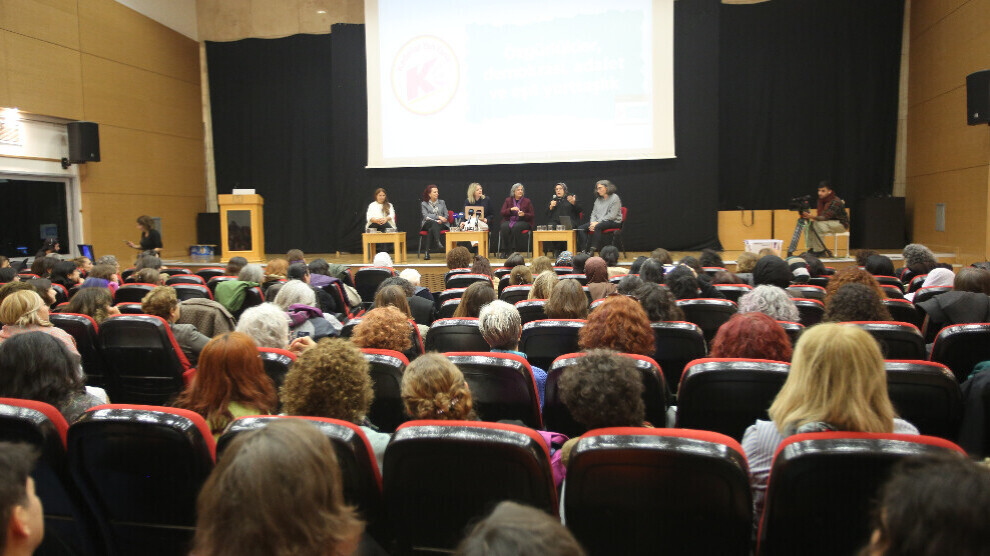
ANKARA_With the aim of building lasting peace and strengthening joint struggle, the “Women Side by Side to Discuss the Future” conference was held today, Saturday, 31 October, in the chambers of the Union of Chambers of Turkish Engineers and Architects(TMMOB).
The opening speech of the conference was delivered by the two artists Feryal Öney (in Turkish) and Rojesh Veliz (in Kurdish). The speakers in the speeches pointed out that women's acquired rights are under attack in Turkey and the world alike, confirming that a historic opportunity has been formed for a democratic solution to the Kurdish issue and the achievement of peace. They also stressed the values of justice and equality and the necessity that women be a fundamental actor in this phase, and that they lead the front rows with their will in the decision-making process.
The first session of the conference launched under the title "Freedom, Democracy, Justice, and Equal Citizenship," moderated by journalist Cansu Çamlıbel, with the participation of member of the "I Need Peace" initiative Feride Eralp, professor of political science Füsun Üstel, Kurdish politician Gültan Kışanak, writer Hidayet Şefkatli Tuksal, and politician Zeynep Altıok Akatlı.
"Asking Questions Is an Integral Part of the Struggle"
The session's moderator, Cansu Çamlıbel, noted that in the current phase public spaces are shrinking, and even constructing a simple sentence or asking a question becomes difficult. "The word itself has become the struggle itself. Asking questions is an integral part of this struggle."
She explained that the fundamental question for discussion lies in how to ensure lasting peace and equal citizenship in a period when democratic rights are shrinking, noting the importance of discussing what equal citizenship means and what content it should acquire, in an environment where the authority determines who possesses which rights.
For her part, academic Füsun Üstel pointed to the report submitted by the Peoples' Equality and Democracy Party to the parliamentary committee. She mentioned that the arrangements related to the structure of transitional justice have different dimensions, some of which require a constitutional amendment and others do not, confirming that the discussion of equal citizenship cannot be addressed through legal status alone.
"The Demand for Equal Citizenship Is Not Enough from Women's Perspective"
Füsun Üstel stressed the necessity of discussing separately the extent to which the concept of equal citizenship includes women, noting the existence of masculine standards behind the current concept of citizenship. She explained that women's citizenship rights have been historically restricted, considering that the demand for equal citizenship is not enough for women under conditions in which the binary gender system is imposed and family standards are transformed into part of the state system.
She pointed to the necessity of discussing different possibilities of citizenship, proposing three main headings: differentiated citizenship, restorative citizenship, and gender-based citizenship. "Differentiated citizenship means achieving actual equality by taking into account the law and social structures of differences. As for restorative citizenship, it aims to confront the injustices, discrimination, and inequality that occurred in the past through democratic negotiation, and to repair exclusionary practices. While gender-based citizenship represents a concept that places women's demands and the discrimination they are subjected to at the center."
Füsun Üstel stressed the necessity of reflecting these discussions on budget policies as well, noting the importance they attach to the study prepared by the Women's Council of the Peoples' Equality and Democracy Party under the title "Budget of Equality, Freedom, and Peace," and stressed that women's needs and demands must be made visible in budget policies.
"No Peace Without Achieving Justice for Women"
Feride Eralp noted that masculine violence against women continues because of impunity policies. "They escape punishment because they are soldiers, police officers, bureaucrats, or sons of conservatives, and because their backs are supported by power. How can peace be possible without achieving justice for all women? War continues in daily life in the form of masculine violence targeting their bodies and lives." She stressed that the discussion of equal citizenship cannot be addressed in isolation from family policies.
For her part, Zeynep Altıok Akatlı noted that peace is not just a political goal, but is also a matter of culture and language, considering that the culture of peace is being dissolved within the culture of violence, and stressed that in order to build peace, societies must get to know one another.
She pointed to the release of the perpetrators of the Sivas massacre and the policy of impunity in crimes against humanity, confirming that lasting peace cannot be built without confronting the pains of the past and discussing practices that contradict the discourse of peace.
Building a Common Future
Gültan Kışanak noted that freedom is a space that a person builds with their own will, not by waiting for permission from others, explaining that democracy is not limited to representation and elections only, but can be built by listening to women's daily needs and ensuring their participation in decision-making processes.
She stressed that equal citizenship cannot be guaranteed through laws alone, noting that different identities can meet on the ground of joint struggle, confirming the possibility of building a common future through pluralism.
She mentioned that young people must bear the responsibility of the future and unleash their own dynamics, confirming that the struggle is a continuity that continues across generations. She noted that everyone must go out into the public space with their own priorities, alongside meeting around common issues.
She pointed out that the non-recognition of Kurdish identity and language in Turkey fuels the conflict, citing the experience of South Africa as an example of the possibility of recognizing different languages. She concluded by saying that peace can be built through societal consensus.
"We Have Lost Our Enthusiasm for the Peace Process"
Writer Hidayet Şefkatli Tuksal pointed to the disappointments left by previous solution paths and the state of distrust that has developed in society, noting that hostility has been fueled throughout those phases. She confirmed that even if the authority is convinced of peace, convincing people is difficult due to the state of hostility that has formed within society.
She explained that different methods must be developed in order to give peace a societal character, stressing the necessity that everyone bear responsibility in line with their capabilities and own priorities.
She also conveyed what happened in a meeting they organized in Amed with the participation of women with different political views; she recounted how the attendees shared their pains and the stories of marginalization they were subjected to, explaining that this shared experience opened an important space for understanding one another.
She stressed that peace cannot be defended with words alone, but tangible steps must be taken in daily life, citing her own experience. "To protest the language issue in Turkey, one must learn the Kurdish language. I bought the books in Mardin and went to the lessons. We have to do something."
At the end of the session, which was organized over two rounds, the floor was opened for participants' interventions and questions.