
Onar: Öcalan Conspiracy Failed to Break Kurdish Popular Will Unity
Sabiha Onar of the Jineology Academy in Makhmour says plot against Abdullah Öcalan strengthened Kurdish resistance, proving unity and determination defeated efforts to erase will.
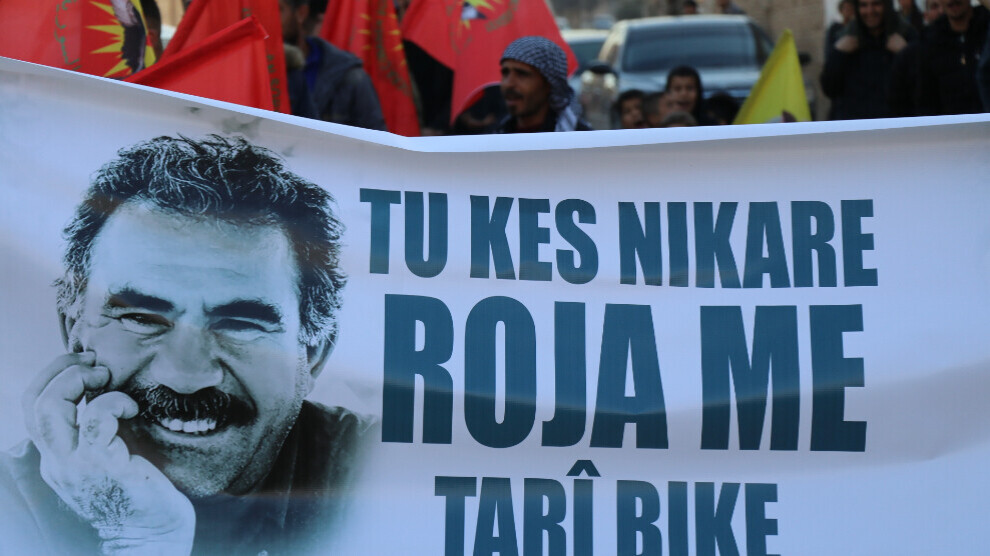
Makhmour – On 15 February 1999, international powers arrested Leader Abdullah Öcalan as part of a conspiracy and handed him over to the Turkish state. Since that date, he has been held in strict isolation in İmralı Prison, where 27 years of his detention have passed. This long period clearly reveals the denial of his “right to hope,” which is a fundamental human right that has been withheld by the Turkish state and the conspiring powers. The European Court of Human Rights has stressed that the right to hope is an essential right that must not be denied to any prisoner.
On the 27th anniversary of the international conspiracy against Leader Abdullah Öcalan, Sabiha Onar spoke to our agency about the dimensions of the conspiracies that targeted both Öcalan and the Kurdish people. She also addressed the ongoing attacks on Rojava and their political and social implications.
Sabiha Onar explained that the month of February, despite the pain it carries, remains a month connected to the roots of the Kurdish cause:
“For twenty-seven years, hostile forces have tried to plant a dark consciousness in the hearts of our mothers, fathers, and children, but they have not succeeded and never will. As long as our children chant the slogan ‘Long live Leader Apo,’ no one will be able to destroy Kurdish consciousness. The path opened around the leader is the path of resistance. For twenty-seven years the leader has been in captivity, yet he has never abandoned his fundamental goal. This is not a short period, and no one else has been able to endure to this extent. Although he is behind four walls, with his thought he uplifts this people and carries them on his shoulders. When one reflects on this, one realizes that this power is the power of the Kurdish consciousness he planted within the people and transformed into an energy that drives them to action in their surroundings.”
“The conspiring powers wanted to sabotage the 27 February call and continue the conspiracy”
She emphasized that the resistance of the Kurdish people and the 27 February 2025 call for peace and a democratic society constituted an important turning point in confronting conspiracies:
“The conspiring powers tried to break the will of this people, but they failed. On the contrary, unity and resistance strengthened Kurdish and Kurdistani consciousness. Throughout history until today, this consciousness has not only been divided into four parts, but into hundreds of parts. Despite attempts to leave the people without awareness or will, the Kurds extended their hands to build a peaceful and democratic society that allows peoples to live freely together. This process established hope and morale and proved that the brotherhood of peoples can be realized in this context. Through their jihadist tools, the conspiring powers wanted to sabotage the 27 February call and continue the conspiracy because they do not want the unity of peoples or a society based on fraternity, fearing that this would conflict with their interests. Those who stand against the brotherhood of peoples will never achieve victory. Leader Apo intervened in this process because the conspirators sought to revive a new conspiracy that would last for another hundred years. In Rojava, the attacks began with bombardment, and the aim was to ignite a war between Kurds and Arabs.”
“Those who build and lead the ethical and political society are women”
Sabiha Onar pointed out that Leader Öcalan brought women’s power to the forefront in the process of building a peaceful and democratic society and communal life:
“He highlighted the role of women in war and society and pushed them toward freedom. In Rojava, when the enemy attacked the people brutally, mothers embraced their children while their comrades took up arms and defended their streets. They did not abandon their land because they know that defending the land is defending life and purpose. Women are the ones who liberate society, lead its path, and establish the ethical and political society. Despite the enemies’ attempts to kill women’s feelings and eliminate them, the idea of women’s liberation that Leader Apo put forward from the beginning of the first conspiracy aimed for women not only to be part of war, but for their thought and knowledge to appear within society. That is why the Rojava Revolution became known as the women’s revolution. They participated in all fields, from war to society, and played their role everywhere. The greatest fear of the enemies was that women would become a real force, and therefore the second conspiracy also targeted the women’s revolution.”
In the conclusion of her speech, Sabiha Onar called on women around the world to hold on to their achievements and defend them, stressing that confronting jihadist ideology requires global women’s unity:
“If women around the world do not unite in the face of this ideology, the system will grow stronger against women’s achievements. Therefore, it is essential to possess awareness and to wage a strong struggle.”