
Mezkin Hassan: Continuing Higher Education in Kurdish Requires Constitutional Recognition of Language Rights
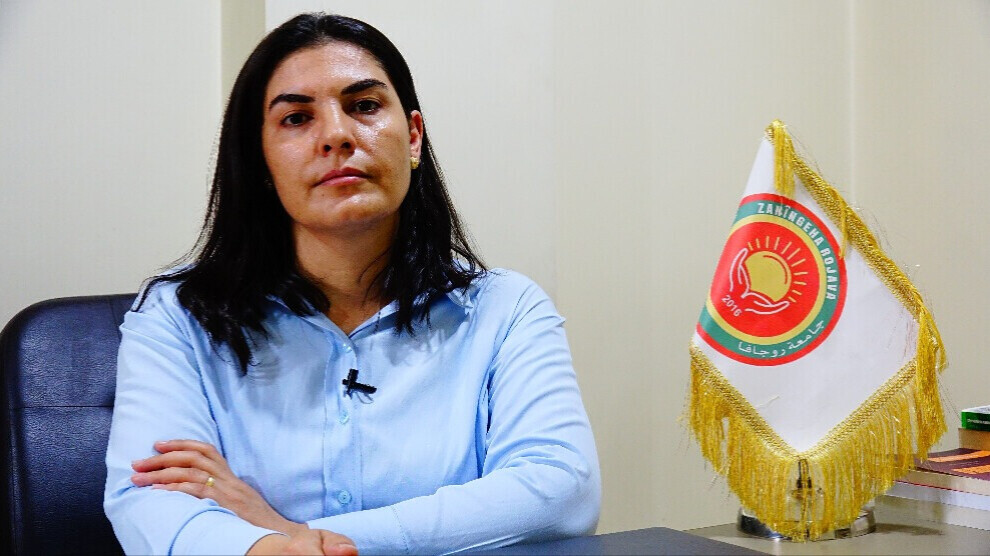
Rojava University’s Kurdish Language Research Center sporkesperson Mezkin Hassan said continuing Kurdish higher education requires a clear government strategy recognizing Kurdish in academia, calling for its constitutional adoption.
SORKEL SHEIKOU
Qamishli – Amid efforts aimed at enhancing cultural and linguistic diversity in the educational process, support for higher education in the Kurdish language in Syria stands out as one of the files linked to expanding opportunities for access to university education in the languages of local components, amid ongoing discussions about developing academic curricula and qualifying educational cadres.
On 17 September, Rojava University announced its readiness to assist the Syrian Ministry of Education by translating study materials into the Kurdish language. The university also expressed its readiness to provide an academic strategy aimed at facilitating the continuation of higher education (undergraduate studies) in the Kurdish language.
Regarding the educational reality and proposed strategies to ensure the continuation of the academic journey of university students without interruption, Mezkin Hassan, spokesperson for the Kurdish Language Research Center at Rojava University, explained that the university merger process has not yet been officially completed, except for one meeting held earlier. She questioned the reasons for not adopting the Kurdish language as a basic requirement within the institutions included in the merger project, despite the ongoing talk about this process.
On the reason for the absence of demand for the Kurdish language and its lack of presence in the merged institutions, she said: "If the merger process is proceeding with the recognition of the Kurdish people as an authentic Syrian component, the recognition of the Kurdish language as a national language in Syria, and even the acceptance of Kurdish educational certificates, then why does the Syrian interim government and the Ministry of Education still view the Kurdish language as a problem? Despite the existence of an institution for our language, a curriculum body, and a Kurdish language research center, the Kurdish language is not requested as a requirement in the merged institutions or other centers."
"We Are Ready to Manage the Translation Process of Materials"
She noted that the Kurdish Language Research Center presented its visions and practical solutions. "We can manage the process of translating government materials into the Kurdish language. We can also provide a strategy and plan to the Ministry of Higher Education regarding completing the development of Rojava and Kobani universities, and the mechanisms for converting colleges that have not yet adopted Kurdish as a language of instruction to adopt it. As for the financial aspects, if the government proceeds to merge these universities and schools into its system, it will be responsible for providing the necessary budgets. We undertake the preparation of concepts and strategies, while the responsibility for allocating budgets falls on the government and the Ministries of Education and Higher Education."
"No Framework Has Been Announced Yet"
Mezkin Hassan pointed out that despite issuing statements in this regard, they have not received any response from the Ministry of Higher Education so far, and the course of the process remains unclear. "We have not received any response yet. We do not know what the status of our universities will be. There is very little time left before the start of the new academic year, and yet no framework has been announced so far."
She expressed her optimism about developing a culture of exchange between the educational sectors in Rojava and Syria, and identified the important steps that should be taken, noting that there is no longer a need for war. "We want to get to know each other in peace and to respect each other's cultures and languages. If the Kurdish people are an authentic people in Syria and the Kurdish language is a national language, then the Syrian interim government must view us as Syrian citizens, not as a nation whose regions were treated as neglected areas as was the case under the Baath regime. We want to share in the field of education, specifically at the level of higher education, to discuss issues and accept one another. In the end, the truth is that we live on the same land and within the borders of the same state."
"The Government Is Responsible for Elevating the Status of the Kurdish Language"
Mezkin Hassan shed light on the importance of elevating the level of education in the Kurdish language, confirming that this is the responsibility of the Syrian interim government. "The government cannot recognize the Kurds as an authentic people while treating them as foreigners. Therefore, it bears the responsibility for development and elevating the level of education in the Kurdish language, for it is a rich language for education and science."
She pointed to the experience extending for more than thirty years in the field of education in the Kurdish language in the Kurdistan Region and Armenia, considering that this experience proves that the Kurdish language is a rich language capable of accommodating education and science. "To those who claim that the Kurdish language is not suitable as a language of science, the experiences in the Kurdistan Region and Armenia, alongside the thousands of students who graduated there, constitute clear evidence to the contrary. Between 2012 and 2014, Syria witnessed a renaissance of the Kurdish language, as thousands learned this language, students graduated, and translators qualified, which contributed to entrenching its status and historical presence."
She noted that if appropriate conditions are prepared for the Kurmanji dialect and the necessary foundations are established for its development, the Kurdish language is capable of achieving great progress. "Kurmanji needs broad support. The Kurdish language should also be adopted as an official language in the Syrian constitution. Alongside that, the current government must establish a strategy for the Kurdish language that enhances its status and guarantees its equality with Arabic in Syria. University graduates must also be enabled to practice their work and professions in the Kurdish language instead of Arabic. To achieve this, and for the Kurdish language to rise to the level of Arabic, the Syrian interim government must also provide the necessary financial support in the near and long term."