
Meryem Çağlı: A Peace That Does Not Include Everyone Cannot Be Peace
Meryem Çağlı, a member of the Democratic Alevi Women's Union (DAKB), affirmed that Alevis are not outside the peace path, stressing that freedom of belief, identity, justice, and equality form the essence of their demands.
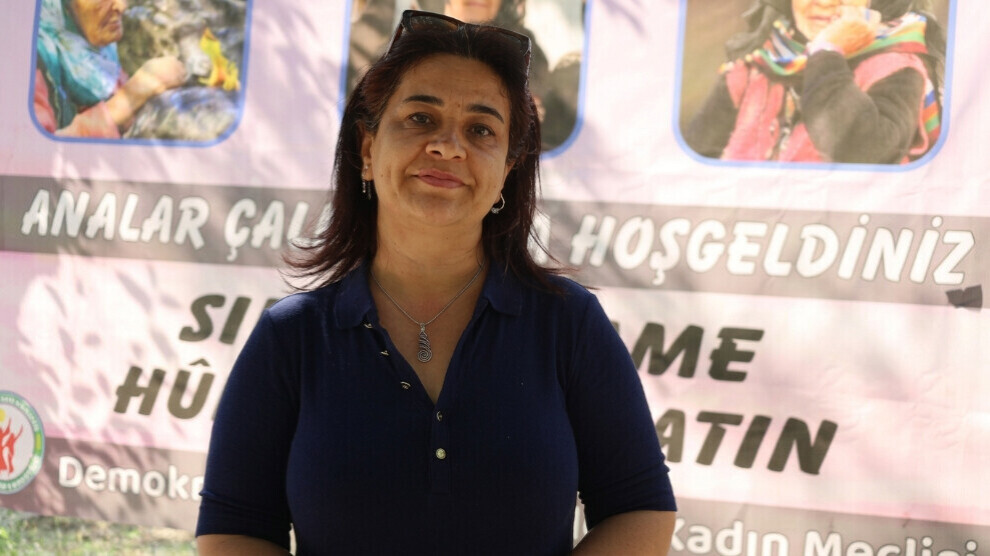
AKIN STERK
Amed — Amid ongoing discussions on the peace process and the building of a democratic society in North Kurdistan and Turkey, hate speech and attacks targeting Alevis and their identity and beliefs continue.
Recently, positions and statements have emerged from various quarters targeting Alevi identity and beliefs, sparking reactions and criticism from Alevi institutions. These institutions believe that the continuation of such discourse and practices poses a threat to the will for societal peace and undermines efforts to promote coexistence and pluralism.
In the context of ongoing discussions on the peace process and democratic society in Turkey, Meryem Çağlı, a member of the Democratic Alevi Women's Union (DAKB), stated that Alevis are not outside the peace path but are "right at the heart of this peace."
"Alevis Support Societal Peace"
She explained that Alevi demands related to freedom of belief, identity, justice, and equality align with the core themes of the peace process: "Alevi belief and identity are very important. We see in the recent period that we are among those who most want peace. We do not want peace only for ourselves; we actually want societal peace."
She added: "Today, it is not only Alevis who are subjected to oppression in Turkey. There are major discussions in the recent period. They are working toward a big conspiracy. We found ourselves through the Kurdish struggle and the efforts made within its framework. Previously, I did not even realize that I was Alevi and Kurdish, but we united through the Kurdish struggle. There is a great state of chaos in Turkey."
She noted that Alevis have historically been subjected to repression due to their identity and beliefs, yet they have remained committed to peace: "Everyone wants to take their share from this file. In particular, those with vested interests are conducting a counter‑campaign, saying 'Alevis do not stand with this peace.' But I, on the contrary, do not see it that way. All the demands raised by Alevis are included in this peace. We, especially regarding Mr. Öcalan's proposal, stand with this peace and hold on to it, because all the demands raised speak to us and concern our issues as well. No matter what they say, this is our position."
"Alevis and Kurds Have Been Subjected to Double Oppression"
Meryem Çağlı pointed out that Alevis and Kurds have been subjected to repression on one hand due to their identity, and on the other due to their beliefs. She criticized the statements of Altan Tan, who claimed that Alevis remained outside the peace process.
She added: "When I mention Altan Tan specifically, I truly feel sorry. He is also Kurdish, yet he says 'Alevis are not included in this peace.' I ask him: Is he himself part of this path? And how much effort and struggle has he contributed? This means he wants to continue pursuing his own interests."
She continued: "It has always been said, as you know, that Alevis and Kurds are particularly subjected to double oppression—oppression at the level of identity and oppression at the level of belief. I ask him: When Alevis were being killed in Syria, did Altan Tan stand by them with this much enthusiasm? What does he want now? There is a clear effort to dismantle Alevi institutions and divide their ranks, but they will not succeed. Because today there is a conscious and empowered Alevi base that knows itself, knows what it wants, and stands united around its demands. I believe that this time they will not achieve what they want."
"We See Ourselves Right at the Heart of Peace"
Regarding the debate over what Alevis have gained from the peace process, she affirmed that religious freedom and justice are at the core of their demands: "Everything being discussed today for peace speaks to us and directly concerns our issues. What more could we ask for? When we look at this recent period, we see ourselves right at its heart."
She said: "Above all, we want Turkey to be a free republic. And what do we mean by a free republic? We mean that every person can express themselves freely, and that everyone can express their language, belief, and identity. We grew up under these prohibitions. When we faced those prohibitions, we held on to each other and came together to overcome them. I look at this period with great and clear positivity. There will be very important answers and solutions for Alevis."
She noted that "there is a call for a constitution that includes all minorities and peoples living in Turkey, from Armenians and Laz to Circassians and others. The seed of peace has been planted, and now it is our responsibility to nurture it and turn it into reality, to protect this path and hold on to it."
"Let Us Add Colors to the Flowers of This Peace"
Meryem Çağlı stressed that Alevis do not demand a constitution that protects only their rights, but want a constitution that includes all peoples living in Turkey: "All the conditions and demands voiced by Alevis are present in this peace. Let us add colors to the flowers of this peace."
She pointed out that Alevis have not forgotten the massacres and forms of oppression they suffered in the past, recalling what happened in Maraş, Sivas, and Dersim: "Of course, we have not forgotten what we endured over many years of oppression and massacres. In Maraş, crosses were marked on the doors of Alevi homes, and they were treated as if they did not exist. In Sivas, we were preparing to hold events related to our poetry, culture, and to present our books, but they burned the souls of our children. As for the Dersim massacre, it was a great catastrophe and tragedy. In truth, the issue was not only about Alevis; there was an attempt to eliminate an entire Kurdish people in that region. We remained silent for many years, and lived for years seeing ourselves as if we were powerless, but today we have a self‑confident public, and we have a society that is aware and conscious of its rights."
She added: "We will do everything we can everywhere for peace. It is true that the peace process is moving slowly, and this does not satisfy us, but we must insist and hold on to this path. We see what is happening in the Middle East around us. The solution must be with all of us together—the Kurdish people and the Alevi people together."
"Our Elders Still Live in Fear"
Meryem Çağlı stressed that society should be able to freely express its identity and beliefs, noting that inherited fear from the past still persists, especially among older generations: "If we do not work for this, not only will the Kurds and Alevis disappear in Turkey, but all of Turkey will lose. First, we must be able to define ourselves freely and comfortably, and not have to hide our identity. This fear is still present, especially among the elderly."
She recalled one of the moments she experienced: "I recently went to Dersim, and when we approached some elderly people there, we said to one elderly woman, 'How are you, auntie?' She replied, 'I'm fine.' But what really affected me was what she said next: 'We have lived through many things, and seen many things.' Then she stopped at that and fell silent. Out of sheer fear, she said, 'My daughter, leave it, don't speak.' I was deeply moved by that. Why are our elders still unable to see even one flower of peace? This drains us and pains us greatly. That is why we must convey this feeling to our people, and give them hope and confidence, so that the fear we inherited from the past does not remain in our lives."
"Peace Is Moving Slowly but We Are Not Losing Hope"
She noted that the peace process is advancing slowly, but she also stressed that they do not look to the future with despair: "Let us all make our efforts together, and let us be able to practice our beliefs freely and confidently, and return to our councils and religious rituals. Talk of peace is still strong and alive, and the voices calling for it are still alive. But the struggle at this time is moving from one side alone. From the state's side, things are progressing somewhat slowly, and this really bothers us. Nevertheless, I do not look at things with despair. We will continue to insist, and we will always continue to do everything we can for these causes. What matters to us is the satisfaction of our people, and societal satisfaction. We do not want war in any form, and we do not want bloodshed under any circumstances."
She concluded her remarks by saying: "Whether we are going to sink on this ship, or whether we are going to reach freedom, we must be together. Turkey has lived through enough pain, and its people have endured enough tragedies and suffering. We must unite on the basis of societal satisfaction."