
Meral Beştaş Demands an End to the Ambiguity of the Peace Process and Calls for Tangible Political Steps
Meral Beştaş criticized parliament's subordination to National Security Council decisions on the disarmament framework law, warning this reinforces ambiguity and undermines public confidence in peace.
ALEV AKGÖL
ISTANBUL_The Turkish Plarliament approved the “Framework Law” last August with a majority of 467 votes, but its implementation was tied to the issuance of an assessment and confirmation report from the National Security Council (MGK). As the end of the year approaches, the report has not yet been issued, nor has the follow-up committee that was supposed to be established within the Parliament been formed.
The political process in Turkey is witnessing a state of stagnation as the end of the year approaches, in light of the continued suspension of the implementation of the "Framework Law" pending the issuance of the evaluation report of the Turkish National Security Council (MGK), which has not yet been issued, raising questions about the future of the political path and the mechanisms for moving forward in implementing its steps.
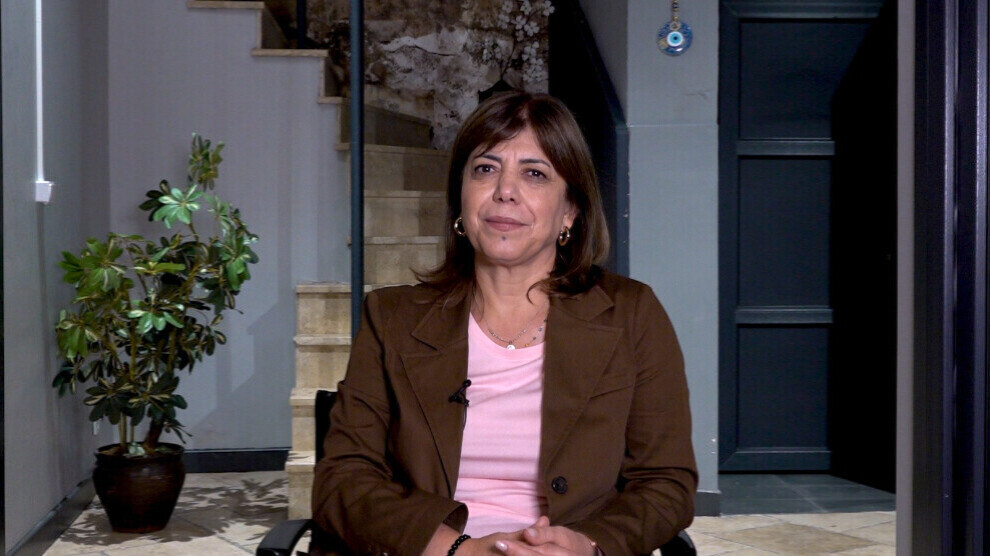
In this context, the co-spokesperson of the Peoples' Democratic Congress (HDK), Meral Danış Beştaş, criticized in a special interview with our agency the linking of the political process to the approval of the National Security Council, indicating that this would limit the role of legislative institutions and the will of political parties in reaching a solution.
"The Turkish Parliament Must Be the Primary Center for a Political Solution"
Meral Beştaş confirmed that forming a platform within the Turkish Parliament with the participation of all political parties except one party represents a highly important historic step, noting that leader Abdullah Öcalan stressed from the first day the necessity of dealing with him as a main actor in the political process.
She added that the Peoples' Equality and Democracy Party adopted the same position, confirming that the Turkish Parliament should constitute the arena and primary center for dialogue and reaching a solution, away from subjecting the political and popular will to the approval of the National Security Council.
She noted that the committee's report was based on two main pillars: a framework law for disarmament, and steps toward democratic transformation (or establishing democracy), criticizing the linking of the implementation of this law to the approval of the National Security Council. "Important and valuable work was accomplished within the committee; the language used in it was characterized by respect. Despite the public discourse that promoted the slogan 'Turkey free of terrorism' with few exceptions, the Kurdish issue and the history of Turkey in all its dimensions were actually discussed at the dialogue table."
Meral Danış Beştaş confirms that there is a large gap between the solutions proposed by the different parties from the beginning. "Later, a joint committee was formed to draft the texts, and we voted in favor of the final report while recording a dissenting opinion in preparation for moving forward. Following that, a framework law was enacted, and despite the shortcomings and flaws it contained, which we expressed in our criticisms, the President of the Republic ratified it. But unfortunately, the implementation of the law was made conditional on the approval of the National Security Council, a condition that should not have been included at all. We are talking here about a legislative proposal approved by the Turkish Parliament with a majority of 467 votes, the highest approval rate in the history of the Turkish Republic. Since the will of Parliament is the essence of the people's will, we do not see it appropriate for the National Security Council alone to bear the responsibility of evaluation and ratification."
The Necessity of Forming a Parliamentary Committee
Regarding the implementation mechanisms, she stressed the necessity of forming a parliamentary committee. Although she described it as a "monitoring" body, its role will not be limited to passive monitoring or standing as a spectator. "From our point of view, this committee should play a pivotal role in the evaluation and ratification process as an institution representing the people, undertaking the tasks of oversight and making recommendations. This committee can also establish an independent monitoring and follow-up body. To my knowledge, the women's movement has a similar initiative, namely a monitoring body composed of academics, experts, legal professionals, politicians, and independent figures."
She says: "We read daily in the media, even those loyal to the government, reports indicating the withdrawal of the guerrillas and the evacuation of certain areas, yet no official assessment or report has been issued to verify the accuracy of that. It was expected that the matter would be settled this October, and now the date of the Council's meeting has been set for 27 November, although it was not obliged to wait for this date and could have convened and issued an urgent declaration. We are living in a state of uncertainty, as the current path does not exceed the limits of speeches and repeated statements from the movement's leadership and government officials without any tangible action. We need clear steps and a real substance that everyone can see, and an end to this ambiguous state of anticipation as soon as possible."
"Peace Cannot Be Achieved Through a Unilateral Effort"
Meral Danış Beştaş warned that the current ambiguity weakens the public's hopes and deepens the state of despair and the decline in the confidence index in the peace process, criticizing the absence of practical steps and the repeated imposition of new conditions. "There is an existing dialogue and mechanism between the state and the movement's leadership, whose details we follow through the statements issued by it, which today speak of a 'state of stagnation' and a dead end. Peace is not achieved by a unilateral effort, but requires mutual commitment, fulfillment of promises, and the provision of a minimum level of trust, alongside establishing a tangible legal framework that transcends mere speeches and declarations of political intent."
She criticized the non-formation of the "Peace and Politicization Council" until now, confirming the need to establish a council that works in coordination with leader Öcalan. "While the movement's leadership confirms its commitment to its leadership's directives, the conditions of this leadership remain ambiguous. Journalists and experts are prevented from visiting and providing support to the process. The public awaits knowing the details of this council, its structure, and the dates of its meetings. It is paradoxical that the government's ministerial monitoring and evaluation committee has been formed under the framework law and has held two meetings. If this committee has already been established, why has the other committee not been formed until now?"
"The Process Has Not Yet Yielded Any Tangible Results"
She noted that this process has not yet yielded any tangible results inside the prisons, and highlighted the postponement of release operations by decision of the administrative monitoring and evaluation committees, in addition to the suffering of sick prisoners. "There is currently a problem related to the momentum of work, an absence of tangible results, and a failure to bring about real change in people's lives."
She confirmed that two days ago she attended a press statement by the "Association of Relatives of Detainees and Convicts" in front of "Bakırköy" Prison, with the participation of more than a thousand people from the families of prisoners who expressed their shock at the extension of the actual implementation of penalties under the current circumstances. "The administrative monitoring and evaluation committees have come to extend the detention periods of persons who deserved legal release, based on flimsy pretexts lacking any legislative basis," noting the figures of the Association of Lawyers for Freedom (ÖHD), which confirm the extension of the penalties of 99 people during the past month alone.
She cited the file of sick prisoners, saying: "About 10 days ago I visited 'Buca' Prison and met the sick prisoner Saeed Yildirim, who has been behind bars for 34 years. Although he was supposed to be released after two years, his detention is being extended without any justification." She added: "There are hundreds of sick prisoners who are deprived of medical care and transportation facilities and are no longer able to endure prison conditions."
She confirmed that resolving these simple humanitarian files does not require a decision from the National Security Council, but they can be released immediately. She concluded by stressing that real peace passes through democratic transformation and the actual strengthening of societal participation, while these arbitrary practices undermine trust and the entire peaceful endeavor.