
Leader Öcalan Calls for a Positive Phase and the Construction of an Integrated Democratic Republic
On peace call anniversary, Öcalan: Weapons lose meaning where democratic politics practiced. He urges reconciliation, integration, and a legal peace framework guaranteeing all components' rights.
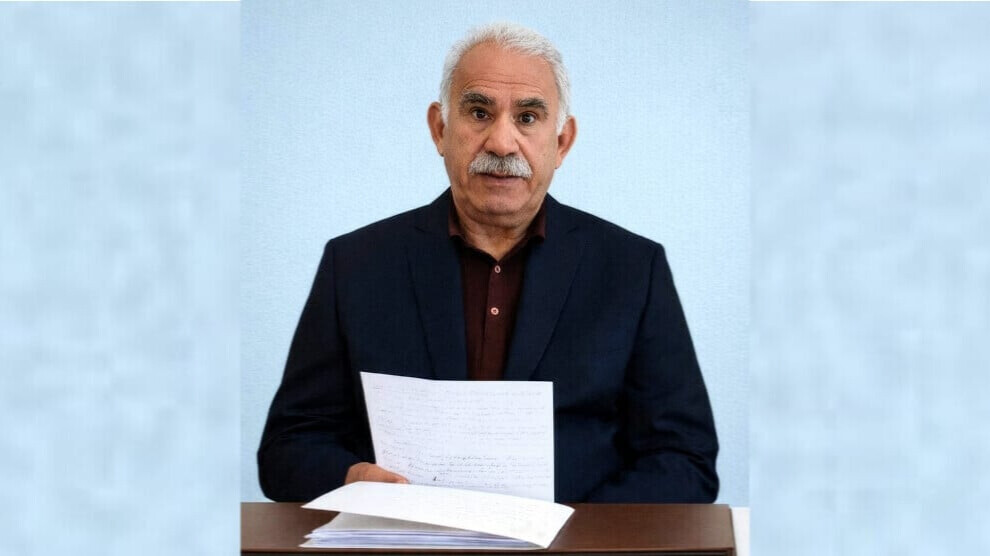
News Center – The İmralı delegation of the Party of Equality and Democracy of the Peoples, together with the party leadership, participated today, Friday, February 27, in commemorating the first anniversary of the Call for Peace and Democratic Society. During a press conference held at Yılmaz Güney Theater in the capital Ankara, a new message from Leader Abdullah Öcalan was read, presented by the delegation as part of the event.
In his message marking the first anniversary of the Call for Peace and Democratic Society, Leader Abdullah Öcalan stated:
“Our call on February 27, 2025, declares that weapons lose their meaning wherever democratic politics is practiced. It is a clear statement of preference for politics and the continuation of principles. Through will and unilateral practice, we have fundamentally moved beyond the phase of negative uprising. The process has demonstrated our capacity and strength for negotiation, and we are now able to pave the way for a transition from a policy of violence and division to a democratic policy based on integration. Our calls, conferences, and congresses have all been for this purpose. The movement’s decisions to dissolve itself and end the strategy of armed struggle do not merely constitute a formal and practical rejection of violence; they also express an internal transformation toward a political path. This was also a declaration of an intellectual reconciliation with the Republic.
I see in the positions of Mr. Recep Tayyip Erdoğan, the call of Devlet Bahçeli, and the contribution of Özgür Özel, as well as the efforts of various political, social, and civil forces that participated positively in the process over the past year, elements of great importance. I also remember their comrade Sırrı Süreyya Önder with respect and longing.
The existence of Turks is tied to the existence of Kurds. This dialectical relationship is historically authentic. The foundational texts in the establishment of the Republic demonstrated the unity of Turks and Kurds. Our call on February 27 is an attempt to revive the spirit of that unity and to demand a democratic republic. Our goal is to break the mechanism of bloodshed and conflict. Acting according to narrow and short-term political interests, rather than considering the historical dimensions, seriousness, and potential risks of the issue, will weaken us all. Continuing denial and uprising means perpetuating greater corruption. We are removing the obstacles to the unity that some have sought to undermine over the past two centuries, providing its legal conditions, and seeking to discuss how we can come together and build a shared life.
Now we must move from the negative phase to a phase of positive construction. The path is opening toward a new political era and strategy. Our aim is to end the period of politics based on violence and to open a path grounded in democratic society and the rule of law. We call on all components of society to create opportunities in this regard and to assume responsibility.
Democratic society, democratic reconciliation, and integration are the foundations of awareness in this positive phase. The positive phase excludes methods of struggle based on coercion and violence. The goal of positive construction is not to seize any institution or structure, but to enable every individual in society to assume responsibility and participate in social construction. The aim is for construction to take place jointly and within society. Oppressed groups and ethnic, religious, and cultural communities can protect their achievements through organized and continuous democratic struggle. It is very important in this process that the state respond to democratic transformation.
Democratic integration is no less important than the founding phase of the Republic. It carries the same level of meaning, future potential, and strength. It is based on the model of democratic society and stands as an alternative to methods of division or reverse assimilation. Transitioning to democratic integration requires peace laws. The solution of democratic society necessitates building a legal system and structure within political, social, economic, and cultural frameworks.
Many of the problems and crises we face today stem from the absence of democratic law. We advocate a legal solution within the framework of democratic politics. We need an approach that opens space for democracy and builds strong legal guarantees for it.
Citizenship must be based on attachment to the state, not on ethnic belonging. We advocate for free citizenship that ensures freedom of religion, nationality, and opinion. Just as religion or language should not be imposed, nationality should not be imposed either. The legal relationship of the citizen within democratic boundaries and on the basis of the unity of the state includes the right to free expression and to organize religious, ideological, and national identity.
Today, no intellectual system can survive without being grounded in democracy. Stagnation, paralysis, tensions, and crises are temporary; in the end, democracy will endure. Our call aims to find solutions not only in Turkey but also in the Middle East to the problem of coexistence and the crises arising from it. We defend the right of every oppressed person to exist and to express themselves freely.
Women are among the most important leading social forces, without whom no society or state can endure. Today, domestic violence, femicide, and patriarchal domination represent contemporary manifestations of a historical assault that began with the enslavement of women. Therefore, women constitute the force most aspiring to freedom and the driving force of democratic integration. The language of this era should not be authoritarian or despotic. We must allow everyone the opportunity to express themselves freely, listen to them attentively, and articulate our truths clearly. Achieving all of this requires a shared reason that respects the other.”