
Lawyer: Consitutional Court ruling reignites debate over poverty alimony and women’s rights
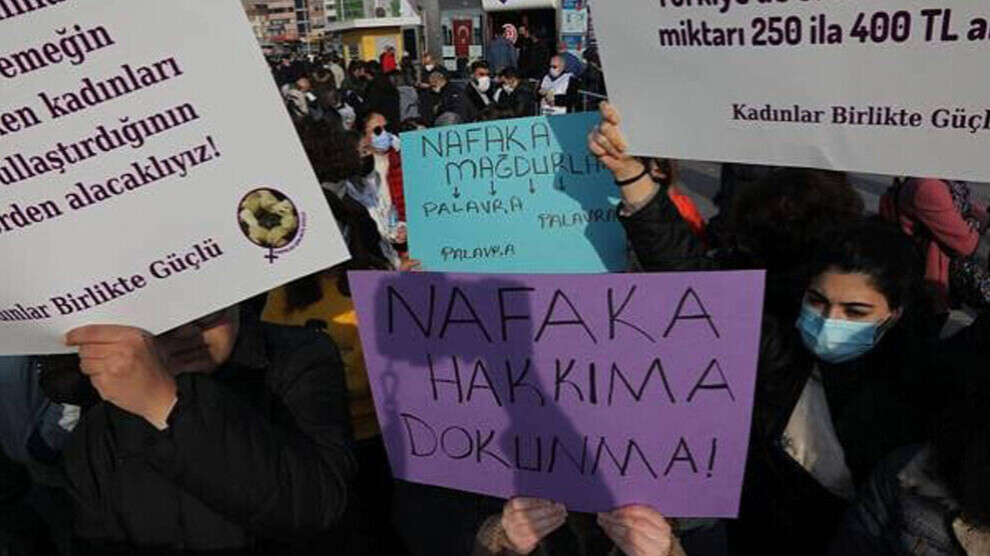
Feminist human rights activist Sevda Chetinkaya affirmed that talk of “indefinite alimony” does not reflect the legal reality nor the lived experience of women who find themselves without work or property after years of unpaid domestic labor.
ELIF AKGUL
Istanbul – The Turkish Constitutional Court has annulled the phrase "for an indefinite period" in Article 175 of the Turkish Civil Code, which allowed post‑divorce alimony to be granted without a time limit. The court placed the file on its general assembly agenda upon a request from the 12th Family Court of Antalya, and the decision will take effect nine months after its justification is published in the Official Gazette.
The 12th Family Court of Antalya had submitted a request to the Constitutional Court in 2025 to annul the said provision while hearing a case. After examining the request on its merits, the high court ruled to annul the text.
The right to alimony has been targeted for years
This article has been a subject of debate and targeting by the Justice and Development Party (AKP) for about nine years. The Constitutional Court had rejected another objection to the same regulation in 2012. In the review it conducted at the request of the Kestel Basic Rights Court, the court affirmed that the obligation to pay alimony for an indefinite period aims to protect the spouse who falls into poverty due to divorce, and that this is a requirement of the principle of the social state.
The ruling at that time stated that continuing the alimony obligation as long as the conditions for entitlement persist, without subjecting it to any specific time limit, does not conflict with the constitution. This issue was also part of the 12th judicial package submitted to parliament. The Constitutional Court's decision has opened the way for the government to reorganize the relevant article.
Among the formulas under discussion are that alimony be paid for a period equal to the duration of the marriage, or for a certain portion of the marriage duration, or that the payer's responsibility ends after a fixed period of payment. In response, the state would support the alimony recipient if they are unable to earn an income.
"Talk of 'indefinite alimony' does not reflect reality"
In her assessment of the decision, feminist lawyer and human rights activist Sevda Çetinkaya said that the term "indefinite alimony" circulating in public opinion for years does not reflect reality. The regulation in the Civil Code grants the right to alimony to the spouse who falls into poverty after divorce when certain conditions are met, and the law also clearly specifies the circumstances under which alimony ends.
She stated: "The claim that poverty alimony is a permanent right forever is completely incorrect. The law does not stipulate that it is paid only to women; it speaks of the right to alimony for the party who becomes poor as a result of the end of married life, to compensate for this decline in living standards. But due to gender inequality, and because the party that often lacks means after divorce is women, it has become entrenched in people's minds that this right belongs to women. The poor after divorce are mostly women. Nevertheless, the law does not define poverty alimony as an eternal or unlimited right."
"Women deprived of property and work"
Sevda Çetinkaya pointed out that most of those who need alimony after divorce are women who spent many years in unpaid domestic care work. "During marriage, women are often outside the labor market. They bear the burden of childcare, housework, and elderly care. When the marriage ends, we are talking about women who have mostly remained outside paid work and outside the ownership of rights and property."
At the end of the marriage, a woman may be between 45 and 55 years old, having spent many years caring for the family, husband, children, and the elderly. According to the lawyer, she has not worked or was not allowed to work, and has no income, wealth, or savings. "Yet the alimony amounts we are talking about average only between 3,000 and 5,000 Turkish lira."
The right to alimony within the 12th judicial package
Lawyer and feminist activist Sevda Çetinkaya also said that the Constitutional Court's decision may push the government to prepare a new legal regulation, warning that this decision poses a risk to women's economic guarantees. "It seems that the annulment of the phrase 'for an indefinite period' comes within another plan. In 2012, a request was also made to the Constitutional Court to annul this phrase, but the court rejected it at that time. Today, there is a government willingness to make a legal amendment."
She added: "In the draft of the 12th judicial package, it is planned to subject the right to alimony to time constraints and to set a period for it. Even this simple right to alimony, which originally does not represent real compensation for all the effort and unpaid work that women have provided throughout the marriage years, has become targeted. Women do not become wealthy thanks to alimony of 5,000 lira; they are already struggling to survive and secure basic needs."
Common claims do not reflect reality
She also affirmed that widespread claims in public opinion, such as "a woman marries for one year and then receives alimony for life," do not reflect reality. "This is fundamentally incorrect. Many women cannot even collect the alimony that courts have awarded in their favor. If we look at enforcement offices, we will find thousands and tens of thousands of files where even the simple alimony amounts of 3,000 to 5,000 lira have not been collected."
In conclusion, according to lawyer Sevda Çetinkaya, the right to alimony is a right that women fully deserve, and it is not an eternal or unlimited right as is rumored. "Abolishing this right in this manner constitutes a significant assault on the gains women have achieved and on their struggle for these rights."