
Palestinian female artists: Our participation is a national duty and a message of solidarity with female prisoners
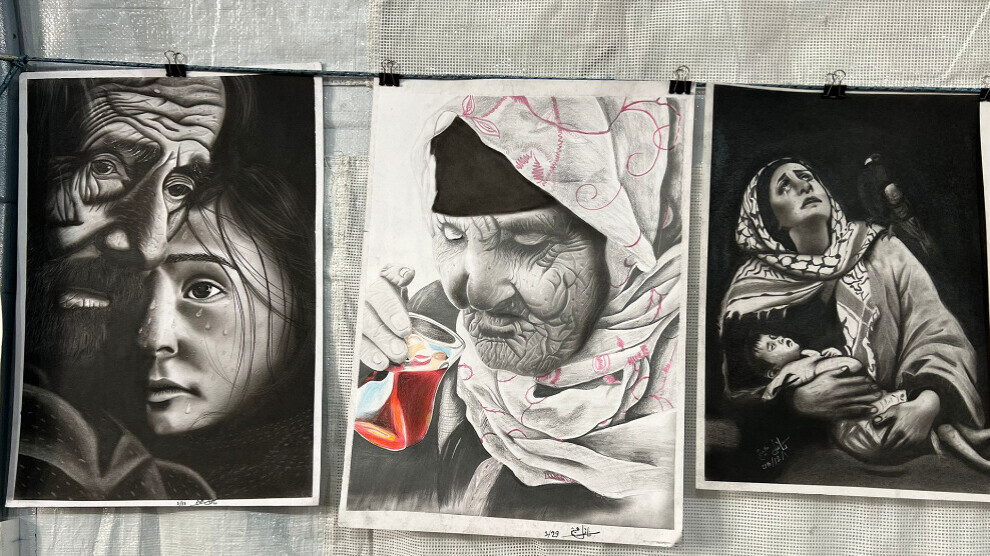
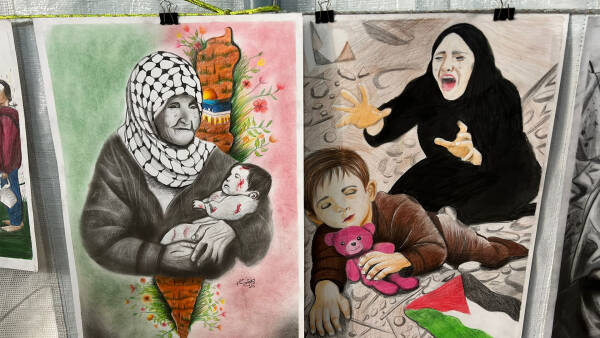
On the occasion of Palestinian Prisoner's Day, the Palestinian Center for Culture and Creativity organized an art exhibition in Gaza with wide participation by Palestinian female artists who presented works embodying the suffering of prisoners inside Isra
Rafif Aslim
Gaza — The participants in the exhibition unanimously expressed their support for Palestinian prisoners, rejecting the prisoner execution law, affirming that art constitutes a means of resistance to convey what is happening inside Israeli prisons, and that their participation is a national duty and a message of solidarity with female prisoners in particular.
The Palestinian Center for Culture and Creativity organized an art exhibition yesterday, Thursday, April 16, on the occasion of Palestinian Prisoner's Day, with broad female participation, in support of prisoners in Israeli prisons and affirming their right to freedom, contrary to the Palestinian prisoner execution law recently approved by the Israeli Knesset.
"Art is the simplest form of expression"
Kafa Khaira, a member of the board of directors of the Palestinian Center for Culture and Creativity, said that the event was organized to convey the voice and suffering of prisoners to public opinion, noting that women's biological nature makes them suffer more from physical and sexual torture compared to men. She said, "We cannot bear to hear testimonies of torture practiced inside prisons, which have recently begun to be revealed."
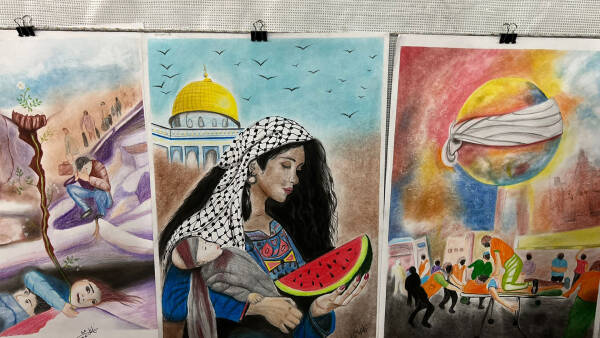
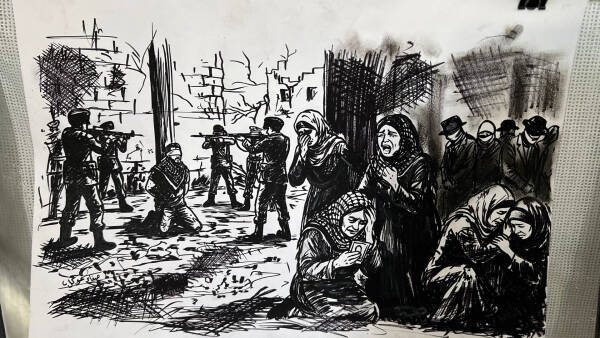
Regarding the participants in the exhibition, she explained that about 50 artists participated with various works expressing freedom, the injustice of the jailer, displacement, and the arrests that occurred during the ground invasion of the Gaza Strip, especially in hospitals and civilian homes, whether men or women. She stated that art is the simplest form of expression through which Palestinians can address the world and convey their voice in defense of their legitimate rights.
She said, "What we hear about prisoners only reflects part of the truth. Since the beginning of the attack, we have heard about hundreds of prisoners who died in Israeli prisons due to torture and lack of medicine and food. Today, an unjust law is passed before the eyes of the world, with no regard."
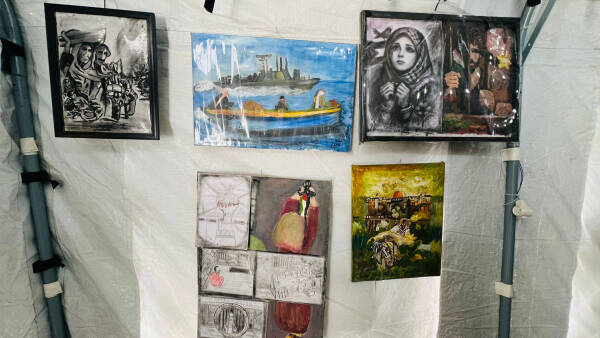
She stressed that she refuses to emigrate from the Gaza Strip no matter how difficult living conditions are, affirming that Palestinian women have remained steadfast on their land since 1948. She noted that today's exhibition is held in a tent next to the Rashad Shawa Cultural Center, indicating the scale of destruction that has befallen the country and the destruction of most cultural centers in Gaza City, and to convey messages that exhibitions will continue, even if held in a tent, on the Gaza beach, or in the open air, to preserve the continuity of cultural activities.
"We support all prisoners"
For her part, artist Nisma Abu Husseira explained that her reason for participating in the event stems from what she has experienced of loss, whether of the killed or prisoners. 45 of her relatives were killed during the attack, while others were captured, which pushed her to express her feelings through drawing and colors, noting that she supports all Palestinian prisoners in Israeli detention centers, especially female prisoners who endure torments alone.
Regarding her paintings, she explained that through her drawings she showed the reasons for arrest: some were arrested during their displacement from the north to the south, others were fishermen who went in search of a livelihood and were surrounded by boats at sea and arrested, some were in hospitals as displaced or receiving treatment and were captured without guilt, and another was singing about Jerusalem and was arrested at a checkpoint.
She affirmed that she received a participation notice only two days before, so she rushed to buy canvases and colors, but was surprised by their extremely high prices. Unable to afford the costs, she resorted to using women's makeup tools such as blush, eyeliner, kohl, and others. She added that even these tools were not cheap, and when she asked for help from her family's women, they were initially surprised and laughed, but soon decided to support her, each donating one of her tools.
Nisma Abu Husseira asks, "Are two million Gazans prisoners in that stricken land? Israeli forces control their entry and exit, their food, drink, and all their basic needs. When the prisoner law was issued, I felt as if a death sentence had been passed on me, because no one in Gaza is safe from killing or capture." She wishes that all mothers would be reunited with their missing children, and that she and all prisoners would be freed.
A national duty
For her part, artist Asma Tafesh affirmed that participating in events supporting Palestinian prisoners is a national and moral duty to stand by them and support them, as Gazans oppose any arbitrary decision issued against them. She noted that she and other female artists use simple methods and tools to express what is happening inside prisons and convey the message to the whole world through paintings.
She said that the scarcity of tools will not stop female artists nor prevent them from holding exhibitions on national and international occasions. If they do not find canvases, they will paint on paper; if they do not find colors, they will paint with the ash left after cooking. Palestinian women will find a way out of every crisis they face, stating that this is what she thought of when she produced several paintings that she participated with in the current exhibition.
"Our participation is in support of female prisoners"
In turn, artist Safaa Awkal explained that through her participation, she supports Palestinian female prisoners so that they may gain freedom and the unjust law against them be repealed. She said she drew a Palestinian female prisoner with broken chains around her to indicate that the shackles will one day be broken and she will return to her life. Her second painting combined the prisoner's shackles and the tent to show their shared suffering imposed by Israeli forces, whether through imprisonment or destruction. Another painting depicted the moment of arrest, and the last one the dream of national unity.
She pointed out that, like other Palestinian female artists, she drew with chalk, coffee, women's makeup tools, and the ash from fire. Everything available was used. She explained that their attempts express art within the Gaza Strip and are a clear message from a people who love life. She not only creates through drawing but also through writing and reciting poetry.
"Remembrance and reminder"
For her part, artist Farah Ajour affirmed that participating in the exhibition is both a remembrance and a reminder, to embody what cannot be seen inside prisons. She pointed out that there are threats against female artists in the Gaza Strip, explaining that those who paint the truth may be killed. However, she stressed that she is not afraid to express the suffering of Palestinians and speak about the silent war that female prisoners endure inside prisons. She added that everyone has the right to know what is happening in a simple and direct language, the language of art.
"We transfer suffering to the paintings"
For her part, Sama Abu Hassan said she came to visit the exhibition to support Palestinian female prisoners and her artist friends who transferred suffering to the paintings, noting that she admires the methods they innovated to produce drawings using makeup tools. She also admired the simple charcoal paintings resulting from cooking ash, which the artists transformed from something worthless into a painting speaking about an integrated subject. Therefore, she hopes to see more exhibitions at upcoming national occasions.