
Konul Ozonay: Kurdish uprisings thwarted international conspiracy goals
Konul Ozonay, co-chair of the Democratic Regions Party in Wan, said the international conspiracy against Abdullah Öcalan aimed to prolong conflict, violating international law and human rights.
MEMİHAN HİLBİN ZEYDAN
WAN – Leader Abdullah Öcalan, who has been held on Imralı Island for nearly three decades, has not abandoned his commitment to peace and dialogue as the path to resolving the Kurdish issue. Despite the severe isolation he has endured for 27 years, he has remained steadfast in advocating negotiation and democratic solutions, considering the Kurdish issue not merely an internal Turkish matter, but a regional issue affecting all the peoples of the Middle East.
The international conspiracy, which began with Leader Abdullah Öcalan’s departure from Syria on October 9, 1998, and continued with his transfer to Turkey on February 15, 1999, has now entered its 27th year. Throughout these years, the plans have taken various forms of destruction and fragmentation. The most recent of these were the attacks launched on January 6 on the Sheikh Maqsoud and Ashrafieh neighborhoods in Aleppo, which later spread across Rojava. Öcalan described these as the “second February 15 conspiracy.”
Kurds commemorate February 15 every year as a “black day,” organizing events to demand Öcalan’s freedom. However, February 2025 brought new developments, as on the 27th of the month Öcalan called for “peace and a democratic society,” stressing that the aim of the conspiracy was to keep the Kurdish issue unresolved. In response, he presented a vision for a democratic life that opened new horizons for the Kurdish people and the peoples of the Middle East.
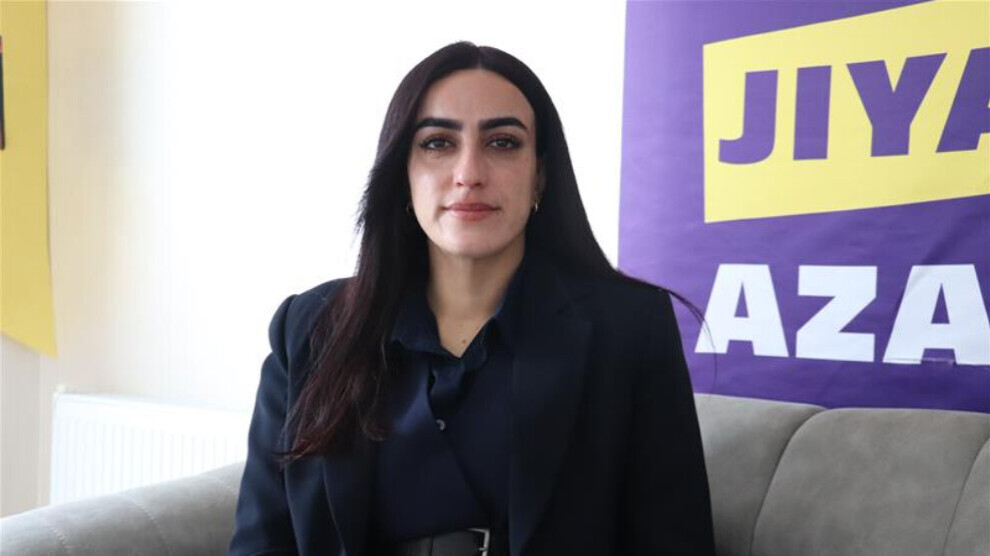
Konul Ozonay, Co-Chair of the Democratic Regions Party branch in the city of Wan, stated that the goal of the international conspiracy against Abdullah Öcalan was to keep the Kurdish issue unresolved and to redraw the region’s borders accordingly. She noted that “Kurdistan was first divided into two parts under the Treaty of Qasr-e Shirin in 1639, and later into four parts under the Treaty of Lausanne signed on July 24, 1923, which left it vulnerable to exploitation.”
She pointed out that Kurdish uprisings were suppressed at both regional and international levels. However, the emergence of the Kurdish Freedom Movement under Öcalan’s leadership presented a new model that reshaped the Kurdish reality in line with the modern era, alongside the development of the Kurdish people’s struggle for freedom and survival. She added that the movement grew into a broad popular movement defending its rights and freedom. “In its early stages, it was not accepted by other states at that time, as Turkey and others sought to shape their policies in line with their own interests,” she said.
She affirmed that during that period, a regional and international conspiracy against Abdullah Öcalan took shape. Statements by then–Turkish Prime Minister Bülent Ecevit — “We still do not know why Öcalan was handed over to us” — as well as Öcalan’s later evaluations on Imralı Island, revealed all aspects of the reasons behind his handover. International powers, she insisted, were determined not to reach a solution in order to serve colonial interests.
She noted that the conspiracy aimed to turn the Turkish–Kurdish conflict into a century-long struggle. As Öcalan stated in his defense, “I visited four European capitals, but I did not see any effort to find a solution to the Kurdish problem.” She stressed that many countries that speak of democracy, justice, and equality insisted on avoiding a solution to the Kurdish issue, which affects the region and the Middle East as a whole. This, she said, demonstrates the depth of hegemony and colonialism, and the conspiracy has continued on Imralı Island for 27 years.
She explained that Öcalan’s attempts to find a solution have been continuously obstructed and that the isolation imposed on him has intensified, constituting a violation of Turkish and international law and human rights. Alongside this isolation, a counter-propaganda campaign has targeted his ideas, ideology, and visions. The democratic, ecological, and women’s liberation model he proposed is considered a “third way” alternative, placing democratic modernity in opposition to capitalist modernity and offering a vision of freedom and equality for all peoples of the Middle East. For this reason, she argued, the international conspiracy did not end with the events of 1999 but continues to this day.
“The conspiracy has failed”
She confirmed that recent meetings with Kurdish leader Abdullah Öcalan reveal the consistency of his ideology, theory, and practice over the past 27 years on Imralı Island. He remains committed to the positions he declared in the 1990s. “Öcalan’s fundamental goal is to achieve a democratic solution to the Kurdish issue through dialogue and negotiation. This issue concerns not only Turkey but the entire Middle East,” she said.
She added that the conspiracy targeting Öcalan has lost its effectiveness. Kurdish uprisings in Turkey, Europe, and the four parts of Kurdistan, along with the “You Cannot Darken Our Sun” actions, the sacrifices of many comrades, and the global spread of his ideas have rendered it futile. “The current stage reached by this thought proves that,” she stated.
She also pointed to the Rojava Women’s Revolution and the “JIN JIYAN AZADΔ movement in the region as among the most prominent outcomes of Öcalan’s model, affirming that the conspiracy, which began with regional and international dimensions, has now been thwarted. “The freedom of an entire people was targeted in the person of Abdullah Öcalan,” she said.
Ozonay continued by emphasizing that Kurdistan has suffered centuries of colonialism, which extended beyond the division of land to the erasure of language, identity, and Kurdish existence. She noted that in the twenty-first century, Kurds are still deprived of education in their mother tongue, of exercising their cultural rights, and even of declaring their existence in their homeland.
She added that the Kurdish people are engaged in this struggle with seriousness, having paid a heavy price throughout history, as their leaders were subjected to repression, exile, or execution. “The targeting of Kurdish freedom and existence has recently been embodied in the person of Mr. Abdullah Öcalan. As a Kurd and a Kurdish woman, we condemn the February 15 conspiracy with complete rejection and anger, and we repeat this every year,” she said.
“We achieved unity around Rojava, but it did not last”
She noted that the process initiated by Öcalan’s call on February 27, 2025, still carries significant implications, stressing that his initiative for peace and negotiation continues, although “the peace and democratic society process has not yet reached the desired level.”
She concluded by emphasizing that February 15 of this year holds particular significance, as it reflects the struggle of the Kurdish people, Kurdish women, and Kurdish political existence. She stressed the need to make effective use of this day: “Condemnation alone is not enough. We must be present in the streets and participate in the events organized on this occasion. The unity achieved with Rojava in the recent period must continue,” calling on everyone to condemn the events of February 15 and to demonstrate determination to steer this process toward peace and negotiation through an organized stance and broad mass participation.