
Kobani Municipality Mayor:We Adhere to Local Democracy and Seek to Preserve Women’s Role and Gains
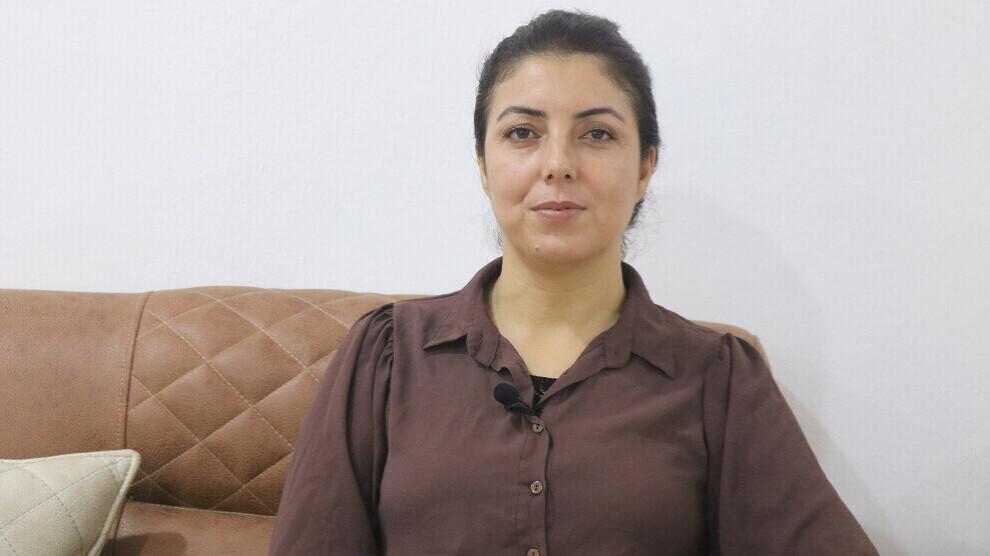
Kobani Municipality Mayor, Almas Rumi, affirms that the new phase represents a test for preserving the approach of local democracy and the will of society, emphasizing that limited capabilities do not prevent continuing work and serving the residents.
BARJAM JOUDI
Kobani_As events in Syria escalate, political efforts to contain tensions have intensified,culminating in the agreement signed on January 29 between the Syrian Democratic Forces (SDF) and the interim Syrian government, which constituted an important milestone in the path of understandings regarding the country's future and the shape of its local institutions.
Amid these transformations, local institutions in Rojava entered a new phase, one of the most notable milestones of which was the official engagement of the Kobani People's Municipality in the integration path on April 9, under the presidency of Almas Rumi—a notable step as she became the first woman to assume the municipality presidency in this phase.
Five months after the beginning of the integration process, the municipality's experience raises questions about its reality, the challenges it faces, its ability to continue serving residents, in addition to the role of women and their position in local administration and decision-making.
From this standpoint, our agency conducted the following interview with Kobani Municipality Mayor Almas Rumi to examine the nature of the new phase, the municipality's working mechanisms, the challenges it faces, the future of local administration, in addition to the role of women and their position in Syria's future.
In light of the phase Syria is going through, which should be based on local democracy, how do you see the role of Kobani Municipality and its position within this new system?
At its core, the municipality is an institution that emanates from the people and society and works for them, so it cannot be separated from its social environment or from the will of the residents. Its role is not limited to providing services, but extends to responsibilities related to organization, the community sphere, consolidating a culture of participation, in addition to various files that affect citizens' lives. On this basis, the municipality's structure was built in line with the principle of representing the people and their participation in various fields.
After the agreement was reached, the Kobani People's Municipality was the first institution in the city to initiate integration steps. Since then, we have been working on the basis of joint coordination with Aleppo Governorate, and communication and cooperation channels between us exist in various fields, including economic, administrative, and functional aspects.
However, this coordination does not in any way mean abolishing the municipality's will or reducing its role to a subordinate or unilateral party. On the contrary, we work within a framework of coordination and partnership, based on an approach grounded in democracy and respect for society's will. What is happening today represents a new experience at the Syrian level, and it is natural that it be accompanied by challenges and difficulties, especially in economic and service aspects, as well as in securing the necessary support and capabilities.
Due to limited resources and available capabilities, we often find ourselves compelled to manage our work according to existing circumstances, despite the scale of needs and responsibilities. Nevertheless, these difficulties do not diminish our responsibility toward the people of Kobani; rather, they drive us to continue working, seek more capabilities, and develop coordination mechanisms to ensure the best possible services for citizens.
After Kobani Municipality institutions officially entered the integration path, what were the most prominent challenges you faced on the ground? Have differences in visions or working mechanisms emerged during this phase?
As heads and employees of Kobani Municipality, our primary responsibility is to serve the city and its people, and to do everything in our power to respond to their needs. However, limited available capabilities often constitute an obstacle to our ability to meet all needs as required. Naturally, under these circumstances, there are observations and criticisms from residents regarding the municipality's performance, and we deal with them responsibly and respectfully, considering them a motivation to review, develop, and correct shortcomings in our work.
In this framework, we ensure that communication channels remain open with Aleppo Governorate, working together to secure the capabilities and opportunities that Kobani needs, enabling the municipality to improve the level of services provided to the city's residents and respond to their requirements as much as possible.
Over the past fifteen years, the areas administered by the Autonomous Administration, particularly Kobani, have operated on the principles of self-administration and local democracy—an approach that has been shaped and developed through years of work and experience. Today, we seek to preserve this expertise and vision, and continue our work in cooperation with the current government, in line with new circumstances, while adhering to the principles we believe in.
For us, the current phase is not merely an administrative transition; it is also a test of our ability to preserve our vision and community awareness, and to entrench justice and democracy based on the people's will as the foundation of our work. Ultimately, our existence and work stem from serving our people and responding to their needs. At the same time, we cannot ignore the fact that weak capabilities and current circumstances impose real challenges on the municipality's work and limit its ability to perform all its responsibilities in the way we aspire to.
As the first woman to assume the presidency of Kobani Municipality, and in light of the current political phase, how do you view this responsibility? What were the most prominent challenges you faced as a woman in a leadership position?
When I was assigned to the municipality presidency, this sparked widespread interest, especially as women's assumption of top leadership positions still faces significant reservations from the current government. Therefore, many questions were raised about a woman's ability to manage the municipality, bear its responsibilities, and run its affairs.
But for me, assuming this position is not an exceptional experience or a task beyond my capabilities. I have accumulated years of experience in bearing more complex responsibilities and tasks. Alongside other women, I have held important positions and responsibilities in multiple institutions. This experience has enabled us to build extensive expertise in administration, organization, and political work—expertise that is today directly reflected in our performance and the way we manage our work.
It is important to note here that women's freedom has been, and remains, one of the fundamental pillars of the project we believe in. On this basis, we adopted the system of co-presidency in all our institutions, from communes to administrative institutions in northern and eastern Syria, to ensure women's active participation in decision-making and administration.
Therefore, women's presence in positions of responsibility is not new to us, nor does it represent an experience that causes surprise or hesitation. Women have, over the years, assumed leadership responsibilities and co-presidency positions in municipalities and various institutions, proving their ability to manage and bear responsibility, and achieving tangible successes in various fields.
At the level of Syria in general, the government's appointment of a woman to this position is a notable development, and it is natural for it to attract widespread attention. But for us, it is not a new precedent; women have proven for years their ability to manage institutions and bear responsibilities, and we possess accumulated experience and long practical expertise in this field. From this perspective, what we are doing today is not the beginning of a new experience, but a continuation of a path of work and struggle that has spanned years.
In the current phase, how will you be able to activate women's role in Syria's future?
As a woman holding a municipal responsibility, I see that my presence in this position carries two intertwined responsibilities: the first is fulfilling my duty to serve the community and respond to its needs; the second is preserving the vision we have developed regarding women's role and working to develop it and enhance their presence in various fields.
From this perspective, women's responsibility is not limited to participation in work, but also lies in being an active and leading force, with a genuine presence in decision-making and responsibility-bearing positions. Today, we see that women's aspirations are great, and these aspirations constitute a source of strength for us, pushing toward expanding women's participation and consolidating their role in various areas of life.
In Kobani Municipality, we currently have a large number of women who actively participate in work and deliver outstanding performance. Their presence is not merely numerical; it is an influential and active presence in the management process, decision-making, and service delivery.
From here, I will continue to work on supporting women, protecting the gains they have achieved, and benefiting from the expertise we have accumulated over the years, and from the efforts and sacrifices made in various fields, to strengthen women's role and elevate the level of their participation and presence in Syria's future.