
Iranian Protests are Extension of “Jin Jiyan Azadî” Movement
An article by Klawig Oren
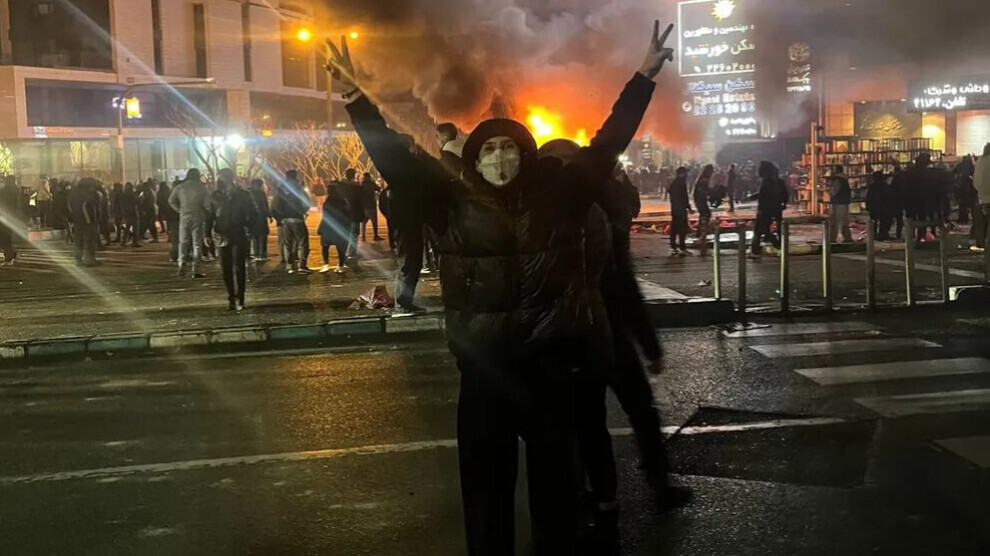
The recent protests in Iran, while seemingly linked to economic and livelihood demands, are at their core an extension of collective memory and past struggles. At the heart of these movements lies the philosophy of the "Jin Jiyan Azadî" movement as a powerful and inspiring force. The movement has redefined the role of women, moving them from the margins to the forefront, and transformed street protests into a bold, mass movement. Thus, these protests can be seen as a continuation of the Jin Jiyan Azadî uprising.
Three years after the Jin Jiyan Azadî uprising, it has become clear that it was not merely a fleeting protest slogan, but rather a comprehensive intellectual and value system. This system unites women as independent beings bearing their own responsibilities, life in the face of the death-defying policies imposed by the patriarchal state, and freedom as a philosophy of living and a universal demand that transcends politics to encompass society and culture.
This uprising removed the barrier between feminist demands and general demands, proving that women's issues are the issues of society as a whole. Therefore, even in the recent protests focused on living conditions and economic inequality, the impact of this reality is clear, confirming that the spirit of the Jin Jiyan Azadî uprising remains present and active.
The active presence of women on the front lines has changed many negative perceptions and the prevailing patriarchal views in society. Contrary to narrow assessments, women in the recent gatherings were not merely participants, but rather initiators and organizers of the movement. Their presence on the front lines, raising slogans, and standing firm in the face of repression is a natural extension of the Jin Jiyan Azadî uprising. This leadership shattered the traditional image of protest as a "masculine" act and declared the end of the notion that men alone determine the fate of societies. Through three years of women's resistance and resilience, Iranian society has realized that building a free life cannot be achieved without women, and more importantly, that it is impossible to live freely without them.
The philosophical discourse of the uprising has imbued the language of protest with a deeper human dimension and social resonance. As seen in recent protests, the focus has been on human dignity in the face of poverty, gender discrimination, and political oppression. Furthermore, the use of feminist symbols and the body in protest actions has demonstrated that the issue is not merely a feminist demand, but a call for a dignified life for all—a core principle directly derived from this discourse.
Women, particularly the younger generation, have played a crucial role in broadening the scope of the protests and breaking down the barriers of social fear. Through their courage, they have sown the seeds of freedom in the streets and alleys of Iran. The Jin Jiyan Azadî uprising has proven that the female body, long targeted for control and oppression, can be transformed into an instrument of resistance and a symbol of liberation. This experience has become a symbolic asset for the popular movement, encouraging various segments of society to actively participate and join the march toward freedom.
Although the recent protests may appear limited in time or sporadic in their manifestations, they are, in essence, an extension of a long-term social movement. The Jin Jiyan Azadî uprising taught women that the street is a legitimate space for their existence, and that politics is not confined to official institutions. Therefore, no social change can be achieved without the active participation of women. This is why, even in protests of an economic nature, women have continued to carry the moral and ethical dimension of the movement.
The recent protests in Iran cannot be understood without recalling the profound impact of the Jin Jiyan Azadî uprising—a discourse that opened a historical revolutionary horizon and moved women from a position of oppression to one of conscious and active leadership. The street has become a space for redefining the philosophy of this uprising, where women are no longer merely part of the ranks of the protesters, but a force that gives the dissent its direction and meaning—a force that will not be erased from the collective memory of society, even in moments of temporary silence. Every revolution emerges from a historical and social context, and the Jin Jiyan “Azadî” uprising is simultaneously a historical event that reflects the realities of the present, and an embodiment of a long social path filled with women’s resistance.