
Interactive meeting in Tunisia to enhance media's role in combating violence against women
UN Women and CAWTAR's interactive meeting highlighted developing media coverage of violence against women, rejecting normalization, and using technology to protect victims and facilitate their access to justice.
ZOHOUR AL-MASHARQI
TUNISIA— Participants in the interactive meeting agreed on the necessity of working between international and local institutions and the media to develop journalistic treatment of violence against women and girls, especially technology-facilitated violence, by adopting a rights-based approach and precise terminology that rejects justification or normalization.
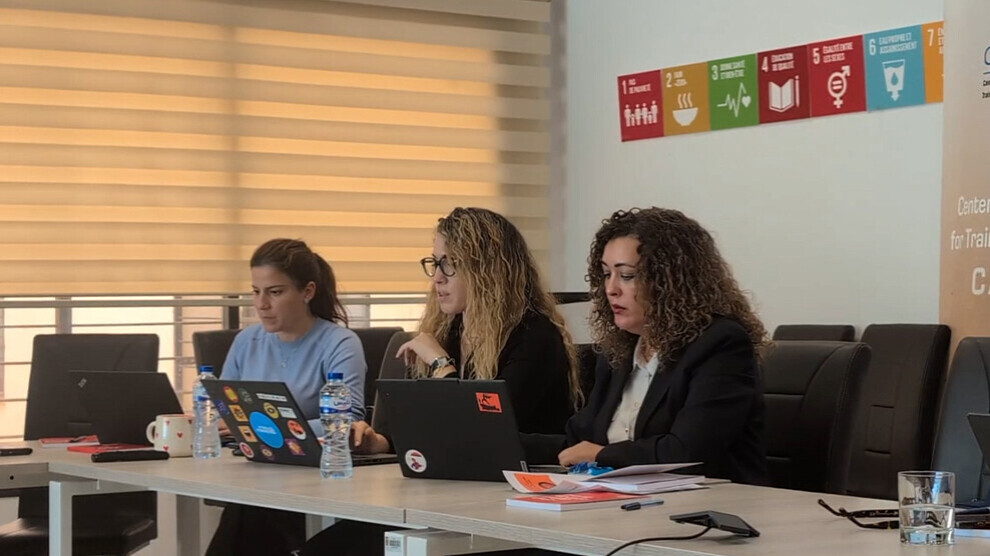
An interactive meeting was organized yesterday, Friday, November 20, in Tunisia, for the benefit of journalists and media professionals, in partnership between the United Nations Population Fund (UNFPA), UN Women, and the Arab Women's Center for Training and Research (CAWTAR). This meeting comes days before the launch of the 16 Days of Activism against Gender-Based Violence campaign, with the aim of activating the media's role in eliminating stereotypes and protecting victims.
Media has a pivotal role in awareness
Loubna Najar from the Arab Women's Center for Training and Research (CAWTAR) said that the awareness meeting proceeded from belief in the role of media in shaping perceptions and enriching public debate on critical issues related to the rights of women and girls, especially with the emergence of new terminology and emerging forms of violence that transcend the traditional patterns in circulation.
She added that media plays a pivotal role in awareness and questioning erroneous ideas and perceptions, which requires it to possess appropriate mechanisms to address violence issues according to a rights-based approach and with precise and correct terminology capable of deconstructing its various forms and mechanisms. "The interactive meeting, despite being limited to half a day—a duration that may not be sufficient—represented an opportunity for joint thinking about mechanisms for confronting technology-facilitated violence and ways to raise awareness of it with a rights-based approach."
She expressed her hope that this will be reflected in media practices and content produced by journalists, affirming that civil society, UN agencies, and media meet at the same objectives, and the possibility of intersection in multiple issues that enhance women's rights and introduce the various forms of violence against women and girls.
"Journalists must be equipped with knowledge"
For her part, Mariam Ouled Al-Shaib, a communication analyst at the United Nations Population Fund, stated that the interactive meeting with a number of journalists was dedicated to discussing media coverage of violence against women and girls issues, with a focus on technology-facilitated violence as an emerging pattern that calls for discussing professional and personal practices alike. "The journalist, male or female, is a human being prone to error, but correcting this error through self-adjustment of media practices represents a shared responsibility between civil society, journalists, and actors in the media sector," noting that the meeting was held days before the launch of the international 16-day campaign with the aim of equipping journalists with the knowledge necessary to cover its events and content.
Mariam Ouled Al-Shaib recalled the national slogan of the campaign "Ma Femmach 3lech" (There's No Reason), which rejects the normalization of violence or minimizing its danger in all its forms, including technology-facilitated violence. She pointed out that the regional slogan of the United Nations Population Fund "Name It" aims in turn to put things in their proper perspective and name this behavior as explicit violence that does not accept justification, stressing the need to believe the victim and show solidarity with her, and the combined efforts of all, including the media sector, to combat and reduce violence, reaching zero cases of violence against women and girls or gender-based violence.
"Converting listening centers into a digital service"
For her part, the president of the "Kalam" association, Feryal Jeradi Sharafeddine, said that the association launched two weeks ago a platform that works on converting the listening and guidance center for women victims of violence into a virtual digital service, so that the center's services reach the victim directly without the hardship of movement or the psychological pressure resulting from it.
She pointed out that the platform is based on three main axes. The first is an artificial intelligence tool with a feminist orientation as much as possible, which works to inform the victim of her legal rights, listen to her, and provide empathetic support that clarifies that violence is unjustified. The second axis allows the victim to report and attach evidence, such as screenshots and links, if she wishes only to communicate with platforms and companies such as Meta and TikTok to limit violence.
She indicated that the third axis enables the victim, if she chooses to resort to the judiciary and file a complaint, to communicate with a lawyer or psychological specialist, and book the appropriate appointment and time for her directly to follow up on her path on her own, with the association covering the lawyer's fee. "Employing technology in this platform lightens the burden on civil society organizations and victims alike, and makes the path easier and smoother."