
“Hope” Festival…A Platform for Reviving Kurdish Theatre in Its Mother Tongue
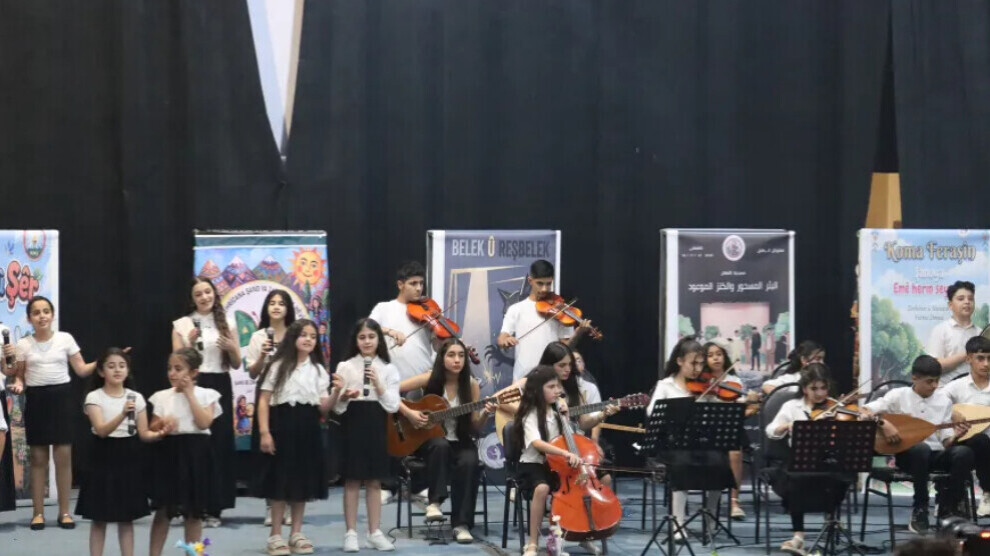
The “Hope” Children’s Theatre Festival in Qamishlp launched with hundreds of children, showcasing emerging talents and theatre’s role in strengthening cultural identity.
NAGHAM JAJAN
Qamishlo_The field of culture and the arts is among the most important domains for developing children’s imagination and creative abilities. At the same time, this field enhance children’s self-confidence, cultivates values of communication and cooperation, and plays a significant role in building a conscious and creative generation.
The first edition of the “Hope” Children’s Theatre Festival was launched in the city of Qamishlo on
on the evening of Tuesday, June 16, under the slogan "Theatre in the Mother Tongue Is Beautiful." The festival is organized by the Culture and Arts Authority in cooperation with Çiya Theatre and the Golden Crescent Movement (Hîlala Zêrîn). It is the first of its kind in Rojava and will continue until today.
Approximately 600 children and 7 theatre troupes are participating in the festival, which aims to showcase children's talents and enhance their presence in performing arts. Various artistic and cultural works prepared by children from different cities are being presented.
"Great Enthusiasm"
Speaking about the Children's Theatre Festival, organizing committee member Zelan Majeed stated that the children showed great enthusiasm for participating in the festival's activities. She noted that preparations lasted for about three months, during which the organizing committees worked intensively through continuous meetings and discussions to ensure the event's success.
She pointed out that theatre is a universal art, but the repressive policies of the former Ba'ath regime made the use of the mother tongue prohibited, preventing theatrical performances in the Kurdish language for many years. Today, children feel great enthusiasm to revive this art in their mother tongue and are eager to present their theatrical performances with passion.
She explained that the festival, in its general vision, includes all regions of Kurdistan, but is currently being held within Rojava. "The same festival will later be organized in Kobani."
She added: "Syria, and particularly Rojava, is going through a complex political phase and challenging circumstances. Despite this, a large number of children have gathered and participated in theatrical preparations with high morale, which in itself is an important achievement. The festival lasts for two days, with theatre troupes participating from several cities in Rojava, in addition to a troupe from the Armenian community that will present theatrical performances in their own language and culture."
Theatre Doors Are Open to All
Regarding the festival's objective, she affirmed that all children aim to showcase their talents and intelligence and to be empowered to express themselves freely. "Theatre gives children the opportunity to work collectively and provides an important space that helps them become familiar with their own culture and learn the foundations of Kurdish theatre." She called on parents to bring their children to watch the performances, emphasizing that participation is open to every child who wishes to experience theatre—the doors are open to everyone.
On the first day of the festival, participants performed the songs "Ey Hevala Evîndar," "Haylê Dînê," and "Canê." The Dengbêj Children's Group Pargîn also presented several performances along with folk singing in traditional Kurdish attire.
The Martyr Feraşîn Theatre Troupe presented the play Mişk û Şêr (The Mouse and the Lion), while the Baronyan Troupe presented Bîra Bi Sêhr (The Magical Well) and Gencîneya Sozdayî (The Promised Treasure). The Martyr Shiyar Troupe presented Dadwerê Biçûk (The Little Judge), and the Golden Crescent Troupe presented Belek û Reşbelek (The Spotted and the Black-Spotted).
The second day of the festival will open with performances by the Martyr Erdal Theatre Group, the Martyr Feraşîn Troupe, the Yekpar Troupe, and other participating groups, each presenting their theatrical works before the audience.