
“Honesty Is Nakedness”: Writer Rafiqa Al-Bahouri in Confrontation with the Self and Society
Writer and feminist activist Rafiqa Al-Bahouri sees her autobiography as healing after years of pain, liberating her through writing and offering courage to women still searching for their true selves.
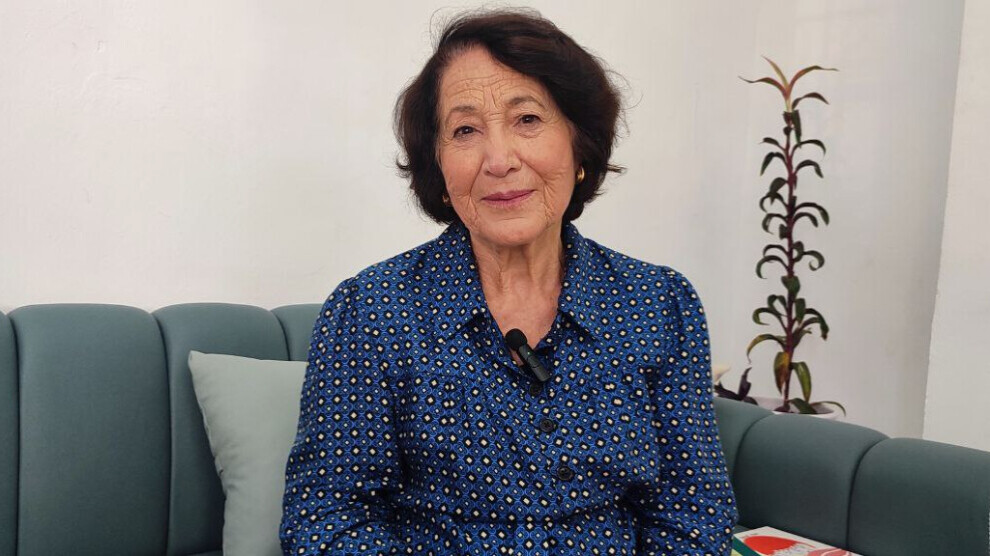
Zahour Al-Mashriqi
Tunis — Through her autobiography and novels, Tunisian writer Rafiqa Al-Bahouri has sought to encourage women to speak out, break the barriers of pain and fear, and liberate and rescue themselves before they burn out. She believes that a woman will not free herself from internal and external constraints unless she dares to lose her way, take risks, and endure hardship in order to become the master of herself and the owner of her abilities.
After years of repression and emotional fractures, Tunisian writer and feminist activist Rafiqa Al-Bahouri found in writing a cure that restored her to herself and gave her the strength to confront fear and shame. She declares that a woman is not liberated unless she dares. In the following interview, we delve deeper into her inner world.
Why did you choose autobiography in “Salty Waters,” where disappointment and disillusionment dominate? What did you want to say through it?
Throughout my life journey, I found myself facing contradictory choices—between an outwardly successful image and an inward self burdened with conflict. My life appeared full of achievements: I studied, married, built a family, and engaged in civil society. Yet behind this image lay another story. From the beginning, I faced my father’s refusal to educate girls, but my brother secretly enrolled me. I clung to that opportunity to prove my ability to break restrictions and sought to be a modern woman equal to men, despite obstacles and betrayals.
What I lived is the reality of most women who are seen as deficient and forced to double their efforts to prove their worth. I formed a strong image in society’s eyes, but it did not reflect my deep self, filled with sorrow and fractures. I concealed my essence behind an artificial shell until the burden became unbearable. A decisive moment came after forty, when my suppressed self exploded and poetry flowed from my tongue like a flood long held back.
Later, in my sixties, I began writing my autobiography “In Salty Waters,” realizing that honesty can only be achieved through reconciliation with one’s deep self, and that writing succeeds only when one truly values oneself.
What does it mean for a woman in the region to dare to write her autobiography honestly, without embellishment or evasion? How did you experience this, and how satisfied are you with it?
I spent eight years writing, stopping, returning to the pen, then abandoning it again—because my greatest obsession was honesty. My goal was not merely to write a book, but to undergo an existential experience that transcended literature, one that revealed my true self. I read autobiographies by Arab women writers and found them vague, lacking true self-exploration, and I did not want to add another such work.
I told myself: either I write honestly or I do not write at all. My struggle was not with society or with traditional authorities like religion or politics, but with myself—with pain, pride, and shame that prevented me from confronting my truth. From here came my conviction that “honesty is nakedness.”
In my autobiography, I revealed things even those closest to me did not know. I portrayed myself in difficult situations and disclosed secrets I had never spoken of before. Confessing my private life was a major challenge; by nature, I am shy. But I realized that the crises I lived through were essential to the autobiography—among them my marital relationship, which I hesitated long to document, my father’s image that contradicted stereotypes, and coercive relationships within the family and with colleagues. I wanted my autobiography to be transparent, hiding nothing people are accustomed to concealing, because a woman’s personality is shaped by all these details.
Today I feel satisfied. I believe I accomplished what I could. From a feminist perspective, I see that I took a step toward encouraging women to speak about what is silenced. I wrestled with my pride, my modesty, and all the constraints that shackle women. I overcame social barriers that were not the greatest obstacle for me. What I wrote contains a boldness that satisfied me, because it presented everything that contributed to shaping my personality on both psychological and social levels.
I spoke about my activities and work, but I gave equal attention to my feelings and emotions, to what I considered obstacles in my path and how I overcame them. Honesty was my refuge and my salvation; I sought it and found comfort and serenity in it. That is why I am happy with this autobiography, and winning the award for “Best Female Creativity on Rights and Freedoms” was a form of vindication.
Do you believe that novels and writing are still capable of being tools of struggle and resistance, even in an era of declining reading habits?
A book is an act of resistance. It addresses the mind, emotion, and soul, and delves into the depths of the human psyche, carrying a power for change that surpasses fleeting ideas or rapid images. It draws the reader in and leaves a deep impact. Ideas continue to advance even if not everyone reads everything written, because a word born of a book has wings that carry it far and wide.
For a long time, books were the primary vessel of knowledge. Even when their circulation was limited to cultural elites, they retained the ability to create wide impact through these influencers. This confirms that books are the essential tool for breaking the chains of ignorance and backwardness and opening horizons of liberation. Women, in particular, have no alternative but to open themselves to new ideas, as traditional heritage often marginalizes and excludes them. Thus, it becomes necessary to read this heritage critically, filter and question it, while also welcoming the new with an open mind—because that is the path to real change.
How does Rafiqa Al-Bahouri view the current state of the feminist movement in Tunisia and the region? What differences do you see between your generation and today’s generation?
Historically, women’s reality was extremely harsh, though it gradually improved. Women were deprived of education and basic aspects of life, forced to veil, and even cutting one’s hair or wearing trousers was a battle. I personally fought those battles. These sacrifices allowed later generations to surpass constraints that once seemed impossible.
Still, violence against women remains a major obstacle. We started from a condition akin to slavery, without rights, and today we demand equality and freedom—a transformation incomparable to the past. Yet the road is still long. While women overcame barriers to education and public presence, new forms of violence and domination emerged. Despite laws in Tunisia that guarantee women’s rights, the real challenge lies in implementation, requiring awareness campaigns and continuous pressure.
A key development today is the emergence of young feminist movements. After independence, there was only the Muslim Women’s Union founded by Bchira Ben Mrad, followed by the Women’s Union that focused on integrating women into education and work. Later it became the Tunisian Women’s Union and its role weakened.
The positive shift was the emergence of many associations, most notably the Tunisian Association of Democratic Women, which organized regional and international networking conferences. I recall a 2011 meeting with Iranian activist Shahla Shafiq, who warned us against repeating Iran’s experience, where a revolution turned into a reality hostile to women. Such meetings expose women’s realities and build cross-border collective awareness.
Today, youth organizations raise demands unimaginable to our generation. Women are more aware of their rights and the threats to them—whether they are educated, workers, or farmers—ensuring the development of those rights. International forums also play a vital role in unifying efforts. Violence against women no longer passes in silence; it is met with public condemnation by media and associations, which strengthens hope for the future.
Women today have better tools of struggle. In the past, raising one’s voice was nearly impossible under family pressure and dominant mentalities. Silence was imposed on women, newspapers and radio were closed to them, the internet did not exist, and associations were state-controlled. Today, the situation is completely different: the revolution and the internet have provided vast spaces for expression, making protest and assembly possible and strengthening activism. The struggle continues, and women’s resistance does not cease.
What is the importance of feminist solidarity today in building a strong regional African feminist generation?
As the saying goes, “one hand does not clap.” The more women unite, the greater the results and the deeper the strength. We are extensions of one another regionally and internationally. Diverse feminist experiences, despite differing contexts, add to a collective legacy and open new horizons.
The Tunisian experience, for example, is pioneering in legal reforms thanks to intellectual changes and women’s struggles since colonial times. In the region, the experiences of Lebanon, Palestine, Syria, and the Kurdish movement enrich the scene, especially under repression and conflict where women are forced to invent new methods to amplify their voices.
A symbol of global solidarity is the song from South America that exposed sexual harassment and spread in multiple languages to become a transcontinental feminist anthem. When a Tunisian woman chants it, she feels part of a global struggle that doubles her strength. Feminist solidarity holds immense value—there is no greater joy than realizing one’s effort is not solitary, and that one’s voice is part of a collective path toward a better future.
After decades of writing—from the 1980s to post-Arab Spring—despite limited freedoms and setbacks, which period do you find most fertile for creativity?
A writer or artist has a fragile soul, like a sponge absorbing everything around them. Pain, pressure, and restrictions accumulate within and remain present in their work. Difficult times, no matter how harsh, give writing extra power and depth. Writing born of suffering differs from writing about birdsong; those who confronted history and crises produced richer, deeper work.
Writing also needs the ease of freedom. One who writes amid crises writes from the heart of pain and may soar high, but their wounds bleed and may prevent them from expressing everything. These are not only external constraints, but inner ones imposed by sorrow, depression, and tragedy.
I lived this before the revolution. The situation weighed heavily on me, and I wrote short poetic fragments filled with sadness, often ending on a hopeful note—because my nature leans toward hope despite pain. Writing in freedom differs fundamentally from writing under constraint. I wrote about the revolution before it dawned and titled my collection “The Light of Jasmine,” not borrowing from its slogans, but from my own vision and inner sense of what was forming on the horizon