
Hêvîdar Xalid Stresses the Importance of Forming a Women's Lobby to Eliminate the Patriarchal Mentality
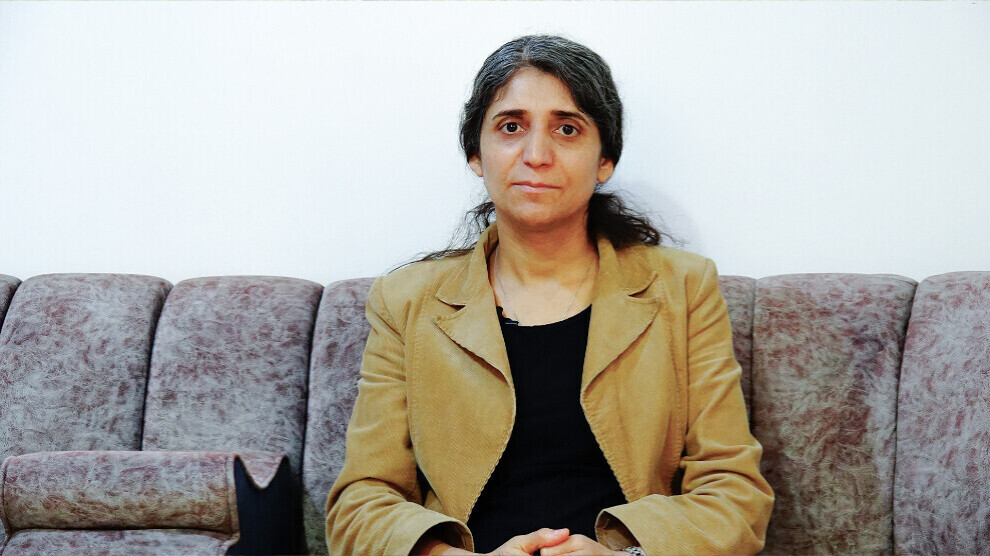
Kurdish journalist and writer Hêvîdar Xalid Stressed the importance of Kurdish and Syrian women building their own organization, in the face of women’s exclusion from the negotiating table and political and constitutional representation in Syria.
SORKEL SHEIKHOU
QAMISHLO_ Simultaneously with the beginning of the implementation of the provisions of the integration understandings signed between the Syrian Democratic Forces (SDF) and the interim government in Rojava on 29 January, it appears clear that the marginalization of women's will and the exclusion of their specificity from the existing scene continue.
In this context, Kurdish writer and journalist Hêvîdar Xalid reviewed for our agency her reading of the current reality, explaining the available alternatives and the concrete steps that must be taken, while identifying the parties concerned with bearing this responsibility.
The Intellectual Background That Governs Syria Today
Hêvîdar Xalid noted that the agreement of 29 January came at a time when the country was witnessing a crisis and a political war, which made it a new, difficult, and highly sensitive phase for all parties in Syria. "Simultaneously with the integration, important changes and discussions occurred in Rojava. Kurdish women here achieved many gains, but after the fall of the Baath regime and a new government taking over Syria, whose basic background is Hay'at Tahrir al-Sham, the situation changed. We know well where this authority came from, and what the background is in terms of the system and the mentality with which it governs the country. Therefore, this current mentality imposes on us a strong struggle."
She explained that the government that relies on Sharia has placed women's gains in danger today. "There was a need for women to protect the system they created; starting from the co-presidency system, legitimate defense, self-administration, and self-organization. Until this moment, the government has no strategies or plans, nor even an idea about how to enable women to take their place and play their role at the legal and constitutional levels, and on the principle of equality in Syria."
She added: "Today, women's representation rate in the Syrian People's Assembly is about 10% (equivalent to 0.48 of the total percentage as gender representation), as there are only 22 women out of 210 members in the Syrian Parliament. This percentage is a very small representation for women, as their representation rate should not be less than 20%. Due to the absence of strategies and projects, their participation rate remains weak."
She recalled the position of one official in the education sector, asking: "If women are stripped of the prestige of education, will men restore it?" She spoke about the mentality imposed today. "They want to push women away from the conditions and developments in Syria. The government's and its officials' endeavors to exclude women from the Syrian scene remind us of Afghanistan, and how the Taliban destroyed women's gains. They cannot build Syria with a thought that separates girls and boys, imposes the hijab, and targets women's science."
"What Is Expected from a Government That Does Not Tolerate a Painting of a Kurdish Woman's Braid?"
Hêvîdar Xalid confirmed that building Syria will not be achieved without women's leadership and equality, noting that male delegations coming to Rojava ignore women's thought because of their patriarchal mentality. She also cited the attack by "government-backed groups" in Hasakah governorate on paintings bearing the slogan (Jin Jiyan Azadî) and women's braids, which reflects the authority's hostility to Kurdish women's rights and undermines hopes for change.
She believes that in the face of all these difficulties, women must build their solidarity and move in the constitutional and legal arenas. "The government has not yet defined its approaches toward the status of women or toward personal status law, and has not taken women's gains into consideration."
She explained that the interim government has not yet shown any response regarding the existence of the Women's Protection Units (YPJ) and the playing of their role in Syria's future. Regarding the steps that must be taken, she said: "The Women's Protection Units must remain preserving their specificity, and protect and obtain their legal and constitutional existence in Syria. This also applies to all women's movements. And if they are not protected in this way, all these gains will dissipate and disappear before the imposed policies."
She stressed the necessity for women to establish their own lobby. "Women possess sufficient capabilities and awareness that, if they unite, can defeat the jihadist and extremist anti-woman mentality."
She noted that beyond formal and symbolic assignments, a greater responsibility falls on women. "Formal assignments alone are not enough; women need to exercise their actual role in their political and administrative representation within all governmental, social, and women's institutions."
"Follow-Up Committees Must Be Formed for Violations Committed Against Women"
Hêvîdar Xalid explained that statements of condemnation and denunciation alone are no longer useful, demanding the necessity of forming follow-up and accountability committees for killers and criminals in order to put an end to the plans and scenarios targeting women.
Regarding the crimes of killing, violence, and kidnapping to which women are subjected in Syria, she confirmed that protecting women falls on the government, because the violations committed against women "occur under its control and by groups supported by it, and are not groups outside the law."
At the end of her interview, Hêvîdar Xalid stressed the necessity for human rights organizations and women's rights defenders to work on the ground, and to create their own protection and punishment mechanisms.