
Ground fertile for Democratic Revolution amid Collapse of Iranian Regime
An article by Jineology Academy member Bahar Orin
The Middle East, and specifically Kurdistan, is once again witnessing pivotal events and profound transformations. During the past year, with the launch of Abdullah Öcalan's call for "peace and a democratic society," the Kurds have sought to establish a foundation for dialogue and democratic integration with the state. Simultaneously, the outlines of a new regional order have begun to take shape, with the escalating role of Israel and other hegemonic powers.
As historical experience confirms, crises and chaos often contain revolutionary opportunities, as was the case with the Rojava Revolution, which emerged from regional developments in 2011. Today, the current protests in Eastern Kurdistan and Iran possess the same potential to become a central force in future changes. Therefore, any progress or positive transformation in any part of Kurdistan will inevitably have repercussions for the other parts, making them all part of a comprehensive process of change.
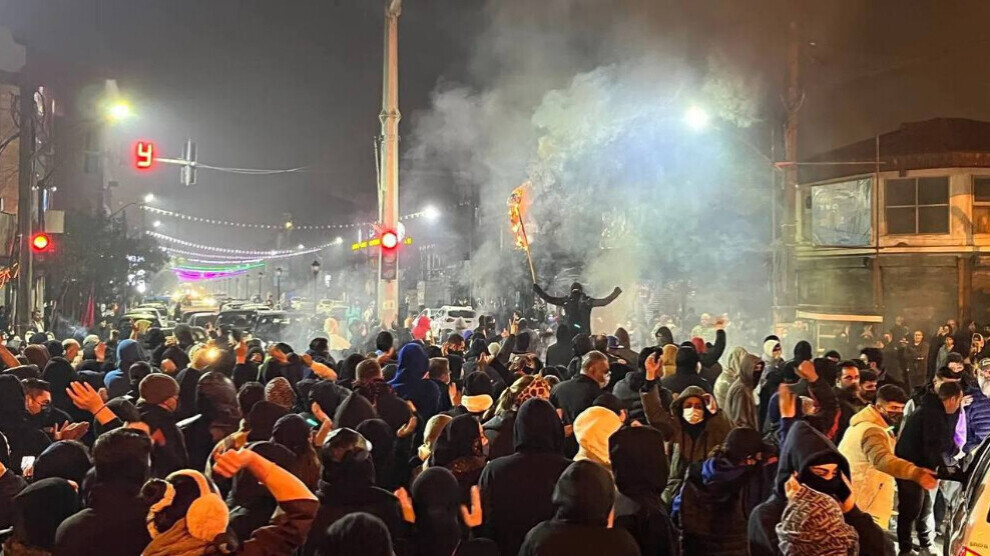
In the final days of 2025, a new wave of popular uprisings erupted in Iran and Eastern Kurdistan, building upon the Jin Jiyan Azadî uprising, revealing a period of profound transformation. The Iranian regime's policies of denial and intensified repression, coupled with the suppression of all aspects of life, led to a widespread explosion of popular anger.
Weary of poverty, injustice, and discrimination, the Iranian people resolved this time, despite the heavy sacrifices, to move forward toward revolutionary change in society. Their revolutionary stance and their insistence on change represent a decisive factor in shaping the future, where the people themselves determine their destiny and their lives.
With the deepening crisis of legitimacy and the political and structural collapse facing the Iranian regime, the ground is ripe for a democratic revolution. In this context, democratic movements and organizations in Eastern Kurdistan can capitalize on this historical moment through coordination, cooperation, and the adoption of clear and unified programs and mechanisms to become active participants in the coming transformation.
Undoubtedly, women constitute the cornerstone of any revolution, as the "women's issue" remains one of the fundamental issues of this century. Abdullah Öcalan, in his call for "peace and a democratic society," emphasized the importance of organizing women and strengthening their struggle, referring to what he termed the "culture of rape."
From his perspective, women cannot achieve their freedom until this culture is eradicated from society. Rape is not limited to its sexual form but manifests in multiple ways, and it is a direct product of the culture of patriarchal power with deep historical roots.
Therefore, the women's issue remains a fundamental and indispensable one, and it must remain a central priority for any revolution seeking to build a free and democratic society.
Women played a pivotal role in the Jin Jiyan Azadi uprising, and today they are once again capable of leading popular democratic uprisings. Faced with systematic exclusion policies and attempts to marginalize women through sexual repression and structural violence, the urgent need to strengthen women's presence and highlight their importance in the course of the revolution is paramount.
Women in Iran face multifaceted pressures, and recent years, particularly since the outbreak of the uprising, have witnessed an escalation of violence against them—organized violence perpetrated as a form of revenge to subjugate them. Nevertheless, Iranian women have demonstrated exceptional courage, transforming every constraint and obstacle into an arena for social and political struggle.
The radical stance of women and their dismantling of traditional structures during this uprising has dealt a severe blow to the ruling ideology, while the regime remains unable to contain their growing energy and resistance.
Perhaps the most prominent characteristic of democratic revolutions is their popular nature. This makes it crucial, at the height of the popular uprisings in Iran and Eastern Kurdistan, to be wary of attempts to circumvent or hijack the revolution. If we examine the history of social movements, we find that the global colonial system has always sought, directly and indirectly, to distort revolutions and movements against hegemony. Therefore, preserving the political and social essence of the revolution is a fundamental factor in its success.
The Jin Jiyan Azadî uprising has produced new values and a culture of resistance in Iranian and Eastern Kurdistan society. It has restored women to the heart of society and reconnected them with life itself. The philosophy of this uprising is based on the premise that the freedom of society and life can only be achieved through the freedom of women.
Abdullah Öcalan has emphasized that the true measure of socialism is how men treat women, and that the foundation of socialism lies in the liberation of women. Historical experience has proven that ignoring the women's issue and considering it secondary to national or class issues has only prolonged crises.
In this context, Kurdish women possess great experience in political, organizational, intellectual and defensive struggle, which can form the basis for an inspiring women's revolution for all women. The Jin Jiyan Azadî uprising brought women together around common demands and paved the way for a comprehensive women's revolution. Hence, achieving this revolution in Iran and East Kurdistan today requires, more than ever, women's unity and the adoption of clear programs that lead to radical revolutionary changes.