
Gaza: Deaths from Bombing, Rubble Removal Could Take Years
Medical sources reported that an Israeli airstrike killed 13 people in the Gaza Strip, including an elderly woman. The UN warns that the massive destruction in Gaza could mean that rubble removal could take over seven years.
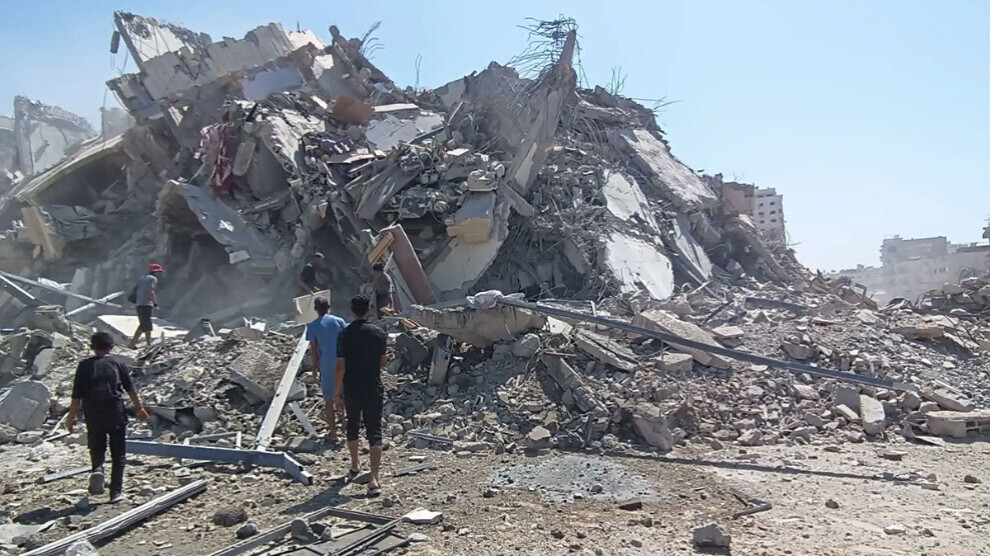
News Center – The effects of the war in the Gaza Strip are escalating to unprecedented levels. Airstrikes and shelling have caused widespread destruction of homes and infrastructure, leading to the collapse of essential services such as healthcare, education, and water. Residents are living in dire humanitarian conditions amidst severe shortages of shelter, fuel, and basic necessities.
Medical sources in Gaza reported on Friday, January 16, that 13 people were killed in the past 24 hours as a result of Israeli airstrikes and operations targeting various areas of the Strip. The sources added that the latest victim was an elderly woman killed when Israeli forces opened fire on a camp for displaced people in the Mawasi area. She was sleeping inside her tent when the attack occurred, killing her instantly and injuring several other displaced people, some of whom are in critical condition.
The Gaza Strip witnessed a series of intense Israeli airstrikes targeting several areas, most notably two residential buildings in the central Gaza Strip. The bombing of a house in Deir al-Balah killed one person and three others, while in the Nuseirat refugee camp, Israeli aircraft bombed a house, killing a man and his wife and injuring several others.
Israeli forces also launched a series of airstrikes on neighborhoods east of the Zeitoun and Tuffah districts, and opened fire on Palestinians attempting to reach their agricultural lands near the so-called "Yellow Line," areas under Israeli control.
Rubble removal may take seven years
The humanitarian crisis in the Gaza Strip is worsening to an unprecedented degree. The United Nations has warned that the sheer scale of the destruction poses enormous challenges to relief and reconstruction efforts, emphasizing that clearing the rubble alone could take many years.
The Executive Director of the United Nations Office for Project Services (UNOPS) explained that the Strip contains more than 60 million tons of rubble, equivalent to the cargo of approximately 3,000 container ships. He noted that the removal process could extend for more than seven years, as every person in Gaza is now surrounded by approximately 30 tons of rubble.
The UN official stated that the population of Gaza is experiencing exhaustion, shock, and despair. He stressed that harsh weather conditions are exacerbating the suffering of the population, and that the recovery of nearly two million people urgently requires the provision of safe shelter, fuel, and the commencement of rubble removal.
For their part, UN and international reports indicated that the scale of the destruction encompassed housing, infrastructure, and basic services. The UN Satellite Analysis Programme (UNOSAT) revealed that 78% of buildings and facilities in Gaza had been destroyed or damaged as of July 2025, including more than 436,000 housing units, equivalent to 92% of the total housing stock. Images also showed that 77% of the road network was unusable, hindering civilian movement and relief efforts.
In the education sector, the UN confirmed that 91.8% of schools—518 out of 564—required complete reconstruction or repair. In addition, more than 2,300 educational facilities, including universities, were destroyed. As for the health and water sector, a joint report by the World Bank and the UN confirmed that 84% of health facilities were damaged or destroyed, while water production had fallen to less than 5% of its previous level, with approximately 89% of water and sanitation infrastructure damaged.