
Filiz Budak: The Aim of the Attacks Is to Create Racial Divisions Among Peoples
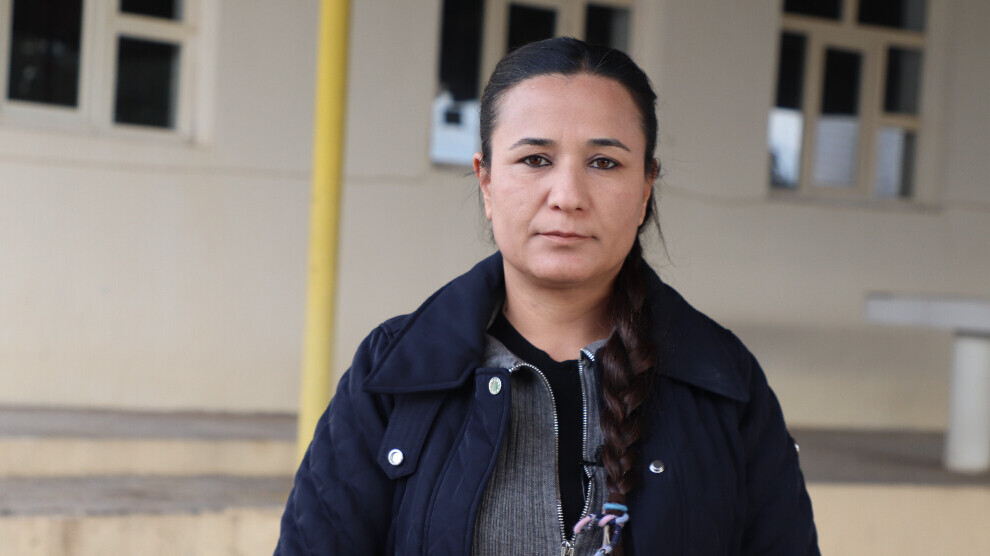
Filiz Budak, Co-Chair of the People’s Council in Makhmour, confirmed that the attacks on Rojava aim to sow racial divisions among the people, stressing the necessity of launching a call for unity among peoples to confront these plans.
BERJIN KARA
Makhmour —Since January 6 of this year, militants of Hayat Tahrir al-Sham, in coordination with international powers—most notably the Turkish state—have launched attacks targeting the people of Rojava. These assaults have resulted in dozens of casualties and have focused on vital infrastructure, including electricity, food supplies, and drinking water, in an attempt to cripple the basic foundations of life.
Despite the intensity of the attacks and the hardships they cause, the people of Rojava continue to demonstrate exceptional and unparalleled resistance. At the same time, people from across Kurdistan—from the north, south, and east—are heading to Rojava to defend their dignity and honor. Meanwhile, masses in various parts of Kurdistan and beyond have risen up, organizing widespread demonstrations to unify their voices and call for resistance against these attacks.
In Martyr Rustem Cudi Refugee Camp (Makhmour), residents have also risen up, organizing continuous activities day and night. They have launched a 24-hour solidarity campaign in support of the resistance in Rojava and in response to the call for general mobilization. Through these actions, the people of Makhmour reaffirm their unwavering stance alongside the popular resistance in Rojava until victory is achieved.
Filiz Budak, Co-Chair of the People’s Council in Makhmour, spoke about the policies and attacks targeting Rojava, clarifying the dimensions of these assaults and their repercussions for the Kurdish people.
“The Attacks on Rojava Contradict the Peace Process”
Filiz Budak emphasized that imperialist ruling powers stand behind these attacks, stating that their primary objective is to eliminate the project of Abdullah Öcalan based on the unity of peoples.
“The attacks on Rojava are not merely an attempt to seize a city or land; they are a direct assault on the project of Leader Öcalan in the Middle East, which is founded on building unity and brotherhood among the peoples of the region as an alternative to the policies of dominant powers that continuously ignite wars and crises. This system has already begun and has found its concrete expression in Rojava, where the foundations of the Democratic Nation have been firmly established, with the participation of Arabs, Assyrians, Turkmen, and Druze alongside the Kurdish people, within an inclusive confederal system. From this perspective, the current attacks target Leader Öcalan’s project, which calls for peace and the construction of a unified democratic society, because the coming together of the peoples of the Middle East under one umbrella would undermine the calculations of imperialist powers that have sought for centuries to impose political and economic domination over the region.”
She pointed out that imperialist powers have worked for centuries to divide the Middle East.
“Since 1639, with the Treaty of Qasr-e Shirin, Kurdistan was divided into two parts under the rule of two states. Then, in 1924, with the Treaty of Lausanne, it was divided into four parts, leading to the emergence of four new states with autonomous governance. In the process of redrawing the map of the Middle East, 22 Arab states were created. Thus, throughout history, dominant powers have pursued policies based on dividing and controlling the region, turning peoples into enemies and demonstrating their rejection of the idea of coexistence.”
“Everyone Must Unite Today to Support the Resistance”
Filiz Budak stressed that the attacks on Rojava pose a threat not only to the region but to the entire world, emphasizing that unity among peoples is the only way to confront this danger.
“Leader Öcalan sought through this project to bring peoples closer together, because the only path to stability in the Middle East is the unity of peoples. When we view the current attacks in this context, they are not directed solely against Rojava; they will be repeated wherever the Kurdish people achieve gains, whether in the north, south, or east. This threat targets every nation striving to build unity among peoples and rally around this project. Therefore, friends of the Kurdish people, their neighbors, and democratic forces opposed to domination must unite today to support this resistance. This danger also targets the women’s revolution—the Rojava Revolution, in which women have been at the forefront.”
She explained that the attacks on Rojava are not merely military operations, but an ideological war that threatens the existence of all peoples, noting that “dominant powers are attempting to spread terrorist gangs in Iran and Iraq, reflecting a broad danger that extends beyond the borders of Rojava.”
She added that these policies target the Kurdish people through the use of ISIS, and that Kobani has become a source of deep concern for them following the success of the Rojava Revolution there. Through daily patrols, military convoys, and airstrikes, the Turkish state seeks to send a message that the victory of Kobani will not endure.
She stressed the need to recognize the scale of the danger threatening Rojava and Kurdistan as a whole, calling on the people to unite in the face of these threats.
Filiz Budak further noted that the attacks on Rojava aim to create racial divisions within society, emphasizing that these policies exploit Arabs—whom the Kurds stood beside in the fight against ISIS—in an attempt to turn them into tools against the Kurds. She stressed that such practices threaten the unity of all peoples, and that the response must be to strengthen resistance and call for unity among Kurds, Arabs, Persians, Armenians, and Turks, away from the schemes of ruling powers.
She concluded by reaffirming the support of the people of Makhmour Camp for the people of Rojava, stressing that they will continue to stand firm and provide all forms of support until the end—whether through material aid, campaigns, or mobilizations. She stated that these attacks target the very existence and will of the Kurdish people, affirming that their slogan will remain, “Resistance is life,” and that they will continue the struggle until victory is achieved.