
Femicide Crimes Are on the Rise, and the Judiciary Is Not Fulfilling Its Role
Turkey is witnessing repeated violent crimes against women that escalate to murder, with the judiciary bearing significant responsibility for the increase in the rate of these crimes.
Memehan Helpin Zeydan
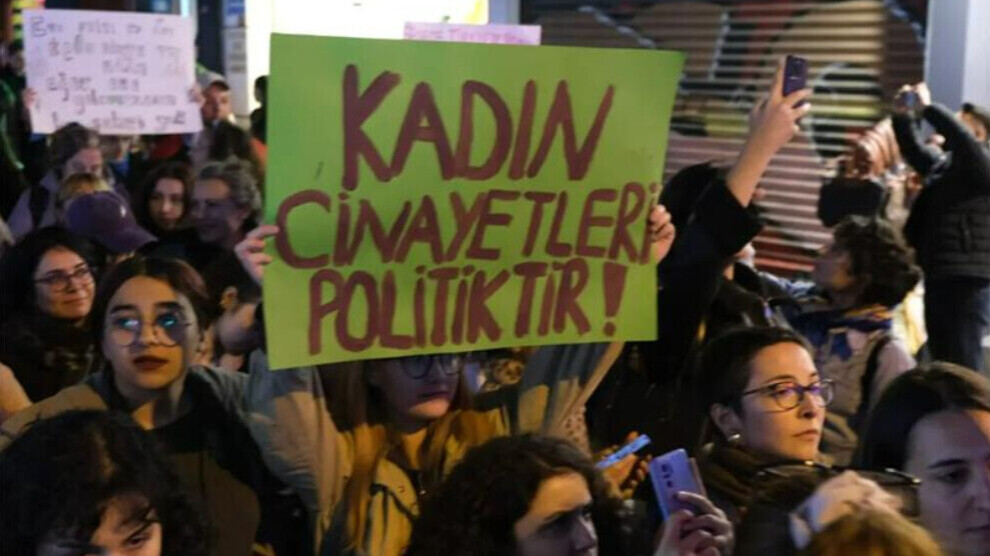
VAN – The issue of violence against women and the associated policy of impunity have led to a renewed escalation of violence in Turkey and North Kurdistan. The tragic events occurring daily reveal stories of violence against women and the chain of negligence in this process that leads them to death. Furthermore, the fact that women are killed despite filing numerous complaints and obtaining protection orders opens up debate about the judicial system in Turkey.
According to data from Turkish and Kurdish women's organizations, 22 women were killed in January, and the bodies of 14 women were found under mysterious circumstances. Reports indicate that during the year 2025, at least 294 women were killed by men, and 297 deaths were recorded as "suspicious."
Protection Orders Do Not Protect Women
Melike Keskin was killed at Erciyes University by her ex-husband, after the perpetrator had been threatening her since 2011. Despite her filing approximately 50 complaints, more than 80 protection orders being issued, and even an electronic monitoring device being attached to the perpetrator's ankle twice, he still killed her.
In Ağrı, 35-year-old Güler Özkan was killed by her husband, a violent man she had reported to the police seven times before.
In Ankara, Recep Cengiz, who had been temporarily released from prison, killed his mother, his child, and the woman he was in the process of divorcing.
Six Women Killed in One Day
During February, on a single day, 6 women were killed. In Istanbul, Filiz Şaban Gül was killed by the man she was divorcing. In Gebze, Aylin Polat was killed by a man against whom a restraining order had been issued. In Van, Gönül Alkan was killed with a firearm by a man who also had a restraining order against him. In Osmaniye, İlknur Koç was killed by her ex-husband. Similarly, in Aksaray, Kübra Kiliç was killed by her ex-husband. The same perpetrator also killed his older cousin, Zeynep Ayaz, with a firearm.
"The Increase in Violence Cannot Be Attributed to a Single Cause"
Lawyer Maria Belderi Borazan, from the Van Bar Association in North Kurdistan, spoke about the policy of violence against women and impunity in Turkey, stating that violence has many causes. "It is not an issue clear enough to be attributed to a single reason. Violence against women continues to increase in all circumstances and at all educational levels. This necessitates evaluating the problem from a more holistic perspective."
Regarding the reasons for the increase in violence, she explained, "We can generally link this to the concept of masculinity, and we need to talk about the existence of attitudes that bring out, feed, and perhaps even revive this concept of masculinity."
"Laws Are Sufficient, But They Are Not Implemented"
She pointed out that one of the main reasons for the increase in femicides is the social perception that fuels "masculinity," the policy of impunity, and also "the absence of preventive protection measures." She emphasized that we should not view the judiciary as a one-sided structure, and that the structure we call the judiciary must also develop preventive mechanisms. "Punishment alone is not enough; in no era of history has punishment alone been sufficient to prevent crime."
She added, "The real problem lies in the judiciary not using its preventive authority. The laws are sufficient; anyone from outside the judicial system can read any law and say, 'No crimes are committed here, there is no violence against women.' Women can obtain restraining orders and protection orders, they can request shelter when needed, they can take refuge in shelters, they can change their identities... There are actually many options available, but unfortunately, we don't see this happening on the ground."
This is because the effective implementation of protection orders is "essential" for women. Maria Belderi Borazan explains that many women in Turkey are still harmed despite the existence of these orders, and that it is necessary to discuss the shortcomings in laws and legislation. "Perpetrators who are imprisoned are released early on parole for good behavior."
"We Must Act According to the Principles of a Democratic Social State"
She affirmed that all forms of violence and discrimination against women are a prominent issue on the women's agenda. "Women's organizations wage all kinds of struggles; they are in the streets and in institutions, but this is not something we can do alone. We women will fight for our rights, but even without us having to fight ourselves, there are structures that must take action before us and operate according to a social welfare state approach."
Committing Crimes During Prison Leave
Regarding temporarily released prisoners committing retaliatory crimes against women, the lawyer pointed out that "men released from prison on leave commit crimes against women or children again." She explained this is because "leaves from prison are not related to political crimes. Perhaps it is necessary to tighten control in this case, especially concerning violent crimes, at least crimes against life. Monitoring mechanisms can be developed, restrictions can be placed on the permits of individuals convicted of these crimes and the like, limiting their presence in certain places and confining them to specific areas of social life."
"The Perpetrator of Violence Must Be Rehabilitated"
Violence against women, as she affirms, is not a problem that can be solved by punishing or imprisoning the perpetrator. "The state must ensure for us the rehabilitation of this person convicted of killing women, because these perpetrators are released after a while. So, it is necessary that they do not remain in prison and worsen further during their detention. The state must guarantee this for us. And while we are still discussing impunity policies, this might seem like a luxury for us. However, we must never stop demanding all our rights."
"Deterrent Systems Are Ineffective and Highly Neglected"
Maria Belderi Borazan believes that for a person with a tendency towards violence, a person who poses a serious threat, non-deterrent decisions are useless. A person ready to kill, as she affirms, will not be deterred from killing by fear of a three-month prison sentence. "What we call a restraining order should actually deter him. As for protection orders, they have been ineffective in this country for a long time. There is electronic ankle monitoring, but sometimes it's not used under the pretext of unavailability. Our main problem is that the current effective systems are ineffective and highly neglected. Therefore, this situation must be changed first."
"Media Language Fuels Violence"
Media language also affects violence and killing against women. "News reports still justify violence. We witnessed a period when so-called honor killings decreased, but recently we are seeing this phenomenon rise again."
The solution, as she explains, lies in carefully studying and precisely examining the reasons for this. "Our people are heavily influenced by TV series and media language. Young children carry toy guns, and while playing, they repeat phrases like 'you are my honor.' In this context, the Radio and Television Supreme Council (RTÜK) pursues an interesting policy; it can impose immediate restrictions and stop broadcasting programs if it deems them contrary to its values."
She criticized the sexist language in the media. "When you say 'love crime,' you romanticize that crime, you make it seem pitiful, as if you're saying 'I will die or kill for my love.' Similarly, news language like 'he killed his wife after seeing her with another man, he saw a text message and killed her' legitimizes the crime. The media must get rid of this language."
"Women Are Killed"
In conclusion, lawyer Maria Belderi Borazan affirmed that "the images prepared regarding killed women and children hide the extent of the violence. Pictures of a murdered woman or an abused child should not be shared as if they were angels with wings. Because when we are killed, thrown from a great height, or assaulted, we do not suddenly transition to a romantic world. We are killed, we are wounded, we are destroyed. We leave behind countless lives and dreams. This reality must be reflected in all its details.